ENEE 684 Optical Fibers (Ray Optics)
 Watch on YouTube →
Overview
Ergun Simsek uses ray optics to explain step-index and graded-index optical fibers, focusing on numerical aperture, guided modes, and intermodal dispersion. He derives how a parabolic graded-index profile reduces the delay spread from roughly n1ΔL/c to n1Δ²L/(2c), then applies the concepts to fiber specifications and worked examples.
Key takeaways
- Numerical aperture, NA = n0 sin(θmax) = √(n1² − n2²), specifies the largest launch angle that still permits guided propagation; an NA of 0.12 in air allows an acceptance half-angle of only about 7°.
- Step-index multimode fibers suffer intermodal delay spread of approximately n1ΔL/c, so increasing fiber length or core-cladding index contrast reduces usable bandwidth.
- A parabolic graded-index profile compensates for longer off-axis ray paths by placing them in lower-index, faster regions, reducing delay spread to approximately n1Δ²L/(2c).
- The normalized frequency V = 2πa·NA/λ0 predicts mode capacity: V below about 2.405 is the single-mode condition, while large-V fibers support approximately V²/2 modes.
- In the example with n1 = 1.48 and n2 = 1.46, a 1 km step-index fiber yields an estimated rate of 7.5 Mbit/s, while the graded-index calculation raises it to about 1.11 Gbit/s.
- Graded-index fibers must be selected for their intended wavelength, such as 850 nm, 1300 nm, or 1550 nm, because their dispersion compensation degrades when used outside the design range.
Chapters
- Fiber communication carries data at about 2 × 10^8 m/s in glass with refractive index near 1.4 to 1.5.
- Converting optical signals to electrical signals for processing can limit system speed; optical computing could accelerate tasks such as matrix multiplication.
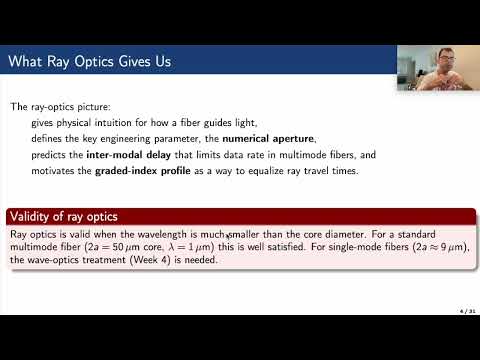
- The lecture focuses on ray optics, numerical aperture, modal dispersion, and graded-index fibers.
- A step-index fiber has a core with refractive index n1 surrounded by lower-index cladding n2.
- When a ray inside the core strikes the boundary above the critical angle, total internal reflection keeps its energy in the core.
- Real fibers still experience material loss, so propagation is not truly lossless over unlimited distance.
- A full wave-optics treatment uses Maxwell's equations and cylindrical Bessel-function modes, but Simsek sets aside those derivations for a practical ray-optics analysis.
- The ray approximation is most useful when the core is large compared with the wavelength, especially for multimode fibers.
- Multimode fibers can carry separate data channels, but different ray paths create different travel times and broaden pulses.
- A simple step-index cable has a constant-index core of radius a, a lower-index cladding, and often an outer protective coating.
- The relative index difference is Δ = (n1² − n2²)/(2n1²), often approximated as (n1 − n2)/n1.
- Small Δ helps restrict guided propagation and is associated with single-mode fiber designs.
- Meridional rays travel in a plane through the fiber axis and reflect in a simple zigzag pattern.
- Skew rays spiral around the axis in larger-core fibers and require a more complex analysis.
- Bending a fiber can change the incidence geometry and cause light to escape, so bends should be limited, particularly when confinement is weak.
- Snell's law and the total-internal-reflection condition give the acceptance relation NA = n0 sin(θmax) = √(n1² − n2²).
- For a fiber launched from air, NA is the sine of the largest external acceptance angle; the full acceptance cone has apex angle 2θmax.
- A smaller NA demands more precise alignment: an NA near 0.12 corresponds to an acceptance half-angle of about 7°.
- For small index contrast, NA is approximately n1√(2Δ), linking the acceptance cone directly to core-cladding material properties.
- The axial ray travels the shortest path, taking approximately n1L/c to cover a fiber of length L.
- High-angle rays travel farther, with the limiting path set by the critical angle, so they arrive later than axial rays.
- In a step-index fiber, the approximate modal delay spread is Δt ≈ n1ΔL/c.
- As pulses broaden, neighboring symbols can overlap, limiting the data rate that can be recovered reliably.
- A pulse-separation estimate gives a bandwidth limit on the order of B ≈ 1/(2Δt), making longer fibers more restrictive.
- The step-index bandwidth-length product scales approximately as c/(2n1Δ).
- Reducing Δ improves the bandwidth-length product, which is one reason precise control of fiber materials matters.
- Graded-index profiles offer another way to reduce the delay spread without relying only on a smaller core-cladding index difference.
- The normalized frequency is V = 2πa·NA/λ0, where a is core radius and λ0 is free-space wavelength.
- For large V, the approximate number of guided modes is V²/2; for example, V = 10 corresponds to roughly 50 modes.
- A step-index fiber operates in the single-mode regime when V is below approximately 2.405, a cutoff associated with Bessel-function solutions.
- Increasing core radius or NA, or reducing wavelength, raises V and permits more modes.
- A graded-index fiber changes refractive index smoothly from the high-index center toward the lower-index cladding.
- The profile is described by a power law with exponent α; α = 2 gives a parabolic index profile.
- The outer portions of the core have lower refractive index than the center, changing the speed of rays that travel farther from the axis.
- The ray equation in a varying-index medium predicts continuous bending rather than straight-line zigzags.
- For a parabolic profile, the transverse ray trajectory is approximately sinusoidal, repeatedly bending back toward the fiber axis.
- Meridional rays in the ideal parabolic profile share a spatial period of about 2πa/√(2Δ), independent of launch angle.
- High-angle rays travel farther from the axis, where the refractive index is lower and their phase velocity is higher.
- The parabolic profile therefore compensates for the longer geometric path with faster travel through the outer core.
- The approximate delay spread becomes Δt ≈ n1Δ²L/(2c), compared with n1ΔL/c for a step-index fiber.
- For small Δ, the reduction in delay spread can be large; the optimal power-law exponent is close to, but slightly below, 2.
- Graded-index fibers are optimized for a target operating wavelength, with 850 nm, 1300 nm, and 1550 nm given as common design points.
- Using a graded-index fiber away from its intended wavelength can significantly degrade its dispersion performance.
- Step-index single-mode fibers remain a strong choice for very high-bandwidth communication, while graded-index designs improve multimode performance.
- Manufacturing begins with vapor deposition of glass material, followed by controlled doping to shape the refractive-index profile.
- A heated glass preform is drawn into a longer, thinner fiber, with temperature and tension controlling the final diameter.
- For n1 = 1.48 and n2 = 1.46, an example gives Δ ≈ 1.35%, NA ≈ 0.24, and a maximum acceptance half-angle near 14°.
- For a 1 km step-index fiber with those indices, the estimated delay spread is about 66.6 ns and the bit rate about 7.5 Mbit/s; the graded-index example reduces the delay to about 0.41 ns and raises the rate to roughly 1.11 Gbit/s.
- A 1310 nm single-mode design example uses NA ≈ 0.123 and a maximum core radius near 4 μm, consistent with V below 2.405.
- The corresponding acceptance half-angle is about 7°, underscoring the alignment precision needed for single-mode excitation.
- Simsek closes by previewing ABCD transfer matrices for lenses and optical systems, followed by resonators, lasers, and frequency combs.
Transcript excerpt
0:10 Introduction to photonics in E684 as I told you I will be in the panel. So yeah to this lecture recorded um in this lecture we will talk about uh fiber optics optical fibers um and we will assume fiber optic core is quite large with respect to the uh wavelength of the excitation and then uh we will see like what is uh numerical aperture like we care about it. Uh we talk about um dispersion [clears throat] and uh how we can use graded index
1:00 fibers to compensate that dispersion problem. So like fiber optic cables are all over the place right uh for long distance communication uh for data centers or for internet uh we are using these fiber optic cables um so they have a refractive index close to like 1.4 1.5 meaning that the speed of data traveling is close to 2 * 10 ^ 8 m/ second. So it's it's extremely fast but even though we we receive the data u so fast still we need to convert that optical signal into ethical signal then we do the processing which slows down the whole business and in fact uh right now there's a huge push to
1:51 um speed up that process like instead of converting uh light to electricity and using electrons for computations like how can They use light also for computations. So there are a couple of companies uh they are working on um building chips to do these um for example matrix multiplications all by using light. So if it can happen then of course we will speed up that part of the process with byp 300 times 400 times. So it will be a huge improvement. The other great about computing with light is uh at least on theory uh it will
This is the start of the transcript. Save this video free for the whole transcript, searchable and time-coded.
Related notes
Summary, takeaways, and chapters were generated by AI from the video's transcript and may contain errors. The video belongs to its creator, Ergun Simsek.