ENEE 684 Lecture 15 | Ring Resonators, Optical Frequency Combs, and LLE
 Watch on YouTube →
Overview
The lecture develops how Kerr microresonators generate optical frequency combs: dispersion, nonlinear phase shifts, gain and loss must balance to sustain circulating soliton pulses, whose fixed repetition period produces discrete spectral lines. It connects comb applications such as optical clocks accurate to about 10^-16, frequency measurement and low-noise microwave generation with experimental requirements including pump detuning, stabilization of the repetition rate and carrier-envelope offset, and avoided mode crossings; the Lugiato-Lefever equation (LLE) is then used to simulate pulse and comb formation.
Key takeaways
- A periodic pulse train produces discrete optical frequency-comb lines because its fixed repetition rate sets the spacing between adjacent frequencies.
- Microresonator solitons require a balance: dispersion reshapes pulses, Kerr nonlinearity changes phase and enables four-wave mixing, and resonator loss removes energy.
- Comb stabilization requires controlling both f_rep, which sets line spacing, and f_CEO, which shifts the entire comb relative to zero frequency.
- A smaller ring has a shorter round-trip time and therefore a higher repetition rate and wider comb-line spacing than a larger ring.
- An avoided mode crossing created by coupling a secondary ring to the main resonator can support resonant pumping and improve comb bandwidth and line power.
- The LLE provides a computational route to model microcomb formation; the lecture's example solves it with a split-step Fourier method and varies detuning, dispersion, pump strength and nonlinearity.
Chapters
- The lecture sets out four themes: optical-comb applications, the physics of microresonators, current research questions and Lugiato-Lefever equation simulations.
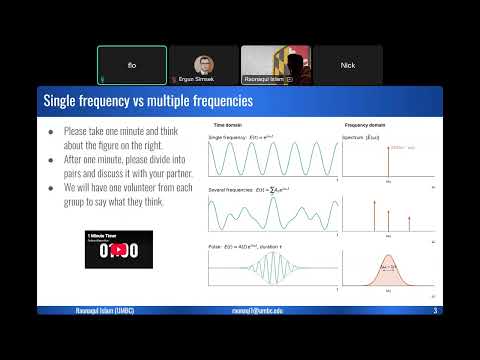
- A classroom exercise compares continuous waves, pulses and periodic pulse trains in the time and frequency domains.
- Fourier transformation connects the two domains: a continuous single-frequency wave gives a spectral line, while a periodic pulse train gives discrete comb lines.
- Optical atomic clocks use stabilized comb frequencies; the lecture cites NIST performance around 10^-16 accuracy.
- For optical frequency measurement, a comb acts as a calibrated ruler: beating an unknown optical frequency against a nearby comb line reveals the difference.
- Comb lines can serve as selectable optical sources for frequency synthesis, avoiding some limitations of tuning individual lasers.
- Photodetection converts a stable comb repetition rate into low-noise microwaves; two-comb spectroscopy is another application.
- The lecture distinguishes microresonator combs from combs made with mode-locked lasers or electro-optic modulators.
- A continuous-wave laser enters a waveguide coupled to a ring resonator, where nonlinear processes can form a circulating pulse.
- Each round trip couples part of the pulse back into the output waveguide, producing a periodic output and a frequency comb.
- A water-wave example illustrates a solitary wave that travels while retaining its shape and speed under suitable conditions.
- The optical counterpart is a soliton pulse circulating in the microresonator rather than a single wave propagating down an open channel.
- A stable round-trip pulse can be sampled at the waveguide coupler, linking pulse repetition in time to comb spacing in frequency.
- Material dispersion means refractive index varies with wavelength, so the frequency components within a pulse can propagate at different phase velocities and alter its shape.
- The Kerr effect makes refractive index intensity-dependent; the lecture emphasizes that the laser field itself supplies the relevant optical electric field.
- Coupling loss and intrinsic resonator loss reduce circulating power, while Kerr nonlinearity enables four-wave mixing and changes optical phase.
- Soliton formation requires these effects to balance so that the circulating pulse maintains its shape.
- Four-wave mixing is a nonlinear process in which three optical frequencies generate a fourth frequency.
- New frequencies can seed further mixing, creating a chain of spectral components around the pumped resonator mode.
- The lecture presents nonlinear mixing as part of the mechanism that supports comb formation alongside dispersion and resonator losses.
- Dispersion tends to reshape a pulse, while nonlinear effects and the resonator's gain-loss balance can counteract that evolution.
- A pulse that retains its shape and travels at a fixed group velocity returns to the extraction point at a fixed interval.
- That fixed repetition period produces discrete frequency lines with a regular spacing, making pulse stability central to comb generation.
- Constructive interference creates resonant modes in a ring, with neighboring modes approximately separated by the free spectral range (FSR).
- Without dispersion, resonant frequency plotted against mode number would follow a straight line with uniform spacing.
- A Taylor expansion describes deviations from that linear trend; subtracting the offset and FSR terms leaves the integrated dispersion used to characterize the resonator.
- The lecture contrasts normal and anomalous integrated-dispersion profiles and identifies anomalous dispersion as favorable for generating the discussed soliton pulses.
- Higher-order dispersion terms can bend the integrated-dispersion curve while the pump remains in an anomalous-dispersion region.
- Interactions between resonances from different mode families can split modes, an effect called an avoided mode crossing that can also support comb generation.
- A pump placed exactly on a resonant mode does not necessarily generate a soliton; the laser generally must be detuned from the nearest resonance.
- In the described experimental approach, the laser is scanned from the blue-detuned side until a comb state appears.
- This scan is a practical obstacle to simple field operation, motivating research into self-starting combs and alternative nonlinear materials such as lithium niobate.
- A frequency comb's repetition rate, f_rep, is the spacing between adjacent comb lines; fluctuations change the microwave frequency produced by photodetection.
- The carrier-envelope offset, f_CEO, shifts the whole comb relative to zero frequency, so its instability moves all comb lines.
- Locking both f_rep and f_CEO is important for stable frequency synthesis and measurement; the lecture cites carrier-induced synchronization work published in Nature in 2023.
- One research project described in the lecture aims to stabilize f_rep using phase modulation.
- A detuned pump can support solitons but may produce a spectrum whose useful power drops off at higher mode numbers.
- An avoided mode crossing can enable pumping at resonance while retaining soliton generation, increasing comb-line power and spectral bandwidth.
- The illustrated design places a smaller ring beside a larger ring; interacting resonances create the mode splitting without requiring an intentional fabrication defect.
- Only part of the input laser couples into the ring; the transmitted pump can remain visible as the central, zeroth comb line in the output spectrum.
- Ring radius sets round-trip time: a smaller ring yields a higher repetition rate and wider frequency spacing, while a larger ring yields a lower repetition rate and closer spacing.
- The secondary ring modifies resonant-mode interactions to improve pump coupling conditions; it is not itself the source of extra comb lines.
- Choosing ring size involves trade-offs between on-chip integration and the desired comb spacing or measurement range.
- The Lugiato-Lefever equation models pulse evolution inside a driven, lossy nonlinear microresonator and can predict the corresponding frequency comb.
- The displayed model includes detuning alpha, a dispersion parameter, pump amplitude F and nonlinear coefficient gamma.
- The dispersion contribution depends on the resonator's modal-frequency expansion, connecting the LLE to integrated-dispersion analysis.
- The lecture's compact LLE code uses the split-step Fourier method to evolve the resonator field numerically.
- The normalized example runs for about 100 photon lifetimes; photon lifetime is related to resonator loss and quality factor.
- Time-step size affects speed and convergence, so an excessively large step can prevent the numerical solution from converging.
- The simulated spectrum displays a central pump and separated comb lines, while the pulse output shows its evolution over time.
- A simulated pulse that shifts position from round trip to round trip indicates a changing arrival time and therefore a fluctuating repetition rate.
- The final mode-crossing demonstration estimates the efficiency improvement from adding an avoided mode crossing.
- The lecture closes with the provided simulation resources and notes that the examples focus on normalized behavior rather than interpreting every absolute power value.
Transcript excerpt
3:29 Your mic is mute. Just letting you know, I don't hear you. I could see your outline though. >> Can you hear me now? >> I hear you now. Yes. >> Oh, sorry. Um Can you speak now? My laptop speaker was switched off. >> I can hear you. >> Okay, okay. Thank you. Uh, can you see the screen? >> Yes, I could see your screen just fine. I saw your title page and now your outline page and I could hear you perfectly. >> Thank you. >> Of course. >> So,
4:16 first we are going to talk about what are the applications, what are where are we going to use this optical frequency combs. Then we'll talk slightly about reviewing some concepts which are important to understand how these combs actually form in these non-linear microresonators. Then we are going to talk about the physical properties which I said like some of the physical properties that where we are doing some research right now and where some other groups um, across the world are of doing their research. And finally, I'm going to show you the since we are a computational photonics group mostly. Um, we use these Lugiato-Lefevere equation a lot.
5:03 Uh, it's called a mean field equation and that can be used to actually actually simulate these pulses in the inside the cavities to generate the frequency combs. I will show you the demonstration. Um, so before we begin, I will just turn on the timer for 1 minute. I will request you guys to just talk about what's actually shown in this picture and then we will get one volunteer from each group to describe what is happening here. If you don't mind, I will start it now. And Florence, since you don't have any group, you can do it
This is the start of the transcript. Save this video free for the whole transcript, searchable and time-coded.
Related notes
Summary, takeaways, and chapters were generated by AI from the video's transcript and may contain errors. The video belongs to its creator, Ergun Simsek.