ENEE 684 Lecture 14 | Passive Photonic Components (Part 2)
 Watch on YouTube →
Overview
Ergun Simsek explains how passive photonic components manipulate light for sensing, modulation, isolation, routing, and dispersion compensation. The lecture derives Mach–Zehnder interferometer (MZI) output behavior, explains electro-optic modulator half-wave voltage and Faraday-effect isolators, then develops fiber Bragg grating (FBG) design—including Bragg wavelength, bandwidth, apodization, and chirped-grating pulse compensation.
Key takeaways
- An ideal 50/50-coupler MZI converts phase difference into complementary output powers: sin²(Δφ/2) and cos²(Δφ/2), making balanced-port operation useful for detecting small refractive-index changes.
- An electro-optic modulator’s phase shift scales as πV/Vπ; lithium-niobate devices near 1550 nm commonly have Vπ around 3–5 V, while high-frequency operation can demand larger drive voltage and incur substantial loss.
- A Faraday isolator combines polarizers with nonreciprocal magneto-optic rotation, allowing forward light through while blocking reflections that could destabilize or damage a laser.
- An FBG reflects wavelengths satisfying λB = 2neffΛ; changing its temperature or strain shifts the Bragg wavelength, enabling fiber-based sensing of conditions such as road traffic loads.
- Apodizing an FBG’s index modulation suppresses spectral side lobes, but the smoother grating broadens its reflection band—an explicit trade-off between spectral cleanliness and selectivity.
- A chirped FBG compensates dispersion by reflecting different wavelengths at different positions, controlling their round-trip delays so a broadened optical pulse can be recompressed.
Chapters
0:00
Assignment Review and Chapter Setup
- The latest assignment is due October 9, before the Monday midterm; students are asked to check its AI-generated questions and solutions for errors.
- Finding each assignment mistake earns 10 extra points, with no stated minimum or maximum grade.
- The lecture continues the passive photonic components unit with Mach–Zehnder interferometers.
1:40
MZI Layouts and Interference at the Output
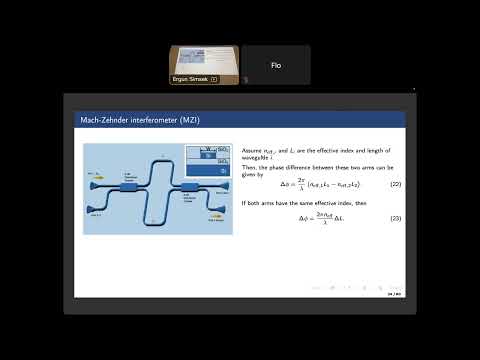
- An on-chip Mach–Zehnder interferometer uses two directional couplers separated by waveguides whose lengths or effective indices can differ.
- In the free-space version, beam splitters divide and recombine light; the reflected path acquires a relative phase shift, ideally π/2.
- When the two paths recombine, their phase relationship determines whether each output is bright or dark, enabling phase-sensitive measurement.
7:00
Waveguide Phase Difference and MZI Port Powers
- Each arm accumulates phase according to its propagation constant and length: φ₁ = β₁L₁ and φ₂ = β₂L₂; their difference is Δφ.
- For identical materials, a length difference creates phase change; for equal lengths, changing effective index creates phase change.
- For ideal 50/50 couplers, the output fields vary with sin(Δφ/2) and cos(Δφ/2), so the port powers vary as sin²(Δφ/2) and cos²(Δφ/2).
13:00
Using MZI Output Balance for Sensing
- At Δφ = 0, the ideal MZI routes power to one output; at Δφ = π, it routes power to the other; at Δφ = π/2, the outputs are equal.
- Biasing a sensor near equal output power makes small phase changes visible as opposite changes at the two photodetectors.
- An MZI can measure refractive-index changes in a sample, as well as length changes, and can also serve in biosensing and optical communications.
16:10
Electro-Optic MZIs and Half-Wave Voltage
- An intensity modulator splits light between two MZI arms and applies voltage to an electro-optic material such as lithium niobate in one arm.
- The half-wave voltage, Vπ, is the voltage that produces a π phase shift and switches the interferometer between output extrema; phase shift scales as πV/Vπ.
- The lecture cites lithium-niobate Vπ values commonly around 3–5 V near 1550 nm, while higher modulation frequencies can require greater drive voltage.
27:00
Faraday-Effect Isolators Protect Lasers
- Optical isolators prevent reflected light from returning to a laser, where feedback can cause instability or damage, especially in high-power systems.
- A polarization-selective isolator combines two polarizers with a magneto-optic Faraday rotator; the forward polarization rotates about 45° to pass the second polarizer.
- Faraday rotation is nonreciprocal: reverse-traveling light rotates in the same sense and is blocked by the input polarizer rather than retracing the forward path.
34:00
Isolator Trade-Offs and Polarization-Independent Designs
- Isolators are wavelength-specific: the lecture names YIG for operation near 1550 nm and terbium gallium garnet for wavelengths near 1060 nm.
- Example specifications illustrate trade-offs: one isolator provides about 38 dB isolation, while another reaches about 55 dB but has different transmission and bandwidth.
- Polarization-independent isolators use birefringent beam splitting to separate ordinary and extraordinary components, then recombine them after polarization processing.
38:00
Three-Port Circulators Route Light Directionally
- A three-port optical circulator routes light from port 1 to 2, port 2 to 3, and port 3 to 1, rather than sending it back to the preceding port.
- Circulators use nonreciprocal Faraday-effect components and are useful in optical communications and sensing.
- Typical insertion loss is about 0.5–0.7 dB, while unwanted reverse-port leakage can be roughly 50 dB below the intended signal.
41:00
Fiber Bragg Gratings Select a Reflected Wavelength
- A fiber Bragg grating (FBG) periodically modulates the fiber’s effective refractive index, reflecting a narrow wavelength band while transmitting other wavelengths.
- The Bragg condition is λB = 2neffΛ, where λB is the reflected wavelength, neff is effective index, and Λ is the grating period.
- For λB = 1550 nm and neff ≈ 2, the example grating period is about 387.5 nm.
47:00
FBG Strength, Bandwidth, and Environmental Sensitivity
- A longer grating region increases reflection; the lecture gives roughly 25 μm as an example length for very strong reflection near 1550 nm.
- Grating index modulation Δn can be as small as 10⁻³ to 10⁻⁵; stronger coupling over a longer grating increases peak reflectivity.
- Temperature and applied strain shift λB, allowing FBGs to sense heat, pressure, and force; embedded fiber sensors can detect vehicle weight beneath road surfaces.
53:00
Apodization Reduces FBG Side Lobes
- A finite, abruptly started grating produces spectral ripples; the lecture notes that the first side lobe can be about 13 dB below the main reflection peak.
- Apodization gradually ramps the refractive-index modulation, applying windowing ideas similar to Blackman or Gaussian signal-processing windows.
- Smoother profiles can reduce side lobes substantially—an example reaches about 58 dB below the main lobe—but broaden the reflection bandwidth by roughly 30–70%, depending on the window.
58:00
Chirped FBGs Compensate Fiber Dispersion
- A chirped FBG varies its grating period along the fiber, so different wavelengths reflect at different positions and travel different distances.
- That wavelength-dependent delay can compensate pulse broadening accumulated in a dispersive fiber by bringing early and late spectral components back together.
- A circulator routes the incoming pulse to the chirped grating and directs the reflected, recompressed pulse to a separate output port.
1:03:10
Passive-Component Recap and Midterm Preview
- The chapter recap connects directional couplers and multimode interference splitters with MZIs, isolators, and circulators as core photonic components.
- Directional couplers use evanescent coupling and are generally narrowband; varying the waveguide gap can support broader-band splitting, while MMIs are valued for fabrication ease.
- The Monday midterm is expected to contain three basic problems; the next class begins active photonic devices.
Summary, takeaways, and chapters were generated by AI from the video's transcript and may contain errors. The video belongs to its creator, Ergun Simsek.