Electromagnetic fields, lecture 5 - cylindical coordinates and diff / int vector calculus
Overview
Tim Gorringe develops cylindrical coordinates as an alternative to Cartesian coordinates for problems with cylindrical symmetry, relating ρ, φ, and z to x, y, and z and explaining how the cylindrical unit vectors rotate with position. He derives the corresponding line, surface, and volume elements, presents cylindrical-coordinate formulas for gradient, divergence, and curl, and applies them to A = Cρ̂, finding ∇·A = C/ρ and ∇×A = 0 away from the axis.
Key takeaways
- Cylindrical coordinates use x = ρ cos φ and y = ρ sin φ, with ρ measuring distance from the z-axis and φ measured around it from the x-axis.
- The cylindrical basis rotates with φ: ∂ρ̂/∂φ = φ̂ and ∂φ̂/∂φ = −ρ̂, unlike the fixed Cartesian basis.
- An angular increment dφ represents a physical distance ρ dφ, producing the line element ds = ρ̂ dρ + φ̂ρ dφ + ẑ dz and volume element dV = ρ dρ dφ dz.
- The cylindrical divergence formula includes (1/ρ)∂(ρAρ)/∂ρ because the outer radial face of a differential volume has more area than its inner radial face.
- For the constant radial field A = Cρ̂, the divergence is C/ρ for ρ > 0 while the curl is zero, demonstrating that a field can have outward flux without local circulation.
Chapters
- Earlier lectures introduced div, grad, curl, line integrals, and surface integrals using Cartesian coordinates.
- Cartesian coordinates suit rectangular charge arrangements, while cylindrical or spherical charge distributions call for coordinate systems aligned with their geometry.
- The lecture covers cylindrical coordinates, their unit vectors and vector-calculus operators; spherical coordinates are reserved for the next class.
- ρ is the distance from the z-axis, found by projecting the position vector onto the xy-plane.
- φ is the angle of that projection measured from the positive x-axis toward the positive y-axis; z is unchanged from Cartesian coordinates.
- The coordinate conversions are x = ρ cos φ, y = ρ sin φ, z = z, and ρ = √(x² + y²), with φ determined from the x and y components.
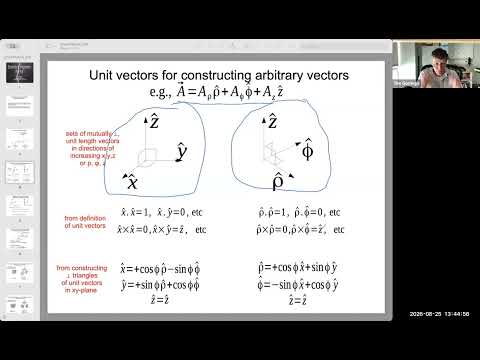
- The cylindrical basis vectors ρ̂, φ̂, and ẑ are mutually perpendicular unit vectors, like x̂, ŷ, and ẑ.
- Their basis relationships include ρ̂·ρ̂ = 1, ρ̂·φ̂ = 0, and ρ̂×φ̂ = ẑ.
- The coordinate-dependent basis is related to the fixed Cartesian basis by ρ̂ = cos φ x̂ + sin φ ŷ and φ̂ = −sin φ x̂ + cos φ ŷ; ẑ remains unchanged.
- Unlike the fixed Cartesian unit vectors, ρ̂ and φ̂ change direction as a point moves around the z-axis.
- Differentiating the basis vectors with respect to φ gives ∂ρ̂/∂φ = φ̂ and ∂φ̂/∂φ = −ρ̂.
- These nonzero basis-vector derivatives are an important difference from Cartesian coordinates and must be accounted for when deriving cylindrical div and curl.
- The position vector is R = ρρ̂ + zẑ; φ is implicit in the direction of ρ̂ rather than appearing as a separate distance component.
- A cylindrical line element is ds = ρ̂ dρ + φ̂ ρ dφ + ẑ dz.
- Because φ is an angle, a change dφ corresponds to an arc length ρ dφ, not a length dφ.
- Cartesian line elements use the length increments dx, dy, and dz along three fixed perpendicular axes.
- The surface element perpendicular to z is built from dx and dy, while the other Cartesian face elements use the corresponding pairs of coordinate increments.
- The Cartesian volume element is dV = dx dy dz; cylindrical elements follow the same construction but must account for the arc length ρ dφ.
- The area element normal to ρ̂ is dAρ = ρ dφ dz, built from an azimuthal arc and a z increment.
- The area element normal to φ̂ is dAφ = dρ dz, while the one normal to ẑ is dAz = ρ dρ dφ.
- Multiplying the three cylindrical line increments gives dV = ρ dρ dφ dz; the factor ρ comes from the azimuthal arc length.
- For a scalar u, ∇u = ρ̂ ∂u/∂ρ + φ̂(1/ρ)∂u/∂φ + ẑ ∂u/∂z; the 1/ρ factor converts angular change into distance-based slope.
- For A = Aρρ̂ + Aφφ̂ + Azẑ, ∇·A = (1/ρ)∂(ρAρ)/∂ρ + (1/ρ)∂Aφ/∂φ + ∂Az/∂z.
- The divergence’s ρ factors reflect the unequal inner and outer faces of a cylindrical volume element, while curl retains a determinant-style structure with additional ρ factors.
- Gorringe emphasizes that cylindrical formulas are more involved than Cartesian formulas, and notes that he consults a reference for the curl expression rather than memorizing it.
- The example field has constant coefficient C, points in the ρ̂ direction, and has no φ̂ or ẑ component.
- In the xy-plane, its vectors point directly away from the origin in every azimuthal direction while maintaining the same magnitude.
- The field is simple in cylindrical coordinates because its only nonzero component is Aρ = C.
- Substituting Aρ = C, Aφ = 0, and Az = 0 into the cylindrical divergence formula leaves (1/ρ)∂(ρC)/∂ρ.
- Since C is constant, the result is ∇·A = C/ρ for ρ > 0.
- The positive divergence away from the axis indicates local outward flux; the expression is singular at ρ = 0, where the radial direction is undefined.
- In the cylindrical curl determinant, the field components Aφ and Az are zero and Aρ = C is constant, so every derivative term vanishes.
- Thus ∇×A = 0 away from the axis: the radial field has no local circulation even though it has nonzero divergence.
- The lecture closes by recapping cylindrical coordinates, rotating basis vectors, and line, surface, and volume elements before moving on to spherical coordinates.
Transcript excerpt
0:07 In the last few lectures, we've introduced integral vector calculus and differential vector calculus. Specifically, we introduced in differential vector calculus div, grab and curl for vector and scalar fields. We introduced in integral vector calculus the line integral the surface integral for evaluating fluxes and circulations through closed surfaces around closed loops. When we introduced differential vector calculus inner ve integral vector calculus we used rectangular coordinates cartesian coordinates uh as our example coordinate system. And so our div, grad, and curl
0:56 were expressed in rectangular coordinates. Our integrals, line integrals, surface integrals expressed in rectangular coordinates. That's great for some problems. If I have a uh rectangular array of charges perhaps in a crystal, uh rectangular coordinates are great. It's not so great for other problems. Supposing you have a problem where you got a spherical distribution of charge. you don't want to be using rectangular coordinates. Uh if you've got a cylindrical distribution of charge, you don't want to be using uh rectangular coordinates to solve that. In this class and the next class, we're going to move on from rectangular coordinates uh and div grad curl line surface integrals and rectangular
1:44 coordinates to cylindrical coordinates. That's this class. Uh spherical coordinates. That's going to be the next class. In each of these classes, I'm going to walk through how to firstly introduce those coordinate systems. What is the language of those coordinate systems that parallels X, Y, and Z? What are the unit vectors that parallel Xhat, Yhat, Zhat? Then we're going to talk about div grad and curl in these coordinate systems. What what do div grad and curl look like in cylindrical and spherical coordinates? And we're going to talk about surface integrals, line integrals, uh volume elements. What what did those things look like in uh cylindrical and
This is the start of the transcript. Save this video free for the whole transcript, searchable and time-coded.
In this course
Related notes
Summary, takeaways, and chapters were generated by AI from the video's transcript and may contain errors. The video belongs to its creator, tim gorringe.