CEUAs e seu funcionamento
Overview
Bruno Martynhak explains how the UFPR Sector of Biological Sciences CEUA applies Brazil’s Lei Arouca and CONCEA regulations to review and monitor animal research and teaching. He details the committee’s multidisciplinary composition, its authority to inspect facilities and halt noncompliant work, and practical requirements for project planning, the 3Rs, staff training, animal welfare, sequential use, and incident reporting through CIUCA.
Key takeaways
- The CEUA’s authority extends beyond approving protocols: it must monitor approved work, inspect facilities, investigate accidents, maintain records in CIUCA, and stop procedures that violate Lei Arouca.
- RN 51 provides guidance for CEUA operations and animal facilities, while RN 55 and the DBCA guide ethical planning and animal-care decisions.
- The 3Rs require researchers to justify animal use, prioritize replacement alternatives where possible, reduce animal numbers responsibly, and refine procedures to limit pain and stress.
- Sequential use of animals requires advance CEUA approval and assessment of cumulative effects, total time in use, future stress, and procedure invasiveness.
- Animal-care checks must happen regularly, including on days without cage changes, because failures such as a loose water bottle can cause preventable harm and undermine research results.
- A researcher who witnesses noncompliance can report it with incident details to the responsible technical staff; the reporter’s identity is protected, and the CEUA can impose corrective measures.
Chapters
- The CEUA is indispensable for institutions conducting animal-based teaching or research and supports institutional accreditation with CONCEA.
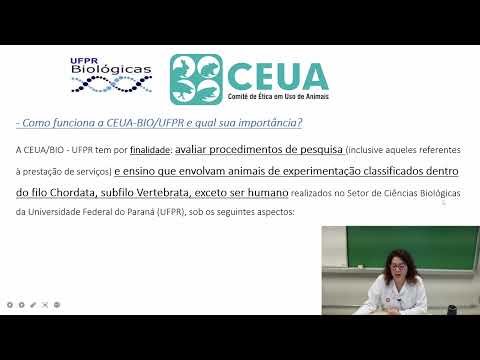
- At UFPR, the committee was called the Commission on Ethics and Animal Experimentation from 2003 to 2011, then became the Commission on Ethics in the Use of Animals.
- Lei Arouca, Decree 6.899/2009, and CONCEA rules form the legal basis for reviewing proposals, monitoring approved work, and promoting the 3Rs.
- Normative Resolution 51 guides CEUA operations and animal facilities, while RN 55 contains the Brazilian guideline for the care and use of animals.
- CEUAs must communicate new rules to researchers and work with institutional leadership to address gaps in compliance.
- Practical and ethical animal-use training is presented as essential for researchers and the wider scientific community, including courses offered online and each semester at UFPR.
- Responsible technical staff, including veterinarians and animal-facility coordinators, help connect researchers with welfare and facility requirements.
- Compliance improvements can take time, so the CEUA’s role includes raising awareness and sustaining pressure for institutional change.
- The committee is permanent and technical-scientific, with a multidisciplinary membership that includes faculty, animal-facility staff, and a legally established animal-protection representative.
- UFPR’s CEUA has at least 10 faculty representatives, five titular and five alternate members, two animal-facility staff members, and an animal-protection representative.
- Protocol decisions are made collectively; reviewers can contact researchers to clarify missing information before the proposal reaches a committee meeting.
- The CEUA maintains researcher and protocol records in CIUCA, can request final project reports, inspect facilities, investigate accidents, and halt procedures that violate the law.
- Researchers should establish that expected benefits outweigh animal-welfare harms and that the scientific question cannot be answered through replacement alternatives.
- The selected species, animal health status, housing, equipment, and facility conditions must fit the experiment and the species-specific rules.
- Everyone handling animals needs appropriate training, and students or early-career researchers require adequate supervision by an experienced researcher.
- Protocols should identify possible welfare impacts and define measures to reduce them, including humane endpoints for procedures that cause stress or pain.
- Regular welfare assessment is necessary even on days when cages are not changed; a loose water bottle can wet a cage, and deaths or cannibalism may go unnoticed.
- Animal care and reliable research results are closely linked, so teams should plan rapid responses to facility or animal-health problems.
- Previously performed studies and control groups, such as a positive-control antidepressant in anxiety or depression research, need clear scientific justification if repeated.
- Researchers must verify permissions for animal capture or import, treatment, euthanasia, release, and the documented origin of animals.
- Reusing an animal in another teaching or research activity is not automatically allowed, even when it might reduce the total number of animals.
- Sequential use must be approved by the CEUA before the additional procedure and must not add unacceptable pain, stress, or discomfort.
- The committee should assess cumulative and long-term effects, total time in use, expected stress from later procedures, and the invasiveness of each procedure.
- Researchers must explain how animals will be selected and whether their prior procedures make them suitable for further use or training.
- A student who has completed an ethics course still needs hands-on technical support before beginning animal research.
- The group leader should address the trainee’s needs or assign an experienced, competent researcher to demonstrate and supervise techniques such as handling and injections.
- Training and supervision arrangements should be documented in the project file submitted to the CEUA.
- Researchers should begin procedures only when they are confident in the techniques, reducing avoidable animal suffering and supporting a culture of care.
- Anyone who observes a welfare concern or procedural violation should intervene promptly and report it; animal welfare takes priority over professional relationships.
- Accidents must be reported to the CEUA, which notifies CONCEA through CIUCA when required; accident investigations and reports to CONCEA are due within 30 days.
- UFPR’s reporting email can include the location, species, incident description, corrective steps, researcher, and group leader; the identity of the person reporting is protected.
- The CEUA reviews reports in meetings and may issue warnings, suspend animal withdrawals, stop procedures, or notify CONCEA; monthly reports feed into the annual submission.
Transcript excerpt
0:00 Olá a todos então a aula de hoje nós vamos falar Mais especificamente sobre as células e seu funcionamento também falaremos sobre problemas que frequentemente acontecem nas análises dos projetos lembrando né aqui quando a gente pensa da legislação das comissões de ética no uso de animais acesas é condição indispensável para o agradecimento das instituições com atividades de ensino e pesquisa que a instituição tenha instituída a seu Ah eu comentei já numa das aulas da aula anterior na aula anterior que eu ministrei para vocês que
0:47 a nossa seu na verdade a nossa comissão de ética e experimentação animal Ela existiu Né desde 2003 até 2011 em 2011 passou a ser denominada de comissão de ética no uso de animais aqui no nosso setor de ciências biológicas competência da ceua agora voltar daqui para o setor de ciências biológicas da UFPR né O que compete a nossa ceua cumprir e fazer cumprir no âmbito de suas atribuições o disposto na lei Arouca tá essa é a nossa principal base nós temos várias resoluções normativas que a seu assegue né para tentar
1:38 adequar com as legislações por exemplo nós temos a resolução normativa de número 51 que é muito importante acerca da instalação e funcionamento da seu a e dos biotérios ou salas de instalações animais então a RN de número 51 é um excelente resolução norteadora para céus e para elaboração dos beautérios e salas de instalações e como eu já mencionei também na minha aula anterior né de número 55 né a nossa bbcam diretriz brasileira para cuidar da utilização de animais ela é bastante completa
2:27 detalhe e cuidados quando experimentação animal de alguma forma tanto e atividades de ensino ou de pesquisa na resolução na adbca que é resolução aqui é uma página ou para vocês verem o
This is the start of the transcript. Save this video free for the whole transcript, searchable and time-coded.
Related notes
Summary, takeaways, and chapters were generated by AI from the video's transcript and may contain errors. The video belongs to its creator, Bruno Martynhak.