Cálculo de Tamanho de Amostra - Conceitos Básicos
Overview
Bruno Martynhak explains how sample size should be based on statistical power and a biologically meaningful expected effect, rather than round numbers or common practice. He outlines the conventional alpha of 0.05 and power of 80%, explains how small samples undermine animal research and replication, and identifies G*Power as a free tool for calculating sample size.
Key takeaways
- An 80% power target corresponds to a 20% chance of missing a real effect, given the chosen assumptions, and is a common benchmark alongside alpha of 0.05.
- With alpha fixed, researchers can improve power by increasing sample size, reducing avoidable measurement variability, or planning around an effect size supported by evidence.
- A statistically significant result is not necessarily biologically important: a 1-gram weight difference could reach significance with 300 mice per group but still have limited relevance.
- Low-powered animal studies can waste animals by failing to detect real effects, while selective findings and inflated effect estimates make later replication harder.
- Sample-size plans should include expected animal losses, such as adding 10 animals when 10 losses are anticipated and 100 usable animals are required.
- G*Power provides free calculations for sample size and statistical power, using inputs such as the planned test, alpha, variability, and expected effect.
Chapters
- Animal-model studies often use small samples and have low statistical power, reducing confidence in their findings.
- Power is the probability of detecting an effect when one truly exists; 80% power means detecting it in about four out of five experiments.
- A false negative is represented by beta, while alpha is the probability of a false positive; the commonly used alpha threshold is 0.05.
- A p-value is the probability of obtaining results at least as extreme as the observed results, assuming the null hypothesis is true.
- Power depends on sample size, data variability, expected effect size, and alpha; with alpha typically fixed at 0.05, sample size is a key factor researchers can control.
- Cohen's effect-size calculation for two groups compares the difference between their means with the pooled variability of their measurements.
- Low-powered studies are more likely to miss real effects and can produce inflated effect estimates through bias and the winner's curse.
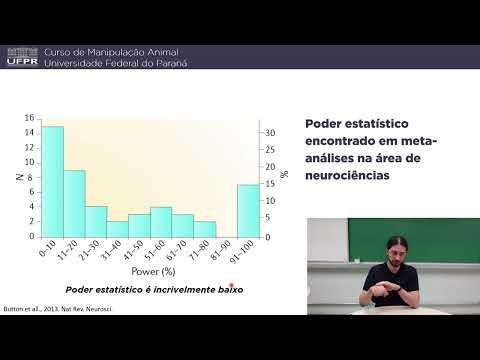
- A review of 49 neuroscience meta-analyses found that most studies had power below 70%, while only 15% reached 91% to 100% power.
- Replication studies may need larger samples than the original: a study with an observed p-value of 0.05 and the same sample size may reproduce its result only about 50% of the time.
- Add anticipated losses to the calculated sample size; for example, a target of 100 animals requires 110 if 10 are expected to be lost during surgery.
- Estimate variability from pilot data or published literature, and define an effect size that matters biologically rather than merely producing statistical significance.
- For example, a 1-gram difference between mice averaging 30 and 29 grams could be statistically significant with 300 animals per group yet have little biological relevance.
- G*Power is a free program for sample-size and power calculations; Martynhak previews a later practical demonstration.
Transcript excerpt
0:00 Oi dando continuidade a minha parte no curso de manipulação animal da Universidade Federal do Paraná a gente vai falar sobre cálculo de tamanho de amostra eu sou o Bruno martiak professor de departamento de fisiologia da Universidade Federal do Paraná e atualmente coordenador do complexo biblioteca de setor de ciências biológicas muito bem essa é uma pergunta importante para a gente se fazer na hora de preencher o formulário de um projeto de seua e é uma coisa que a gente deve ter em mente Porque é importante para os nossos experimentos não é à toa que no seu a gente pergunta não é apenas porque a gente quer que as pessoas utilizem o menor número de animais possível a gente quer que as pessoas utilizem o tamanho necessário amostral Então qual que deve ser o tamanho da minha amostra Qual o
0:49 meu n por grupo 10 por grupo porque o número Redondo oito por grupo porque eu gasto menos 12 para o grupo porque esse parece ser o padrão da literatura para que ela variável como que a gente chega nesses valores e análises indicam que os estudos não clínicos possuem frequentemente baixo poder estatístico e isso leva a uma falta de confiança nos dados que a gente obtém através dos estudos com modelos dos animais Então os modelos de animais os estudos que utilizam modelos animais frequentemente tem embaixo poder estatístico causado por tamanhos de amostra muito pequenos
1:38 mas antes o que que é poder estatístico vai ser o que que é podendo teste é a probabilidade de um teste encontrar um efeito assumindo que de fato há um efeito se um tratamento funciona qual é a probabilidade de não experimento mostrar que esse tratamento funciona É isso que o poder do teste vai dizer vamos ver aqui que essas curvinhas da
This is the start of the transcript. Save this video free for the whole transcript, searchable and time-coded.
Related notes
Summary, takeaways, and chapters were generated by AI from the video's transcript and may contain errors. The video belongs to its creator, Bruno Martynhak.