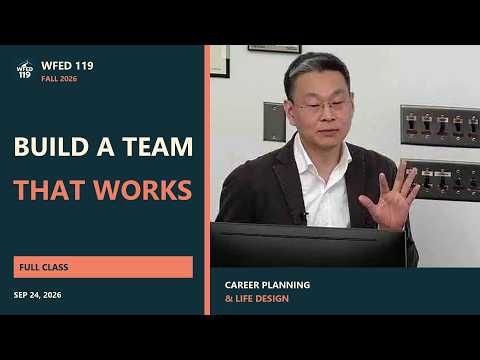
Build a Team That Works: Action Learning & Project Planning | WFED 119 | Sep 24, 2026
 Watch on YouTube →
Overview
WFED 119 introduces action learning as a team-based project process focused not only on completing a project but also on building individual and collective agency through diverse teams. Teams use a project workbook to create a charter, define a problem, set measurable goals, assign roles, establish communication rules, and prepare project registration materials for sponsor review, with initial submissions due September 25.
Key takeaways
- Action learning treats each project as a vehicle for practicing individual and collective agency, not merely as an assignment to finish.
- A useful team charter makes participation, communication, roles, and measurable project goals explicit before execution begins.
- AI can support brainstorming and formatting, but teams must vet every recommendation because they will be responsible for implementing the plans they accept.
- Project questions should expose practical constraints early; the bonfire example highlights regulations, safety, stakeholders, location, and attendance.
- Teams should measure observable impact, such as event participation or social-media views, and use an intervention when comparing pre- and post-survey results.
- The September 25 submission covers Step Zero through Form Two; Form Three’s interview component is deferred until the following week.
Chapters
- Students receive credit for the effort invested in deriving or entering their personal mission statements.
- The instructor notes that some students reused an exact mission while others typed one from their prior reflection process.
- Students are directed to find the Action Learning Team Project Workbook in Canvas.
- Each team must submit its initial workbook materials by September 25, the day after this September 24 class.
- Action learning is framed as learning by doing, with each team project serving as the anchor for learning.
- Project completion is not the sole goal; teams practice agency and learn to use individual differences productively.
- Teams are intentionally designed to maximize diversity, and a sponsor approves the project’s overall direction.
- The instructor describes action learning as a leadership-development method used in corporate and executive settings.
- Teams create a name, tentative project title, concrete goals, and ground rules in the workbook’s Step Zero.
- Projects should ideally be completed by mid-November, ahead of end-of-November presentations.
- Goals should be quantified where possible so teams can assess progress and results.
- Ground rules should prevent a small number of members from carrying the whole project and encourage everyone to participate.
- Teams can require members to acknowledge announcements with a reply or thumbs-up.
- Students compare GroupMe, described as a straightforward chat app often used by college groups, with Microsoft Teams, which they associate with more formal organizations.
- Required roles include team leader, strategist, secretary, communication officer, HR officer, and timekeeper.
- Teams of nine can add more specialized roles to distribute responsibilities.
- The instructor plans a shared Microsoft Teams space with 16 team folders and asks teams to identify their leader and paid-AI user.
- The paid-AI user is encouraged to serve as secretary, organizing team materials and posting them to Teams or Canvas.
- Teams may draw a team symbol in the workbook and use AI Studio to brainstorm, organize, or format planning ideas.
- AI can suggest project directions, but students must choose and verify plans they are actually willing to implement.
- AI may help create presentation slides, but it is not permitted for reflection assignments; ordinary grammar and typo correction is allowed.
- Form One asks why the team chose its problem, what is happening now, what causes it, who is affected, and what data or peer examples are available.
- Form Two formalizes the project with its name, team name and members, sponsor, intended outcomes, and problem-solving questions.
- Teams should set short-term and midterm expected results, identify tasks, and explain alignment with course objectives and vision.
- The sponsor reviews the completed project plan and provides approval or feedback.
- The bonfire example shows how problem-solving questions can guide a project from planning through execution.
- Suggested questions include how to follow applicable rules, who the key stakeholders are, where the event can take place, and how to attract attendees.
- Safety requirements and the relevant approving authorities are identified as essential planning questions.
- Each team should brainstorm three major questions internally before using AI to expand its ideas.
- Students can find their assigned project in the Canvas Team Project Ideas material; the instructor explains how team numbers map to project numbers.
- Only one person per team submits the combined Step Zero and Step One materials as a reply in Canvas.
- The instructor asks each team to report its leader and secretary and confirms that AI Studio is an option if no member has paid AI access.
- Teams are given discussion time to establish their setup and work through the workbook together.
- Canvas People lists team members, and each team has a dedicated Canvas space for announcements, though using it is optional.
- The instructor advises teams to contact missing members and establish accountability early.
- The instructor asks teams to prioritize demonstrable impact rather than collecting data without taking action.
- Possible approaches include a campus carnival, online engagement, or social-media content measured through views and number of posts.
- Pre- and post-surveys should be paired with an intervention so teams can assess change rather than only describe opinions.
- For a TikTok project, low view counts are a problem the team should actively address by developing ways to reach more viewers.
- The required submission includes Step Zero, team roles, Form One, and the Project Registration Form, through Form Two and approximately page eight.
- Form Three, which includes an interview component, is postponed until the following week; teams should not complete it for the September 25 deadline.
- One team member submits the documents as a Canvas reply, and sponsor approval is provided through review and feedback rather than a signature process.
- A team member should enter the team name, team number, leader, and secretary in the Canvas Team Leader and Secretary Info form.
- Clear communication channels matter because teams may struggle to reach members who leave the shared space.
- Teams are reminded to settle on a reliable communication mechanism and keep members informed.
Transcript excerpt
0:00 Uh okay, let's keep going. [clears throat] Yeah, we already uh did that. But if you can record uh yours and then type in it, that would be nice. Yeah, you might need to find it out uh
0:56 from what you've written. [clears throat] >> [clears throat]
3:38 [clears throat] >> trying to so I wasn't able to get any of the codes. >> Okay. >> Okay. Yeah. >> Sorry. >> Yeah. Will it be okay if we check in? >> Yeah. Yeah. Sure. Yeah. Yeah. Sure. Yeah. >> [snorts]
4:45 >> is um editing allowed once you put your um response in. Can you edit your response? Can you try? >> Okay. Okay. Good. Thank you. >> Yeah. Some of you put uh some effort uh into it because uh you've done you've gone through some process rigorous process I guess based on your self self uh self understanding your uh any also values and things like that. So some of you retrieve the exact same mission and some of you just typed in
5:34 and yeah you see uh those efforts. So I will not deduct the points from these but um that's something that I wanted to point out. So this is your life right? Okay. All right. Uh let's see [clears throat] modules. So today what we are going to do is to do some team building activities. It's not just to do team building. It's actually to build your team. Right? So I want you to click on uh this u workbook action learning team project workbook.
6:23 So if you go to Canvas uh and click on this action learning team project workbook. So and with that uh let's see [clears throat] here at the same time uh there are two two assignments uh non-graded but I want
This is the start of the transcript. Save this video free for the whole transcript, searchable and time-coded.
Related notes
Summary, takeaways, and chapters were generated by AI from the video's transcript and may contain errors. The video belongs to its creator, Career Planning and Life Design.