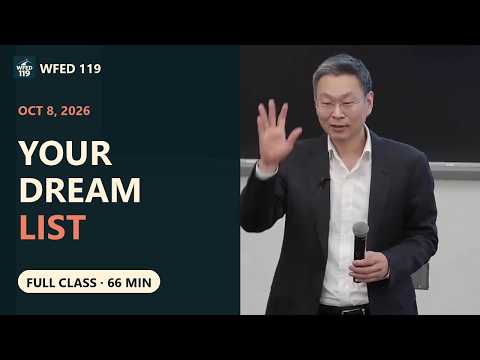
Your Dream List Across Life Stages & Midterm Reflection | WFED 119 | Oct 8, 2026
 Watch on YouTube →
Overview
The class uses a “dream list” to help students brainstorm possible futures across life stages, combining life roles with wellness domains and using LifeCraft or PowerPoint as planning tools. It also clarifies midterm requirements, reflects on how course activities inform career and leadership choices, and sets expectations for team-project progress, feedback, and submissions.
Key takeaways
- A useful life-stage dream list combines possible roles and wellness priorities with a realistic timeline—for example, projecting children’s and parents’ ages when planning for one’s 40s, 50s, and 60s.
- LifeCraft can prompt deeper self-reflection, but its dream-list module currently covers only near-term, five-year, and ten-plus-year horizons; a PowerPoint template is needed to map broader life stages.
- The midterm must be submitted as one PowerPoint file containing the life-book section, one dream-list template, and reflection answers; LifeCraft content must be transferred into that deck.
- Career choices can be assessed against three kinds of values: terminal outcomes, instrumental qualities such as honesty or creativity, and work conditions such as pay, coworkers, and commute.
- Team-project progress is a participation expectation rather than a graded document-quality exercise, and the final presentation must show evidence of action and impact.
- The class connected career engagement with human agency—the ability to make things happen—and used timeline planning to turn broad future goals into possible steps.
Chapters
0:00
Dream Lists Connect Future Possibilities to Life Roles and Wellness
- The class shifts from envisioning life five and ten years ahead to brainstorming possibilities across multiple life stages.
- Students can organize a dream list by previously identified roles, wellness domains, or a combination of both.
- The brainstorm is intended to supply material for future stories in the “My Life Is a Book” midterm submission.
4:06
Project Family, Retirement, and Responsibilities Across Decades
- Students are encouraged to imagine their lives in their 20s, 30s, 40s, 50s, and 60s rather than start with a blank page.
- To make future scenarios concrete, estimate when children might be born and how old they—and parents—could be when the student is 53 or 65.
- One student described a possible timeline of marriage around age 26, a first child around 28, and two children; the class estimated they could be in their mid-20s when the parent is 53.
8:20
Use Excel and Life Roles to Make Future Scenarios Concrete
- An Excel spreadsheet can project the student’s age alongside potential children’s and parents’ ages to help anticipate future circumstances.
- A possible age-40 scenario might include a spouse, children aged roughly 10–15, a stable job, and responsibilities toward aging parents.
- Students also imagined roles such as a little-league football or soccer coach, community volunteer, or religious-service volunteer.
11:25
Choose a Dream-List Template and Begin Brainstorming
- Students were asked to work on the activity during class, with roughly ten minutes initially set aside for brainstorming.
- The LifeCraft platform was recommended as a starting point; students who preferred not to use it could work from the PowerPoint template.
- The dream list is exploratory: students can enter several ideas for a life stage and domain rather than limit themselves to one item.
21:16
LifeCraft Prompts Reflection but Depends on Earlier Modules
- The instructor cited a previous-semester study in which LifeCraft users showed greater self-reflection, because the platform asks questions across different aspects of life.
- The class was told that higher human agency—the ability to make things happen—was associated with stronger later career engagement, with AI-platform users showing an additional increase.
- LifeCraft’s dream-list step depends on completing the earlier role module; students under time pressure can use the PowerPoint template instead.
24:04
Assemble the Midterm as One PowerPoint File
- The midterm should be submitted as one PowerPoint file containing three parts: “My Life Is a Book,” the dream list, and reflection responses.
- Students should transfer one dream-list slide into the submission deck; the LifeCraft platform supplies the dream list but not the book component.
- The book section needs a title, chapter titles, and sections within chapters; students may present each section as a story or as bullet points.
30:46
Customize the Book Deck Without Outsourcing It to AI
- Students may customize their own PowerPoint template to represent them, with a suggestion to use smaller fonts when more content is needed.
- For each book chapter, the instructor recommended two to three sections representing different aspects of life.
- AI may help find images, but students were cautioned against outsourcing the entire assignment; personal past photos are optional if sharing them feels uncomfortable.
- The final submission differs from the midterm: students will record and present their life book and final reflections to a small feedback audience.
35:44
Midterm Reflection: Identify the Most Impactful Course Activities
- Students discussed how visualization, personality reflection, and values exercises affected their thinking about future work.
- One student said the course helped narrow career interests toward biology and helping people, rather than prioritizing profit.
- Another said mapping a timeline by decade made future goals easier to convert into steps and action points.
- Students identified the Enneagram as useful for understanding personal tendencies and considered whether career choices align with their morals.
41:07
Revisit Mission Statements, Values, and Career Alignment
- Students chose earlier activities they would revisit, including the mission statement, life timeline visualization, and values work.
- The instructor distinguished terminal values (desired life outcomes), instrumental values (qualities such as honesty or creativity), and work values (criteria such as pay, coworkers, creativity, or commute).
- Students said visualization can balance what they value with what they must do, while understanding different personality types can help future teams work together.
45:54
Set Team-Project Milestones and Prepare for Peer Evaluation
- Teams were asked to make a project game plan and advance their work through step five.
- Work through step four was due Sunday, with progress through step five due the following Sunday during midterm week.
- A teammate-rating link was expected that day or the next, sent through the Teammates service rather than a Penn State email address.
52:00
Use the Life-Stage PowerPoint Because LifeCraft Has Limited Horizons
- LifeCraft’s current dream-list module covers only the immediate future, one to three years, five years, and ten-plus years.
- Because the platform does not yet span all life stages, students were encouraged to use one of the three PowerPoint templates to brainstorm across decades.
- The instructor clarified that the broader life-stage activity is intended to explore possible futures, not just fill out the platform’s limited time horizons.
59:00
Team Feedback Is Optional; Demonstrated Impact Is the Goal
- The course has about 114 students divided into 16 teams, so shared folders and AI-generated feedback are used to support project management.
- Team progress and document quality are ungraded, but participation credit can be reduced if a team does not submit work or make progress.
- AI feedback documents in the shared folder are advisory; teams may follow suggestions that help and disregard those that do not.
- The semester-end team presentation must demonstrate real action and evidence of impact, not merely a collection of documents; teams that keep work off Teams can receive manual feedback.
1:03:21
Clarify Timed Exam Logistics and the No-Class Midterm Week
- A shared Word document on Teams can function like a Google Doc when students generate a shared URL and enable editing for teammates.
- For a scheduling conflict with another final, the reflection-based exam may be submitted by midnight, but students still need an uninterrupted 90-minute period for the timed exam.
- The class was told there would be no Tuesday or Thursday meeting the following week so students could focus on submissions.
Summary, takeaways, and chapters were generated by AI from the video's transcript and may contain errors. The video belongs to its creator, Career Planning and Life Design.