Basic structural organisation of the nervous system 1
 Watch on YouTube →
Overview
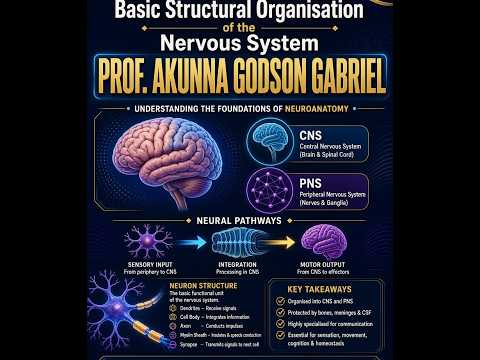
The lecture explains how neurons are built to receive, process, and transmit information, then connects their cellular structure to the nervous system’s larger organization. It covers the soma and Nissl substance, dendrites and axons, myelination and neuron types, followed by centralization into specialized structures and cephalization toward the organism’s anterior end.
Key takeaways
- Nissl substance is found in neuronal somata and dendrites but absent from axons and axon hillocks, making its distribution useful for identifying neuronal structures histologically.
- Dendritic branching and spines expand the area available for synaptic input; spine changes can influence neuronal connectivity, synaptic transmission, learning, and memory.
- Myelin increases conduction speed: Schwann cells produce it in the PNS and oligodendrocytes in the CNS, with action potentials traveling between nodes of Ranvier by saltatory conduction.
- The basic information-flow pattern is dendrites to soma to axon to axon terminals, although specialized neurons can vary from this general arrangement.
- Centralization organizes neurons into specialized processing centers; in vertebrates, the brain and spinal cord form the CNS, while peripheral ganglia remain outside it.
- Cephalization has an adaptive advantage for organisms that move forward because sensory structures at the anterior end encounter new environmental information first.
Chapters
0:00
Neuron Structure: Soma, Organelles, and Nissl Substance
- Neurons are the nervous system’s structural and functional units, specialized to receive, process, and transmit information.
- The soma, also called the cell body or perikaryon, contains the nucleus and organelles that support neuronal maintenance and survival.
- Nissl substance consists mainly of rough endoplasmic reticulum and ribosomes; it supports protein synthesis and occurs in the soma and dendrites, but not the axon or axon hillock.
4:35
Dendrites, Axons, Synapses, and Myelin
- Short, branched dendrites receive input and conduct signals toward the soma; dendritic spines provide sites for synaptic connections and contribute to plasticity, learning, and memory.
- A typical neuron has one axon, which carries action potentials away from the soma to targets such as another neuron, a muscle cell, or a gland cell.
- The axon hillock and initial segment are key sites for action-potential initiation; axon terminals release neurotransmitters into synaptic clefts.
- Schwann cells form myelin in the peripheral nervous system, while oligodendrocytes form it in the central nervous system; impulses travel rapidly between nodes of Ranvier by saltatory conduction.
11:35
Neuron Types and Functional Polarity
- Structural neuron classes include unipolar, pseudounipolar, bipolar, and multipolar forms, distinguished by the number and arrangement of processes from the soma.
- Most sensory neurons in spinal dorsal root ganglia are pseudounipolar, with one process dividing into peripheral and central branches.
- Bipolar neurons occur in specialized sensory pathways, including visual and auditory systems; multipolar neurons, with one axon and multiple dendrites, are common in the CNS and include many motor neurons.
- Neuronal polarity assigns complementary roles: dendrites receive information, the soma integrates and maintains the cell, and the axon and terminals transmit signals onward.
14:10
Centralization, CNS Organization, and Cephalization
- Centralization describes the concentration of nervous tissue into organized centers; simple organisms may have diffuse nerve networks, while more complex organisms develop nerve cords and ganglia.
- A ganglion is a collection of neuronal cell bodies outside the CNS; within the vertebrate CNS, a comparable collection is generally called a nucleus.
- The CNS consists of the brain and spinal cord, while the PNS includes structures such as cranial nerves, spinal nerves, peripheral ganglia, and nerve endings.
- Cephalization concentrates sensory receptors and nervous tissue toward the anterior end, where an organism moving forward encounters environmental information first.
Summary, takeaways, and chapters were generated by AI from the video's transcript and may contain errors. The video belongs to its creator, Prof. AKUNNA Gabriel Lecture Series.