Nervous System Diseases 2of2
 Watch on YouTube →
Overview
Robert Kellar, Ph.D., surveys nervous-system disorders, moving from acute brain injury to meningitis, Creutzfeldt–Jakob disease, multiple sclerosis, Alzheimer’s disease, Parkinson’s disease, and chronic traumatic encephalopathy (CTE). He distinguishes concussion from contusion and hemorrhage, explains how rotational forces can cause diffuse axonal injury, and connects repeated head impacts with progressive brain damage while emphasizing prevention, diagnosis, and the limits of current evidence.
Key takeaways
- Coup and contrecoup describe opposite impact sites: the brain first strikes the skull at the force of impact, then may rebound and hit the opposite side, as in the Flagstaff fall case.
- DAI differs from focal trauma because rotational acceleration can shear axons across widespread brain regions, sometimes with fatal consequences.
- Concussion is transient brain dysfunction, while contusion involves physical tissue damage; hematoma and hemorrhage describe localized blood collection and active bleeding, respectively.
- Meningitis symptoms such as stiff neck, headache, photophobia, and altered behavior warrant prompt assessment; cerebrospinal-fluid testing helps distinguish bacterial, viral, and fungal causes.
- MS involves immune-mediated myelin damage, whereas Parkinson’s disease involves dopamine-related motor-circuit dysfunction; their affected tissues and hallmark symptoms differ.
- Repeated head impacts are associated with CTE, including tau accumulation and progressive behavioral and cognitive changes, making head protection especially important in youth sports.
Chapters
0:00
Lecture Roadmap: Acute Brain Trauma and Neurological Disease
- Kellar frames the session around acute trauma to brain parenchyma, the functional tissue of the brain.
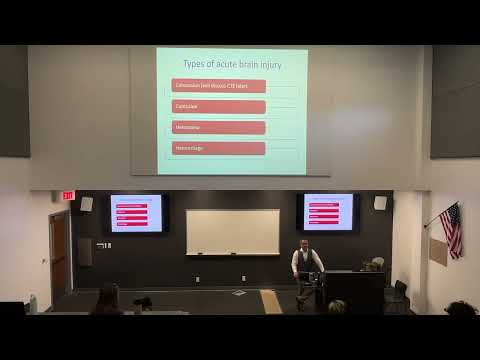
- Planned topics include concussion, contusion, hemorrhage, hematoma, multiple sclerosis, Alzheimer’s disease, Parkinson’s disease, and CTE.
- The opening announcement reminds students that two post-quizzes are due that night.
2:57
Coup and Contrecoup Injuries: A Fatal Fall Case from Flagstaff
- A coup injury occurs where the moving brain strikes the skull; a contrecoup injury occurs when it recoils and hits the opposite side.
- A 20-year-old tourist in Flagstaff fell backward and died en route to the emergency department; autopsy found occipital trauma and a frontal contrecoup injury.
- The autopsy evidence supported brain-trauma-induced death rather than seizure as the primary cause.
10:16
Diffuse Axonal Injury from Rotational Acceleration
- Diffuse axonal injury (DAI) can result when acceleration or rotation twists and shears axons across the brain.
- Examples include severe falls with tumbling motion and some cases of shaken-baby injury; severe DAI can be fatal.
- Unlike a focal injury, DAI affects widespread brain regions rather than one localized site.
12:37
Concussion and Contusion: Transient Dysfunction Versus Tissue Damage
- A concussion can cause temporarily altered consciousness, confusion, memory loss, or feeling stunned; a person does not have to lose consciousness.
- Kellar describes concussion as transient neuronal dysfunction, possibly involving the time required to restore ion balance and normal signaling.
- A contusion is a more structural injury: bruising, laceration, or other damage to brain parenchyma may prompt imaging when symptoms persist.
17:45
Epidural, Subdural, and Subarachnoid Bleeding
- A hematoma is a localized accumulation of blood; a hemorrhage is active bleeding from a ruptured vessel.
- Epidural hematomas are commonly associated with arterial bleeding, while subdural hematomas often involve venous blood.
- Subarachnoid hemorrhage places blood in the CSF-containing subarachnoid space; bloody cerebrospinal fluid can be detected by lumbar puncture.
- Kellar also identifies hypertension and saccular aneurysms near the circle of Willis as important non-traumatic causes of cerebral hemorrhage.
24:34
Meningitis: Infections of the Meninges
- Meningitis inflames the protective membranes around the brain and can be caused by bacteria, viruses, or fungi.
- Kellar highlights Neisseria meningitidis in college-age populations and Streptococcus pneumoniae among pediatric and older patients.
- Headache, flu-like aches, stiff neck, light sensitivity, and personality changes are warning signs; CSF testing helps identify the cause and guide treatment.
27:49
Creutzfeldt–Jakob Disease and Misfolded Prion Proteins
- Creutzfeldt–Jakob disease (CJD) is a prion disease in which misfolded prion protein can induce normal prion protein to misfold and aggregate.
- Prion accumulation produces spongiform changes—vacuoles and a sponge-like appearance—in affected neural tissue.
- Bovine spongiform encephalopathy, or mad cow disease, is the related cattle disease; contaminated neural tissue can pose a transmission risk to humans.
33:45
Multiple Sclerosis: Autoimmune Demyelination
- Multiple sclerosis (MS) damages myelin and oligodendrocytes in the central nervous system; Kellar links cytotoxic T-cell activity to type IV hypersensitivity.
- MS often develops during childbearing years, and Kellar notes that women are about twice as likely as men to develop it.
- Loss of myelin disrupts neural signaling and can progressively compromise motor function; geographic and population patterns are epidemiological observations, not proof of cause.
38:21
Alzheimer’s Disease: Memory Decline, Plaques, and Tangles
- Alzheimer’s commonly first impairs higher-order functions such as short- and long-term memory and can alter personality.
- Kellar describes beta-amyloid plaques and neurofibrillary tangles as lesions associated with neuronal dysfunction and loss.
- He cautions that postmortem findings cannot by themselves settle whether these lesions cause Alzheimer’s or arise as part of the disease process.
- Age and prior head trauma are discussed as risk factors; Kellar estimates that roughly 10% of cases have a hereditary component.
48:49
Parkinson’s Disease: Dopamine, the Substantia Nigra, and Tremor
- Parkinson’s disease affects dopamine-producing neurons in the substantia nigra, a midbrain structure involved in basal-ganglia motor circuits.
- Reduced dopamine signaling disrupts smooth movement and can produce tremor, often more pronounced on one side of the body.
- Kellar raises the question of whether Muhammad Ali’s symptoms reflected Parkinson’s disease, CTE, or overlapping effects of repeated head trauma.
51:10
CTE: Repeated Head Impacts, Tau, and Dr. Bennet Omalu
- Chronic traumatic encephalopathy is associated with repeated concussions and other head impacts; reported symptoms include memory loss, impaired judgment, aggression, depression, balance problems, and dementia.
- Dr. Harrison Martland described punch-drunk syndrome in boxers in the 1920s; forensic pathologist Dr. Bennet Omalu later brought CTE in American football players to wider attention.
- Kellar discusses brain atrophy and tau-protein accumulation in advanced CTE and urges protection of young athletes’ heads.
- The lecture closes by connecting injury prevention with the broader study of hydrocephalus, stroke, DAI, MS, Alzheimer’s, and Parkinson’s disease.
Summary, takeaways, and chapters were generated by AI from the video's transcript and may contain errors. The video belongs to its creator, Robert Kellar, Ph.D..