Embryology: Implantation
 Watch on YouTube →
Overview
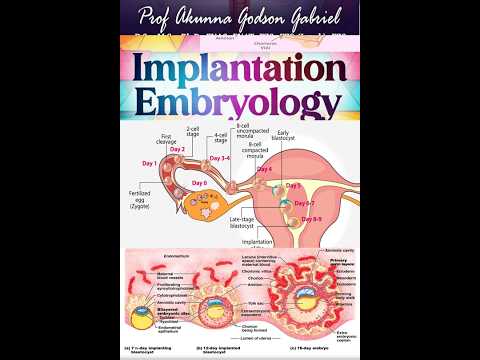
Implantation is the embedding of a blastocyst in the receptive uterine endometrium, a prerequisite for pregnancy and placental development. The lecture outlines its day 6 to 12 timeline, the apposition–adhesion–invasion sequence, trophoblast roles in establishing maternal blood spaces, and clinical consequences including pregnancy loss, ectopic pregnancy, and placenta previa.
Key takeaways
- Human implantation generally occurs within a day 6 to 12 window after fertilization, with the blastocyst attaching around days 6 to 7 and embedding complete by about day 12.
- A receptive, progesterone-influenced secretory endometrium and a developmentally healthy blastocyst must be synchronized for implantation to succeed.
- Implantation has three stages (apposition, adhesion, and invasion) and adhesion involves molecules including integrins and cadherins.
- Cytotrophoblast proliferates while syncytiotrophoblast invades maternal tissue; the resulting lacunae establish spaces for maternal blood flow.
- Implantation is the foundation of placental development: the decidua basalis contributes the maternal placental component, and chorionic villi begin developing during invasion.
- Ectopic pregnancy most commonly implants in a fallopian tube, while placenta previa involves implantation in the lower uterine segment and may cause later-pregnancy bleeding.
Chapters
0:00
Implantation Timing, Clinical Importance, and Prerequisites
- Implantation is blastocyst attachment to and embedding in the uterine endometrium; without it, pregnancy cannot proceed.
- The blastocyst reaches the uterine cavity around days 5 to 6, attaches around days 6 to 7, and completes invasion and embedding by about day 12.
- Successful implantation requires a healthy blastocyst with an inner cell mass and trophoblast, plus a progesterone-conditioned secretory endometrium.
- Embryo and uterine development must be synchronized; implantation outside the receptive window can fail.
3:22
Apposition, Adhesion, Invasion, and Early Placental Formation
- Implantation proceeds through apposition, when the blastocyst loosely positions with its inner cell mass toward the endometrium, and adhesion, when it attaches firmly.
- Integrins and cadherins support adhesion; defects at this stage can contribute to recurrent early pregnancy loss.
- During invasion, the trophoblast differentiates into proliferative cytotrophoblast and invasive syncytiotrophoblast, which erodes maternal tissue and forms lacunae.
- Lacunae connect with maternal blood, while the decidua basalis forms the maternal component of the placenta; implantation also initiates early chorionic villus development.
6:00
Maternal Immune Tolerance and Abnormal Implantation Outcomes
- The maternal immune system must tolerate the semi-allogeneic embryo; trophoblast HLA expression and local regulation of maternal cytotoxic T cells are described as part of this process.
- Ectopic pregnancy occurs when implantation is outside the uterus; the fallopian tube is the most common site, and symptoms can include abdominal pain and vaginal bleeding.
- Placenta previa involves implantation in the lower uterine segment and can cause vaginal bleeding, particularly in the third trimester.
- Failed apposition, adhesion, or invasion can lead to early pregnancy loss.
Summary, takeaways, and chapters were generated by AI from the video's transcript and may contain errors. The video belongs to its creator, Prof. AKUNNA Gabriel Lecture Series.