Aspectos éticos e legais relacionados à experimentação animal
Overview
Bruno Martynhak outlines Brazil’s ethical and legal framework for animal research, from the 1934 Decree 24.645 and the 2008 Arouca Law, No. 11.794, to the roles of CONCEA and institutional CEUAs. He focuses on the DBCA, established by Normative Resolution 55, the 3Rs, and Resolution 49, which requires role-appropriate training, including 30-hour ethics and practice courses and specific technique training where needed.
Key takeaways
- Brazil’s Arouca Law, No. 11.794 of 2008, establishes the framework for animal research, including institutional accreditation, oversight, and penalties for violations.
- CONCEA Resolution 53, effective in 2021, prohibits demonstrative or observational animal teaching activities when they do not build students’ psychomotor skills or competencies.
- The DBCA, established under Resolution 55, applies the 3Rs and gives practical guidance on project review, pain management, humane endpoints, euthanasia, and animal housing.
- CEUA approval must precede animal-based teaching or research, and committees assess scientific or educational necessity alongside likely effects on animal welfare.
- Resolution 49 requires animal users to document role-appropriate training and renew or validate it every five years; ethics and practice courses have a minimum 30-hour requirement.
- New or inexperienced researchers may need supervised, documented training in specific procedures, and using animals for that training requires prior approval and welfare review.
Chapters
- Animal experimentation involves procedures on living or recently deceased animals to advance scientific understanding and health research.
- Researchers need species-specific expertise in animal housing and care before, during, and after procedures.
- Ethical practice includes planning how to minimize suffering and end experiments humanely.
- Decree 24.645, issued in 1934, established state protection for animals in Brazil.
- The 1947 Nuremberg Code contributed principles of bioethics, while Law 6.638 of 1979 regulated vivisection nationally.
- The 1979 law addressed procedures on live animals for physiological and anatomical studies.
- Law 11.794, known as the Arouca Law, was approved on October 8, 2008, to regulate scientific use of animals under Brazil’s Constitution.
- It restricts educational animal use to higher education and technical secondary schools in biomedical fields.
- CONCEA Resolution 53, effective in 2021, prohibits demonstrative and observational animal activities that do not develop students’ psychomotor skills or competencies.
- Institutions that breach the Arouca Law may receive warnings, fines, temporary or permanent closure, or suspension of official research funding.
- Individuals can face warnings, temporary suspension, or permanent prohibition from regulated activities.
- The law establishes institutional accreditation, regulatory responsibilities, and safeguards for animal welfare throughout research protocols.
- COBEA and SBCAL, both founded in 1983, promoted animal welfare, rational animal use, professional training, and dedicated legislation.
- CONCEA, the National Council for the Control of Animal Experimentation, was created by the Arouca Law and began operating in February 2010.
- CONCEA issues and revises national Normative Resolutions as scientific practices and international standards change.
- CONCEA’s online resolutions cover species-specific housing and care, including rodents, lagomorphs, fish, and wild animals.
- Resolution 49 concerns training, Resolution 51 covers CEUA establishment and operation, Resolution 52 standardizes application forms, and Resolution 53 restricts teaching uses.
- Institutions submit annual records through CIUCA, the registry for institutions using animals for scientific purposes, and may be inspected by CONCEA.
- A CEUA, an institutional ethics committee for animal use, is required for accreditation to conduct animal research.
- At the Federal University of Paraná, institutional CEUA rules were established in 2011; an earlier committee had existed in the biological sciences sector since 2003.
- CEUAs review proposals and contribute to monitoring institutional compliance with the Arouca Law.
- The Brazilian Guidelines for the Care and Use of Animals, or DBCA, are set out in CONCEA Resolution 55 and guide research and teaching practices.
- The guide covers the 3Rs, institutional and CEUA responsibilities, project review, pain and distress monitoring, humane endpoints, surgery, postoperative care, and euthanasia.
- Its husbandry guidance includes transport, animal admission, housing, cages, food and water, identification, staffing, and facility management.
- Before a study begins, researchers should review existing literature, consider non-animal alternatives, justify sample size, and describe refinements that reduce adverse effects.
- Replacement, reduction, and refinement must preserve research quality while minimizing animal use, pain, distress, and stress.
- CEUAs assess whether animal use is scientifically or educationally essential and weigh expected benefits against potential effects on animal welfare.
- CONCEA Resolution 49 requires all animal users, including researchers, instructors, technicians, and students, to have training appropriate to their assigned duties.
- Training is mandatory regardless of the protocol’s invasiveness, and documentation must be renewed or validated every five years.
- Ethics and practical training courses require at least 30 hours and should cover relevant species, legislation, handling, and housing.
- Researchers may need documented training in procedures such as intraperitoneal injections, oral gavage, or stereotaxic surgery before performing them independently.
- Evidence can include a training certificate or declaration, a relevant publication or thesis from the previous five years, or documented professional experience; the CEUA validates what fits the role.
- If no team member has the required expertise, submit a separate training protocol before the research protocol, or explicitly request training animals in an approved project.
- Sequential use of animals for training requires CEUA review and welfare safeguards, such as selecting animals that have not undergone painful or invasive procedures.
Transcript excerpt
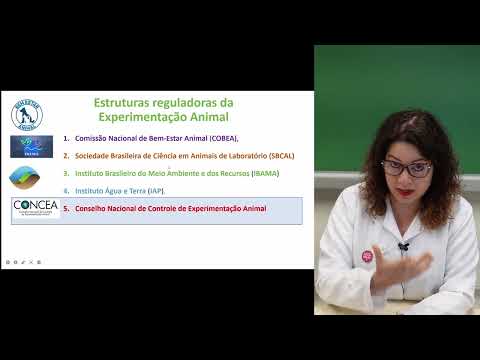
0:00 Olá a todos o tema da primeira aula é aspectos éticos legais relacionados a experimentação animal então nós abordaremos as estruturas reguladoras da experimentação animal conhecido pelas siglas couber sbcal com Sé eap Ibama legislação Nacional referente ao uso de animais em ensino e pesquisa científica a dbca que é a resolução normativa de número 55 a gente vai falar um pouquinho mais dessa RN e da RN número 49 que a legislação referente a obrigatoriedade de capacitação do pessoal envolvido em atividades de ensino e pesquisa científica que utilizam animais há
0:48 várias outras resoluções normativas vigentes mas nessa apresentação gostaria de dar um enfoque especial a essas duas RN bom durante muitos anos os animais eram vistos como parceiros da pesquisa né esse era um vistos não significa que não são vistos hoje também né Nós utilizamos na pesquisa não Clínica temos opções em vitro mas também temos muitas opções em vivo utilizando animais e há um tempo atrás né esses animais parceiros da pesquisa eram submetidos a protocolos que eram inviáveis aos humanos com o tempo hoje nós temos protocolos viáveis a humanos dependendo
1:36 da área de pesquisa mas nós temos também protocolos ainda que são inviáveis aos humanos é de uma maneira bem simples é experimentação animal é prática de realizar intervenções e animais vivos ou recém abatidos com o objetivo de beneficiar e promover o avanço da pesquisa científica então o uso né a experimentação animal é extremamente útil para saúde humana e para o melhor entendimento de processos fisiopatológicos das doenças bom se é necessário utilizar animais nas suas investigações você deve conhecer todos os cuidados necessários com
2:24 animais antes da experimentação ou seja como eles foram criados as condições que eles são antigos para cada espécie existem peculiaridades de condições de manutenção então é importante nós nos
This is the start of the transcript. Save this video free for the whole transcript, searchable and time-coded.
Related notes
Summary, takeaways, and chapters were generated by AI from the video's transcript and may contain errors. The video belongs to its creator, Bruno Martynhak.