ACCT 417 (Fall 2026) - Chapters 17, 18, and 21 Homework
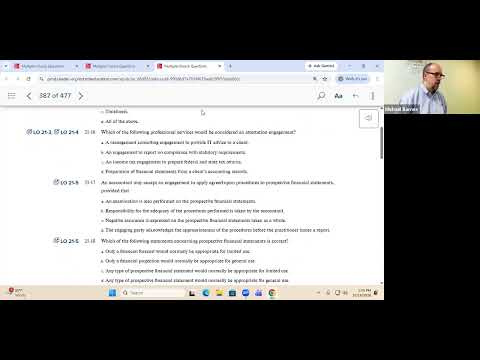 Watch on YouTube →
Overview
Michael Barnes reviews homework from Chapters 17, 18, and 21 as preparation for the second exam, emphasizing legal letters, subsequent events, audit-report decisions, and assurance engagements. He works through classification rules and examples, including how scope limitations and GAAP departures affect opinions, how compilations differ from reviews and audits, and why stronger assurance can reduce a lender’s perceived risk.
Key takeaways
- The primary purpose of an auditor’s lawyer letter is to corroborate management’s information about known legal matters, not to uncover litigation the auditor has not identified.
- For subsequent events, Type I events relate to conditions existing at the balance-sheet date and require adjustment; Type II events arise afterward and require disclosure, with pro forma statements considered when effects are significant.
- A scope limitation can lead to a qualified opinion or disclaimer, while a GAAP departure can lead to a qualified or adverse opinion; the choice depends on severity and pervasiveness.
- A review provides limited negative assurance through inquiries and analytical procedures, a compilation provides no assurance, and an audit provides reasonable assurance.
- A going-concern uncertainty alone does not modify the opinion if properly disclosed; failing to disclose it is a GAAP departure that can change the opinion.
- Greater assurance can reduce a lender’s perceived risk: an audit may support a lower loan rate than a review or compilation, which provides less evidence about financial-statement reliability.
Chapters
0:00
Exam Preparation and Chapter 17–21 Homework Scope
- Barnes identifies this homework as the last assignment before the second exam and urges students to use the study guide, take notes, and complete the practice exam.
- Students can raise questions during Monday’s review, attend office hours, or email Barnes over the weekend.
- The session covers Chapters 17, 18, and 21, topics Barnes says students commonly find challenging on the exam.
1:13
Legal Letters, Dual Dating, and Post-Issuance Discoveries
- A lawyer’s letter primarily corroborates management’s information about litigation, claims, and assessments; it is not a strong tool for discovering matters the auditor does not already know about.
- Auditors remain responsible for subsequent events through the financial-statement issuance date, even when an event occurs after the original audit-report date.
- Dual dating limits responsibility to the specific subsequent event; changing the report date instead extends responsibility to all events through the new date.
- If material information discovered after issuance cannot be tested because management blocks access, the auditor must alert the client, relevant regulators such as the SEC, and parties relying on the report.
6:25
Explanatory Paragraphs, Scope Limitations, and Annual-Report Information
- Significant related-party transactions may warrant an explanatory paragraph; it adds context without changing the audit opinion.
- A material inability to obtain evidence about inventory is a scope limitation, potentially leading to a qualified opinion or a disclaimer depending on severity and pervasiveness.
- If alternative procedures adequately support inventory or receivables, an unmodified opinion may still be appropriate despite missing the originally planned procedure.
- Auditors do not audit all other information in an annual report, but they read it for material inconsistency with the audited financial statements.
12:56
Attestation Services and Agreed-Upon Procedures
- Barnes distinguishes examinations, reviews, and agreed-upon procedures, and identifies compliance reporting as an attestation service.
- Attestation examples discussed include compliance, prospective and pro forma financial statements, management’s discussion and analysis, and service-organization reports such as SOC reports.
- Agreed-upon procedures provide low to no assurance, issue a summary of findings rather than an opinion, and restrict report distribution to the specified parties.
- The engaging party must acknowledge that the agreed-upon procedures are appropriate before the practitioner reports.
19:54
Compilation and Review Rules; Subsequent-Event Classification
- A review requires inquiries and analytical procedures, independence, and a conclusion providing limited—or negative—assurance; a compilation provides no assurance and does not require independence.
- Both compilations and reviews do not require an understanding of internal control; a compilation report must disclose when the accountant is not independent.
- A post-year-end plant explosion is a Type II subsequent event because the condition arose after year-end: disclose it, and consider pro forma statements if the effect is significant.
- Resolution of litigation about a condition existing at year-end is Type I and requires adjustment; a major sale after year-end is Type II and requires disclosure, with pro forma statements potentially appropriate.
- A stock-price decline and a routine increase in the next year’s advertising budget generally are not subsequent events affecting the financial statements.
24:53
Audit Opinions for Component Auditors, GAAP Departures, and Scope Limits
- When a group auditor relies on another CPA firm but declines full responsibility for its work, the report retains an unmodified opinion with modified wording and explanatory language describing the other auditor’s work.
- Omitting the required statement of cash flows is a GAAP departure that can result in a qualified or adverse opinion, depending on materiality and pervasiveness.
- A probable, reasonably estimable liability that management refuses to accrue or disclose is another GAAP departure and may require a qualified or adverse opinion.
- If management prevents receivables confirmation and alternative procedures cannot provide evidence, the limitation may lead to a qualified opinion or disclaimer; suspected concealment should also be raised with the audit committee.
- When alternative procedures provide sufficient evidence about inventory that the auditor could not observe at year-end, an unmodified opinion may remain appropriate.
31:52
Accounting Changes, Inventory Methods, and Auditor Independence
- Undisclosed related-party transactions violate GAAP and can require a qualified or adverse opinion; significant related-party matters may also merit explanatory discussion.
- A justified prospective switch from double-declining-balance to straight-line depreciation can retain an unmodified opinion, with an explanatory paragraph if the change materially affects comparability.
- Barnes explains that U.S. companies may use LIFO domestically while using FIFO for foreign operations where IFRS does not permit LIFO.
- Replacing a non-GAAP current-market inventory valuation with GAAP-compliant FIFO supports an unmodified opinion, with an explanatory paragraph to explain the change.
- An auditor who owns 10% of a client’s stock lacks independence and cannot issue an audit opinion; the appropriate report is a disclaimer.
38:44
Going Concern Disclosure and Multiple GAAP Violations
- A deteriorating financial condition or substantial doubt about continuing as a going concern does not, by itself, change an otherwise unmodified opinion when properly disclosed.
- A properly disclosed going-concern matter generally calls for an unmodified opinion with an explanatory paragraph.
- Refusing to record a necessary loan-loss reserve adjustment violates GAAP; the resulting report may be qualified or adverse depending on severity and pervasiveness.
- Failing to disclose the going-concern issue creates an additional GAAP departure, separate from the unrecorded reserve adjustment.
42:08
How Assurance Levels Affect a Bank Loan’s Interest Rate
- A compilation organizes financial statements from management’s records and representations but provides no assurance.
- A review uses limited procedures and provides limited, or negative, assurance; an audit provides reasonable assurance, the highest of the three levels discussed.
- A lender faces greater uncertainty with compiled statements and may charge a higher rate; an audit can reduce perceived information risk and potentially lower the borrowing rate.
- Barnes uses Orange Grove Farms’ proposed bank loan to connect service selection, assurance, lender risk, and the interest rate charged.
Summary, takeaways, and chapters were generated by AI from the video's transcript and may contain errors. The video belongs to its creator, Michael Barnes.