ACCT 417 (Fall 2026) - Chapters 7, 8, and 9 Homework
 Watch on YouTube →
Overview
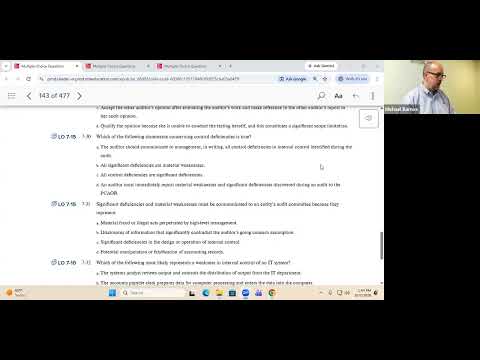
Michael Barnes reviews ACCT 417 homework from Chapters 7–9, connecting SOX requirements and ICFR deficiency classifications to audit reporting and control-testing decisions. He explains attribute- and variable-sampling logic, works through control-severity scenarios, and calculates how sample results compare with tolerable deviation rates.
Key takeaways
- SOX ICFR evaluation covers both control design and operating effectiveness; auditor improvement recommendations are communicated to management rather than presented as external audit-report recommendations.
- A material weakness triggers an adverse ICFR opinion and external disclosure, whereas a significant deficiency is communicated to management and the audit committee but is not itself a material weakness.
- For attribute sampling, compare the tolerable deviation rate with the upper population deviation rate, calculated from the sample deviation rate plus the allowance for sampling risk.
- A sample with 3 deviations in 50 items has a 6% sample deviation rate; adding 2% sampling-risk allowance yields 8%, which exceeds a 7% tolerance and calls for revising assessed control risk.
- Recurring individually small errors can become a material weakness when their aggregate is material and effective compensating controls are absent.
- In substantive testing, higher tolerable misstatement reduces sample size, while higher assessed control risk increases sample size because the auditor must lower acceptable detection risk.
Chapters
0:00
Course Logistics and Chapters 7–9 Homework Scope
- Michael Barnes asks students to check Brightspace for end-of-semester presentation groups and contact their group members.
- The homework review combines Chapters 7, 8, and 9, with material spanning internal controls and audit sampling.
1:40
SOX, ICFR Reporting, and Interim Control Testing
- SOX requires management to report on internal control over financial reporting (ICFR); auditors evaluate whether ICFR is properly designed and operating effectively.
- Auditor recommendations for improving controls are communicated to management, not included as external recommendations in the audit report.
- A control procedure performed by an employee without authorization is an operating deficiency when the control itself has been designed.
- Interim testing best suits continuous controls; unusual transactions, period-end controls, and highly subjective controls are less suitable for interim testing.
5:55
ICFR Deficiency Severity, Opinions, and Required Communications
- Three deficiencies unlikely to cause material misstatements plus one likely to cause significant but nonmaterial misstatements indicate control deficiencies and a significant deficiency—not a material weakness.
- For an ICFR report, a material weakness supports an adverse opinion; a scope limitation may require a disclaimer, while the described absence of a material weakness supports an unqualified opinion.
- Auditors communicate all identified control deficiencies in writing to management; significant deficiencies are also communicated to the audit committee.
- Material weaknesses are communicated to management and the audit committee and disclosed externally; significant deficiencies alone are not reported to the PCAOB as material weaknesses.
10:49
Attribute Sampling: Sample-Size Drivers and Upper Deviation Rates
- Control-test samples use attribute sampling to assess whether a control operates effectively, rather than to determine whether financial statements contain a material misstatement.
- Lower confidence levels, higher tolerable deviation rates, and lower expected population deviation rates generally reduce the required sample size.
- For a 50-item sample with 3 deviations, the sample deviation rate is 6%; adding a 2% allowance for sampling risk gives an 8% upper deviation rate.
- Because 8% exceeds the 7% tolerable deviation rate, the auditor should modify the planned assessed level of control risk.
15:56
Variable Sampling and Substantive-Test Sample Size
- Variable sampling estimates a numeric population amount, such as dollar misstatement, by projecting sample findings to the population; attribute sampling instead answers a yes-or-no control question.
- Increasing tolerable misstatement reduces the sample size for a substantive test of details because the auditor can accept a larger error.
- Increasing assessed control risk raises risk of material misstatement and lowers acceptable detection risk, so the substantive sample size increases.
19:56
Classifying ICFR Deficiencies Through Revenue and Banking Cases
- Limited, nonmaterial revenue errors with review controls over unusual contract changes support a significant-deficiency classification rather than a material weakness.
- Frequent material contract modifications, ineffective review, and material revenue-recognition errors indicate a material weakness.
- Unauthorized discounts that are individually small but recurring and material in aggregate, with no effective corrective control, support a material-weakness conclusion.
- At Lawrence Corporation, combined access-control segregation problems, ledger errors, and untimely reconciliations may collectively constitute a material weakness.
- At First Coast Bank, significant deficiencies in credit-loss estimates and interest-income controls become more serious when loan balances are growing and further growth is expected.
29:35
Attribute-Sampling Calculations and Control Effectiveness Decisions
- Using 95% confidence, a 4% tolerable deviation rate, and a 1% expected rate produces a sample size of 156; the corresponding 5%/2% setup produces 181.
- At 90% confidence, the 7%/3% tolerable-and-expected rates produce a sample of 94, while 8%/4% produce 98.
- Barnes calculates sample deviation rates including 0 deviations, 5 out of 181 (about 2.8%), and 4 out of 94 (about 4.3%); table-based upper deviation rates are about 2%, 6.9%, 8.7%, and 7.3% across the examples.
- Compare the computed upper deviation rate—not just the sample rate—with the tolerable rate: 2% versus 4% and 7.3% versus 8% support effective controls, while 6.9% versus 5% and 8.7% versus 7% do not.
Summary, takeaways, and chapters were generated by AI from the video's transcript and may contain errors. The video belongs to its creator, Michael Barnes.