2026Fall-Math124-Week4Class3
 Watch on YouTube →
Overview
Danny reviews the Tuesday Math 124 midterm logistics, then develops the key trigonometric limit, lim as x approaches 0 of sin(x)/x = 1, using a unit-circle area argument and the squeeze theorem. He applies the limit to evaluate related expressions, uses it to motivate the derivatives of sine and cosine, derives the tangent derivative with the quotient rule, and finishes with a product-and-quotient-rule example.
Key takeaways
- The fundamental radians-based limit lim as x approaches 0 of sin(x)/x = 1 is the key tool for proving trigonometric derivatives and evaluating related limits.
- Comparing unit-circle triangle and sector areas yields cos(x) ≤ sin(x)/x ≤ 1, so the squeeze theorem forces the middle expression to approach 1.
- Conjugate multiplication transforms (cos(h) - 1)/h into an expression containing sin(h)/h, allowing the limit to be evaluated as 0.
- Scaled sine limits follow by inserting matching factors: sin(3x)/(4x) approaches 3/4, while sin(5x)/sin(7x) approaches 5/7.
- The fundamental derivatives are d/dx sin(x) = cos(x) and d/dx cos(x) = -sin(x); applying the quotient rule then gives d/dx tan(x) = sec²(x).
- The Tuesday midterm is designed for 60 minutes, covers material through the Friday class but excludes circles and tangents, and allows one handwritten, double-sided letter-size or A4 note sheet.
Chapters
- Midterm 1 is Tuesday and is designed for 60 minutes, though students may use the remainder of their 80-minute quiz section.
- Coverage includes material from the first class through this Friday, but excludes circles and tangents.
- Students may bring one letter-size or A4 sheet of handwritten notes, front and back, plus the permitted calculator.
- Monday's class and review session will explain exam logistics and likely question types.
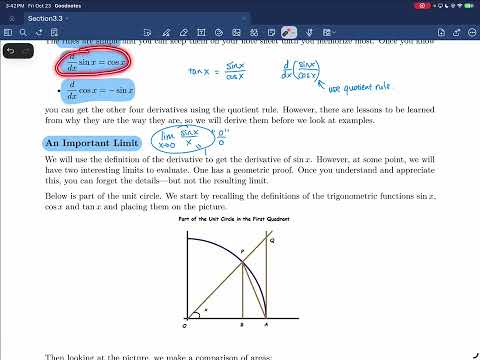
- The core rules are d/dx sin(x) = cos(x) and d/dx cos(x) = -sin(x).
- Danny explains that derivatives of the other four standard trigonometric functions can be obtained from sine and cosine using the quotient rule.
- The lesson will establish why the two core rules hold before using them in derivative calculations.
- For an angle x in the first quadrant of the unit circle, the relevant triangle lengths are sin(x), cos(x), and tan(x).
- Comparing the areas of an inscribed triangle, a circular sector, and a larger triangle gives sin(x) ≤ x ≤ tan(x), with x measured in radians.
- Replacing tan(x) with sin(x)/cos(x), then rearranging for positive x, yields cos(x) ≤ sin(x)/x ≤ 1.
- As x approaches 0, both outer expressions in cos(x) ≤ sin(x)/x ≤ 1 approach 1.
- The squeeze theorem therefore gives lim as x approaches 0 of sin(x)/x = 1.
- The geometric proof is presented for understanding, while Danny says students should know the limit and use it rather than reproduce the proof on the midterm.
- For lim as h approaches 0 of (cos(h) - 1)/h, direct substitution gives the indeterminate form 0/0.
- Multiplying numerator and denominator by the conjugate cos(h) + 1 changes the numerator to cos²(h) - 1.
- Using cos²(h) - 1 = -sin²(h) exposes the factor sin(h)/h, producing a limit of 0.
- For lim as x approaches 0 of sin(3x)/(4x), rewrite the expression as [sin(3x)/(3x)] · [3x/(4x)] to get 3/4.
- For lim as x approaches 0 of sin(5x)/sin(7x), insert matching factors 5x and 7x so both sine ratios approach 1.
- The second limit evaluates to 5/7; both examples illustrate how to show the steps behind a result rather than simply canceling symbols.
- Horizontal tangents on the sine graph occur at x = π/2 + kπ, so the derivative is zero at those points.
- Where sin(x) increases, its derivative is positive; where sin(x) decreases, its derivative is negative.
- The concavity changes at sine's inflection points, indicating where the derivative switches between increasing and decreasing.
- The resulting derivative graph resembles cos(x), suggesting the rule d/dx sin(x) = cos(x).
- The limit sin(h)/h = 1 gives the slope of the tangent to sin(x) at x = 0.
- Danny connects that slope and the derivative definition to the formula d/dx sin(x) = cos(x).
- A corresponding derivative calculation gives d/dx cos(x) = -sin(x), completing the two rules used for the rest of the lesson.
- Write tan(x) as sin(x)/cos(x), then apply the quotient rule using the sine and cosine derivatives.
- The numerator simplifies through sin²(x) + cos²(x) = 1, leaving d/dx tan(x) = 1/cos²(x).
- The result can also be written sec²(x), since sec(x) = 1/cos(x); the other trigonometric derivatives can be found similarly.
- For d/dx [e^x cos(x)/(x² + 4)], apply the quotient rule to the numerator and denominator.
- Differentiate e^x cos(x) with the product rule to obtain e^x cos(x) - e^x sin(x), and differentiate x² + 4 to obtain 2x.
- The derivative is [(e^x cos(x) - e^x sin(x))(x² + 4) - 2x e^x cos(x)]/(x² + 4)²; Danny notes that further simplification is unnecessary.
Transcript excerpt
0:13 I didn't like that. Yeah. Okay, let's get started. Happy Friday. How are you guys doing?
1:01 Good. Is it just me or is the classroom has become a just a little more and more? Is it is it's not just me, right? Maybe my lecture videos are so good they're all watching it on YouTube. I did see my subscriber like double from like 40 to like 80 something. Maybe that would explain. And the 40 you might wonder who they are. One of it is like my parents and the other 39 from the the calculus students from two years ago. Uh okay. Uh let's get started. Um just one announcement today. Uh midterm one is next Tuesday. It's going to be a 60minute midterm. I know your section is 80 minutes. Um so what's really I'm
1:49 going to say more about it on Monday exactly what to expect the logistics and then the stuff you should do the stuff you should not do stuff like that. Uh but basically the midterm is 60 minutes. The length is 60 minutes. So you would go in the uh your quiz section. The first five to 10 minutes is your TA handing out the midterm. You making sure you actually got the right midterm because I think for some of your quiz section, you probably realize it's like joint, right, with another section. Does that happen to some of you? Okay. Anyway, uh making sure you have the right midterm because every professor will have slightly different midterms. Um, and you just do the midterm and I've told the TA, well, I'm going to tell the TA. I have a your TA meeting at 5 where I gather all the TAs
2:36 and uh I instruct them on what to do and
This is the start of the transcript. Save this video free for the whole transcript, searchable and time-coded.
Related notes
Summary, takeaways, and chapters were generated by AI from the video's transcript and may contain errors. The video belongs to its creator, He's Danny.