2026Fall-Math124-Week4Class2
 Watch on YouTube →
Overview
The calculus lesson introduces the product rule and quotient rule as efficient ways to differentiate products and ratios, showing why the tempting approach of differentiating each part separately fails. Worked examples apply the rules to exponential, polynomial, and radical functions, compare the quotient rule with algebraic rewriting, and finish with a tangent-line problem; the announced midterm covers sections 2.1 through 3.3.
Key takeaways
- The product rule is (fg)' = f'g + fg'; differentiating each factor and multiplying the derivatives is incorrect, as x · x would wrongly produce 1 instead of 2x.
- The quotient rule is (f/g)' = (f'g - fg')/g², so the numerator order and squared denominator are essential.
- For a product of three factors, group two factors into one function and apply the two-factor product rule; rewriting √x as x^(1/2) helps with expansion and differentiation.
- A quotient derivative may require a product rule inside the quotient rule, as in x³eˣ/(x² + 9).
- Equivalent algebraic forms can make different derivative rules available: (x² + 5x)/√x becomes x^(3/2) + 5x^(1/2), making the power rule simpler than the quotient rule.
- To find a tangent line at x = 1, first evaluate the derivative for the slope, then evaluate the original function for the point; here those values are -1/4 and (1, 1/2).
Chapters
- The first midterm is scheduled for next Tuesday and covers sections 2.1 through 3.3.
- Monday's class will be a review session with no new material.
- The lesson introduces the product and quotient rules, while Friday's planned topic is trigonometric derivatives.
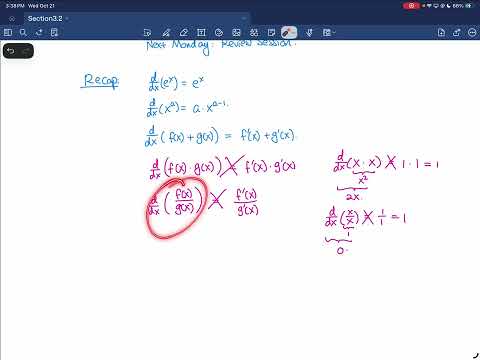
- The sum rule says that the derivative of f(x) + g(x) is f'(x) + g'(x).
- The proposed shortcut for products fails: differentiating x · x separately gives 1 · 1 = 1, but the derivative of x² is 2x.
- The quotient shortcut fails for x/x: separate derivatives give 1/1, while x/x = 1 has derivative 0.
- The product rule is (fg)' = f'g + fg': differentiate one factor at a time and keep the other factor unchanged.
- The quotient rule is (f/g)' = (f'g - fg')/g², with the denominator squared.
- The rules need not be memorized for the midterm if they are included on the permitted cheat sheet, but students must know how to apply them.
- For f(x) = x eˣ, the product rule gives f'(x) = eˣ + xeˣ, using (eˣ)' = eˣ.
- A second exercise differentiates a product of two polynomials, with factor derivatives including 3x² + 8x and 10x.
- Danny recommends leaving a correct product-rule expression unsimplified when further algebra is not required.
- For a product with three factors, group two factors together so the expression becomes a product of two functions.
- The example combines the radical and linear factors in an expression involving eˣ, 9√x + 1, and 8x - 11 before applying the product rule.
- Writing √x as x^(1/2) makes it easier to expand and use the power rule on the grouped factor.
- The product rule can be derived from the limit definition of the derivative, followed by algebraic rearrangement.
- A full proof is outside this introductory calculus lesson, but the derivation connects the shortcut to the definition.
- For quotient problems, label the numerator f and denominator g, then write (f'g - fg')/g² before substituting expressions.
- For (8x + 3)/(x² + 5), identify f = 8x + 3 and g = x² + 5.
- Substitution into the quotient rule gives [8(x² + 5) - (8x + 3)(2x)]/(x² + 5)².
- Simplifying the numerator yields (-8x² - 6x + 40)/(x² + 5)²; Danny advises avoiding unnecessary simplification to reduce error risk.
- For x³eˣ/(x² + 9), the outer operation is a quotient, so use the quotient rule.
- The numerator derivative requires the product rule: (x³eˣ)' = 3x²eˣ + x³eˣ.
- The denominator derivative is 2x, and the quotient-rule denominator is (x² + 9)².
- For (x² + 5x)/√x, the quotient rule uses (√x)' = (1/2)x^(-1/2) and places (√x)² in the denominator.
- Rewriting and dividing term by term gives x^(3/2) + 5x^(1/2), which can be differentiated directly with the power rule.
- Both methods produce the same derivative, (3/2)x^(1/2) + (5/2)x^(-1/2), but rewriting first is shorter.
- For the final quotient-function problem, evaluate the derivative at x = 1 to obtain the tangent slope, -1/4.
- Substituting x = 1 into the original function gives the point of tangency (1, 1/2).
- Using point-slope form gives the tangent line y - 1/2 = (-1/4)(x - 1).
Transcript excerpt
1:46 [clears throat] >> Okay, let's get started. Um How are you doing? Happy Wednesday. Uh quick announcement. Uh midterm one next Tuesday. And the material we cover is section 2.1 to section 3.3. I'll say more exactly about it. What to expect on the first midterm as well as some of the things you should watch out for, what type of question is going to appear. I'll say all that next Monday. So next Monday it's going to be a review session. There's still a lecture, but a lecture there's no new material being taught. It's just a review session, okay? So that's what's going on next Monday. What we're going to do this week, on Wednesday today, we're going to do
2:32 something called the product rule and the quotient rule. And on Friday we're going to do something called a trig derivative, okay? And both of these things will appear on the midterm, okay? So let's get started. As a recap, here's what what happened so far. We're in section three now, and section three is about introducing all kinds of rules. And the point for the rules is for us to be able to differentiate functions faster, okay? Because at this point in section two, you know, we talked about the definition of the derivative and stuff like that. And using the definition is great and all, but in practice it's a little slow, okay? And the point of these rules is to make our life a lot easier. There are different kind of rules. And one of the rule we discussed last time was for
3:21 example, we talked about the power rule and the exponential rule. So last time we talked about d/dx e to the power of x is e to the power of x. We talked about d/dx x to the power of a
This is the start of the transcript. Save this video free for the whole transcript, searchable and time-coded.
Related notes
Summary, takeaways, and chapters were generated by AI from the video's transcript and may contain errors. The video belongs to its creator, He's Danny.