12:3 External Flows - Solving for Equilibrium Frequencies, Velocities, Composite Drag, Rotation
 Watch on YouTube →
Overview
Derek Elsworth explains how external-flow drag changes with Reynolds number, then applies force balances to find the terminal settling speed of spheres in laminar and turbulent regimes. He connects those calculations to particle separation, Felix Baumgartner’s high-altitude jump, golf-ball dimples, composite drag on structures and cars, spin-induced lift, and vortex shedding that can excite bridge oscillations.
Key takeaways
- For a sphere at low Reynolds number, Stokes settling speed scales with diameter squared and inversely with fluid viscosity: v = (ρs − ρf)gD²/(18μ).
- For a sphere in a turbulent regime with CD near 0.4, terminal speed follows a square-root force balance and does not depend explicitly on viscosity.
- Golf-ball dimples can reduce drag by causing earlier boundary-layer transition, which delays separation and narrows the wake.
- Composite structural loading can be estimated by summing component drag forces and their moments; vehicle power required against drag is force multiplied by speed.
- Backspin and topspin alter the airflow and pressure distribution around a sphere, producing opposite lift directions through the Magnus effect.
- Vortex-shedding frequency can approach a structure’s natural frequency and cause damaging oscillation, so bridge and cable design must account for aerodynamic excitation.
Chapters
- Baumgartner’s Red Bull Stratos jump from about 128,000 feet illustrates how low air density at high altitude changes falling-body drag.
- Elsworth recalls a peak speed near 700 miles per hour, above the local speed of sound, and contrasts it with ordinary human terminal speeds near 200 miles per hour.
- Terminal velocity follows from balancing gravity against buoyancy and aerodynamic drag.
- A water column sorts particles because settling speed depends on both particle size and the density difference between particle and fluid.
- Gold panning uses gravity separation: dense gold behaves differently from lighter surrounding material as the pan is swirled.
- In sediment deposits, coarse particles settle sooner while finer material travels farther, producing fining-upward sequences.
- External drag is the flow-direction component of pressure forces plus viscous shear forces integrated over an object's surface.
- The drag coefficient normalizes drag force by one-half fluid density times velocity squared times a reference area.
- Reference length and area depend on geometry: an airfoil may use its chord and planform area for lift, or frontal area for drag.
- For a sphere, the low-Reynolds-number drag coefficient follows approximately CD = 24/Re; at higher Reynolds numbers it approaches a nearly constant value.
- At low speeds, viscous effects dominate; at higher speeds, pressure drag and the wake dominate, with transition occurring around Reynolds numbers of order 1,000 for the examples discussed.
- A thin boundary layer can delay flow separation and reduce the wake, explaining why a turbulent boundary layer can sometimes lower total drag.
- At equilibrium, a falling sphere satisfies weight minus buoyancy equals drag, with acceleration set to zero.
- Using CD = 24/Re for a sphere yields the Stokes settling speed: v = (ρs − ρf)gD²/(18μ), where D is sphere diameter and μ is dynamic viscosity.
- The result depends on the density difference, gravity, diameter squared, and fluid viscosity; check afterward that the Reynolds number is low enough for the laminar model.
- For a sphere in the higher-Reynolds-number regime, Elsworth uses a drag coefficient near 0.4 and balances net weight against 0.5ρf v²CD A.
- Solving gives v = sqrt[2(W − FB)/(CDρfA)]; unlike the Stokes result, fluid viscosity does not appear explicitly.
- The calculated speed must be checked against the assumed turbulent regime, such as Reynolds number greater than roughly 1,000.
- Thunderstorm updrafts carry hailstones upward while supercooled water freezes onto them.
- A hailstone eventually becomes too heavy for the updraft and falls when its weight, buoyancy, and drag reach a new balance.
- The same force-balance method applies, but the appropriate drag relation depends on whether the particle's Reynolds number indicates creeping or turbulent flow.
- Dimples make the boundary layer transition at a lower speed than on a smooth golf ball, delaying separation and shrinking the wake.
- The resulting turbulent boundary layer can reduce drag despite its greater local mixing, helping the ball travel farther.
- Elsworth estimates a roughness-to-diameter ratio around 10⁻² and discusses dimple depths on the order of tenths of a millimeter for a roughly 25-millimeter ball.
- For a water tower, calculate drag on the cylinder and top sphere separately, then multiply each force by its lever arm to find the foundation moment.
- Cylinder drag requires the correct reference area, often frontal area per unit length, while sphere drag uses its projected frontal area.
- For a car, component drag contributions from the front, windshield, roof, and rear can be combined; required power is drag force multiplied by speed.
- Elsworth explains a spinning table-tennis ball by superposing the airflow caused by its forward motion and the airflow induced by surface rotation.
- Backspin shifts the stagnation and separation points, creating a pressure difference that lifts the ball; topspin reverses the effect and makes it dive.
- The same spin-dependent aerodynamic effect helps explain curve and lift on a baseball.
- The lecture’s central comparison with pipe flow is that drag or friction behavior changes as Reynolds number increases and the flow geometry changes.
- Creeping flow is viscosity-dependent, while higher-Reynolds-number drag is increasingly governed by density, pressure distribution, and flow separation.
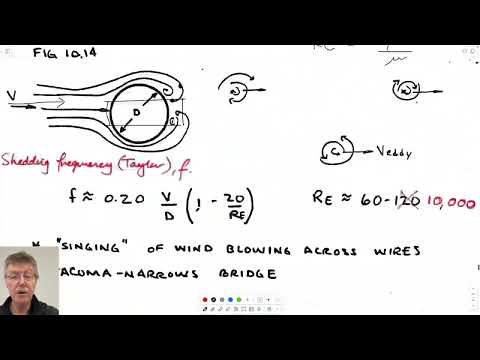
- Periodic vortex shedding provides a further external-flow effect because its frequency can interact with a structure’s natural vibration.
- Alternating vortices shed from opposite sides of a structure form a Kármán vortex street; shedding frequency depends on flow speed, characteristic width, and Reynolds-number effects.
- If periodic aerodynamic forcing aligns with a structure’s natural frequency, oscillations can grow; the Tacoma Narrows Bridge, nicknamed Galloping Gertie, illustrates the danger of aerodynamic instability.
- Elsworth also cites pedestrian-induced motion of London’s Millennium Bridge and vibration-control weights on utility lines as examples of managing resonant responses.
Transcript excerpt
0:00 this is apparently Felix bomgardner I guess it's somewhere in the southern us I would imagine just from looking at it and uh of course sponsored by Red Bull what else wouldn't be these days I guess for something extreme and well all kinds of fluid mechanics I guess uh the the helium balloon that expands as it goes up uh because of the pressure change uh we know that you can't provide any real constraint on on that uh and we know how uh balloons work they're either hot air balloons which are less dense than the stuff around because they're hotter or it's a different gas I guess in this case it's a different gas and I don't know how high they get up maybe oh yeah it says 128,000 ft and then jumps out so I guess we know
0:48 from what we did at uh 10,000 M 30,000 ft that the air is pretty thin by the time you get there and so I guess that's probably why he's wearing essentially a space suit and I'm sure with oxygen and uh he's Free Falling and then I guess ultimately going to pull out a parachute and stop so yeah so he looks like he's been jumping out of planes about as much as I am so where's it gone so yeah so I think interesting thing to watch and so the other fluid mechanics part of that is of course uh what speed is he doing when he comes down I think it clocks him I don't know whether it says it on I guess there are no closed captions say something like a seven going supersonic so the speed of
1:36 sound is something like 600 plus miles an hour and maybe he was doing 700 miles
This is the start of the transcript. Save this video free for the whole transcript, searchable and time-coded.
In this course
Related notes
Summary, takeaways, and chapters were generated by AI from the video's transcript and may contain errors. The video belongs to its creator, Derek Elsworth.