Penn State University EME 303 Fluid Mechanics
Professor Derek Elsworth · Penn State University · 8 lectures with notes
Students in this class: ask your lecturer for the class code, and these lectures will already be in your library when you sign up.
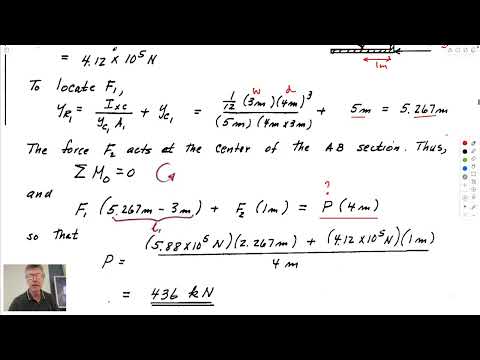
3:3 Fluid Forces on Structures - Forces on Curved Structures, Buoyancy and Stability
Curved-surface forces and Archimedes’ principle explain how fluid loads act and why floating structures stay upright or capsize.
4:2 Fluid Dynamics - Bernoulli Equation - Along Streamline
Bernoulli’s equation balances pressure, elevation, and velocity along a streamline, with applications to Pitot tubes, aircraft exhaust, and lift.
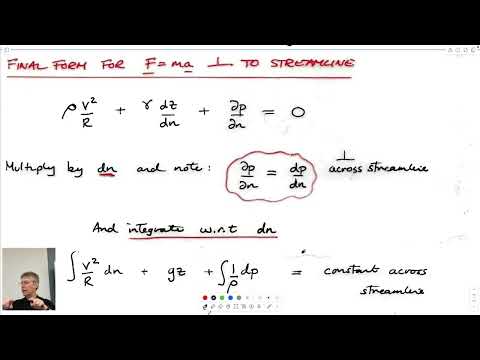
4:3 Fluid Dynamics - Bernoulli Equation - Normal to Streamlines
Curved streamlines create pressure gradients that depend on flow speed and radius of curvature.
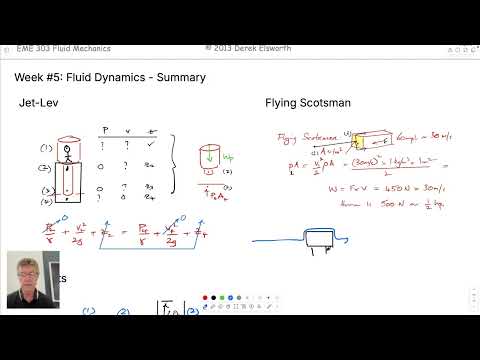
6:1 Conservation of Mass - Frames of Reference, Material Derivatives, Convective Acceleration
The material derivative converts spatially observed flow changes into the acceleration experienced by a moving fluid particle.
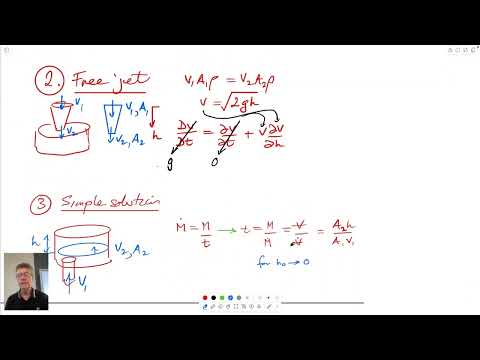
6:3 Conservation of Mass - Static, Moving and Deforming Control Volumes
Mass conservation gives the same beaker fill time for fixed, moving, and deforming control volumes when relative boundary flow is handled correctly.
7:1 Conservation of Momentum - Relationship to Bernoulli and Reynolds' Transport Theorem
Reynolds’ transport theorem turns momentum conservation into a practical force balance for flows, weirs, and turbines.
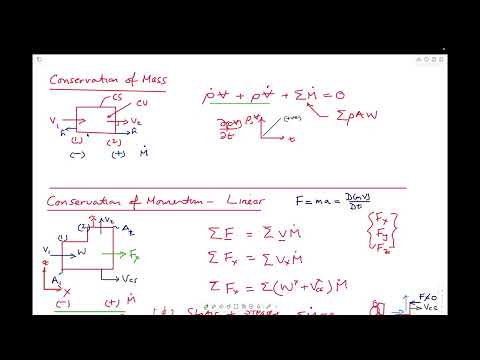
Review Session for Midterm 2 [2026]
Midterm 2 centers on Bernoulli flow, manometry, and control-volume conservation of mass and linear momentum.
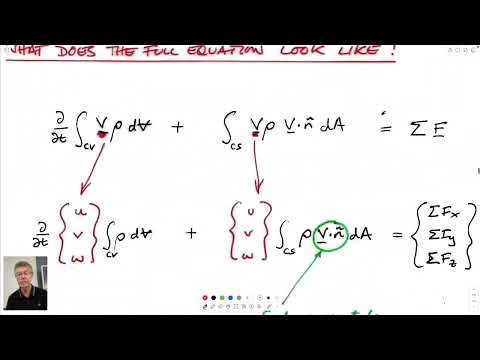
7:3 Conservation of Linear & Rotational Momentum - Static and Moving Control Volume
Angular-momentum balance converts tangential fluid momentum into torque, with useful sprinkler power occurring between the zero-speed and free-running limits.