5:1 Fluid Dynamics - Bernoulli Equation, Pressure Measurement, Free Jets
 Watch on YouTube →
Overview
Derek Elsworth develops Bernoulli’s equation and continuity into practical methods for measuring airspeed and predicting free-jet behavior. He connects iced Pitot tubes to Air France Flight 447, derives the Torricelli jet speed, and estimates that lifting a 100 kg person with a 0.01 m² water jet requires about 14 m/s and 14 kW before losses.
Key takeaways
- A Pitot tube obtains airspeed by comparing stagnation pressure, where the incoming air is stopped, with static atmospheric pressure: V = √(2Δp/ρ).
- Air speed matters for aircraft lift because it measures airflow over the wings; GPS ground speed cannot replace it, and iced Pitot tubes can produce unreliable readings.
- For steady incompressible flow, A₁V₁ = A₂V₂, so a jet speeds up and narrows as its cross-sectional area decreases.
- An open tank’s ideal outlet speed is √(2gH), the same speed an object gains by falling through height H.
- In the simplified jet-lift example, supporting a 100 kg person with a 0.01 m² water jet requires about 14 m/s and 14 kW of ideal power, before pump and flow losses.
Chapters
- A prone land-speed cyclist is introduced as a possible example of estimating the power needed to reach roughly 60 mph by pedal power.
- The Air France Flight 447 report links conflicting airspeed readings to potentially iced Pitot tubes before the 2009 crash that killed 228 people.
- A Pitot tube measures airspeed, which determines airflow over the wings and lift; GPS ground speed does not provide that same measurement.
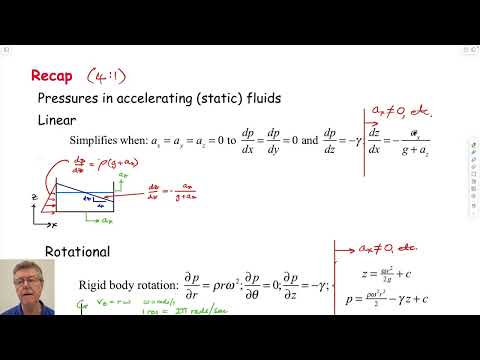
- For a horizontally accelerating container, the free-surface slope depends on horizontal acceleration relative to gravity, with the sign determined by the chosen axes.
- Vertical acceleration changes the effective pressure gradient: accelerating upward increases bottom pressure, while free fall makes the fluid effectively weightless.
- A rotating fluid forms a curved free surface; angular velocity and radius determine its elevation, with a constant fixed by a known point.
- Pressure normal to a streamline reflects the centripetal acceleration needed to follow a curved path.
- When streamline radius becomes infinite, the curvature effect vanishes and the pressure distribution returns to the hydrostatic relation.
- Flowing over a hump reduces pressure relative to the flat-flow case, while flow through a dip increases it.
- The head form used is z + p/γ + V²/(2g), with elevation, pressure head, and velocity head expressed as lengths.
- Bernoulli is applied between points on a streamline and is treated as a steady-flow relation for an incompressible, low-viscosity fluid.
- The lecture sets up applications including Pitot pressure measurement, continuity, and free jets.
- Air entering a Pitot tube is brought to rest at its forward-facing opening, converting velocity head into stagnation pressure.
- With atmospheric pressure as the static reference, the speed follows V = √(2Δp/ρ), where Δp is stagnation pressure minus static pressure.
- An iced or blocked Pitot opening can corrupt pressure readings and produce misleading airspeed indications, as discussed in the Flight 447 example.
- Directional pressure ports can compare readings at different angles to estimate the incoming flow direction.
- Steady flow requires mass flow in to equal mass flow out; for constant-density fluid, this reduces to A₁V₁ = A₂V₂.
- A narrowing river cross-section corresponds to higher flow velocity, while a bucket with unequal inlet and outlet rates must accumulate or lose fluid.
- For compressible flow, density must remain in the mass-flow relation, ρAV, rather than assuming volumetric flow alone is conserved.
- Bernoulli between a large open tank’s surface and its outlet uses atmospheric pressure at both points and negligible surface velocity.
- The outlet speed becomes V = √(2gH), where H is the vertical drop from the tank surface to the jet outlet.
- The result matches the speed of an object falling through the same height, and continuity predicts that a descending jet narrows as its speed increases.
- The jet-lift calculation treats a large pressurized tank as having negligible internal velocity and the nozzle exit as atmospheric pressure.
- Bernoulli relates the tank pressure to the nozzle’s velocity head, giving an ideal exit pressure of ρV²/2.
- At impact, the idealized upward force is modeled as impact pressure times jet area and set equal to the rider’s weight.
- For a 100 kg person, the example approximates weight as 1,000 N using g ≈ 10 m/s².
- With a 4-by-4-inch jet area approximated as 0.01 m² and water density of 1,000 kg/m³, the ideal required speed is about 14 m/s.
- The estimate depends on equating jet impact force with body weight and omits real-world losses.
- The 14 m/s jet speed is roughly 30 mph, illustrating the high velocity needed to support a person in the simplified model.
- Using power = force × velocity, the example estimates 1,000 N × 14 m/s = 14 kW.
- A practical pump and motor must deliver at least this ideal power, with additional capacity required for system losses.
Transcript excerpt
0:11 $128,000 I've seen these things before. If you I use this video for a long time. Actually, allows us to do some fun things in this class with Bernoulli. See the umbilical with a pump running behind it. Greetings. There you go. Got to get one.
1:14 Uh not sure what else. Uh I don't know if there's a Yeah, we'll use this today as well. And so, I think there's a movie that goes with it, but not of him riding. Just kind of curious. And so, uh this is the prone land speed record, face down, facing forwards. And this is the mechanism that he has on his bike to do it. And uh apparently, uh 60 mph by just pedal power. And so, we'll play around with that to see if we can work out what his power input should be to be able to do what he does. So. So, it's kind of kind of interesting. Try to stop it.
2:10 And yeah, this is a bit uh Nearly 2 years ago, Air France flight 447 mysteriously crashed in the Atlantic, killing 228 people. This is 20 2009. recovered from the ocean floor, we know more about what happened in the final harrowing moments of that Rio to Paris flight. Here's Nancy Cordes. The plane's black boxes revealed that the Air France pilots, faced with conflicting speed readings, didn't know whether to speed up or slow down. At 11:10 p.m., the Airbus A330 was heading to a powerful That's the flight that left from Rio to go to Paris, and fortunately didn't make it. And the plane began to roll to the right. Cockpit displays showed
2:57 inconsistent speed readings, a sign that the external speed sensors Pitot tubes. malfunctioned or perhaps had iced over. "I have the controls," called one of the
This is the start of the transcript. Save this video free for the whole transcript, searchable and time-coded.
Related notes
Summary, takeaways, and chapters were generated by AI from the video's transcript and may contain errors. The video belongs to its creator, Derek Elsworth.