Review Session for Midterm 3 [2026]
 Watch on YouTube →
Overview
Derek Elsworth reviews the Midterm 3 scope: energy conservation and losses, Buckingham Pi dimensional analysis, pipe flow, and manometry, with pipe networks and the enthalpy form of the energy equation excluded. He explains the governing equations and solution methods, including Moody-chart friction factors, model-prototype similarity, and pressure changes through fluid columns.
Key takeaways
- A pipe-system energy balance must include pump or turbine head and all major and minor losses between the selected upstream and downstream points.
- For large upstream and downstream tanks, endpoint velocities can be treated as zero, but loss terms still use the average velocity in the connecting pipe.
- The Moody chart relates pipe friction factor to Reynolds number and relative roughness; laminar circular-pipe flow uses f = 64/Re, while turbulent behavior varies with ε/D.
- Buckingham Pi analysis reduces the five pipe-flow variables diameter, density, velocity, length, and viscosity to two dimensionless groups because mass, length, and time are the fundamental dimensions.
- Matching Reynolds numbers supports kinematic similarity between a model and prototype, while matching Euler numbers supports dynamic similarity for pressure forces.
- Manometer calculations can be performed as signed pressure steps: add unit-weight head when descending a fluid column and subtract it when ascending.
Chapters
- The exam covers conservation of energy from week 8 and pipe flow from weeks 10 and the first two sessions of week 11; pipe networks and the enthalpy equation are excluded.
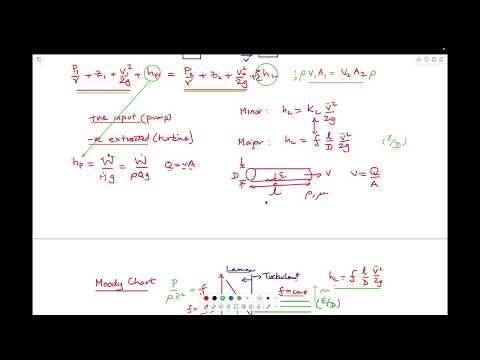
- Write the upstream-to-downstream Bernoulli balance with elevation, pressure, and velocity heads, pump or turbine head, and the sum of head losses; use continuity to relate upstream and downstream flow rates.
- Represent minor losses with a loss coefficient K_L and average pipe velocity, and major losses with friction factor f, pipe length L, diameter D, and velocity squared.
- Use Reynolds number and relative roughness ε/D with the Moody chart: laminar flow is typically below Re ≈ 2,000 with f = 64/Re, while turbulent friction depends on roughness; convert pump head to power using mass flow rate and gravity.
- Buckingham Pi gives the number of dimensionless groups as n − k, where n is the number of variables and k is the number of fundamental dimensions represented.
- For the pipe-flow example with diameter, density, velocity, length, and viscosity, five variables involving mass, length, and time produce two Pi groups.
- Construct each group by combining repeating variables with a primary variable and solving exponents so the resulting expression has zero net dimensions.
- Model-prototype comparisons use geometric similarity for length ratios, kinematic similarity by matching Reynolds numbers, and dynamic similarity by matching Euler numbers, the pressure-to-velocity-squared ratio.
- In manometry, pressure remains constant across a horizontal segment; moving upward through a fluid subtracts γh, while moving downward adds γh.
- Track each fluid column’s unit weight when moving between pressure points; include both liquid densities when a manometer contains two liquids, but a gas roughly 1,000 times less dense than the liquid can often be neglected.
- For an evacuated container, account for vapor pressure when setting the pressure reference.
- The exam schedule assigns energy conservation to Monday, dimensional analysis to Wednesday, and pipe flow plus manometry to Friday; sessions run at 8:00, and questions draw from 2020 through 2025.
Transcript excerpt
0:01 Greetings. Uh this is the review for the third midterm in week 13. Arrangements for the test are same as before Monday and Wednesday and Friday at uh 8:00. The material for this are the sessions in week eight on conservation of energy where we look at energy losses uh dimensional analysis using buckingham pi and other methods by inspection and then the beginning of pipe flow in weeks 10 and the first two of week 11 excluding uh pipe networks. So there's historically no pipe networks in this particular one. The individual questions for the days are split between these three topics. Monday is conservation of
0:49 energy. Uh Wednesday is uh dimensional analysis. Uh recipe question and Friday is pipe flow and monometry. The questions are from the last uh sin and postcoid. So 2020 inclusive to 2025. And this is just a quick run through of the topical areas that it covers and the quest and the concepts you need to be able to answer questions. For the energy equation, we looked at energy losses. So the essence of energy losses is that we can define the BNU's equation written from upstream as it has to be to downstream as it has to be uh in terms of a pump head uh put into the system and head losses summation of head losses
1:39 within the system. These head losses could be typically frictional losses in uh bends of pipes and also in the length of uh pipes as well. Important to realize that if what this looks like is on the uh energy diagram between upstream and downstream upstream uh elevation head um pressure head, velocity head and pump head all added together. uh they are in terms of lengths uh meters in terms of our SI system and then um a loss of head head
This is the start of the transcript. Save this video free for the whole transcript, searchable and time-coded.
Related notes
Summary, takeaways, and chapters were generated by AI from the video's transcript and may contain errors. The video belongs to its creator, Derek Elsworth.