11:3 Pipe Flow - Pipe Networks, Flow Measurement
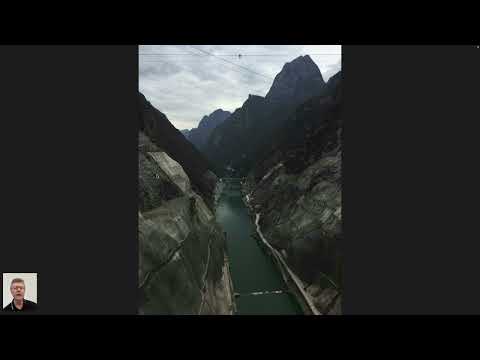 Watch on YouTube →
Overview
Derek Elsworth explains how to analyze pipe networks using continuity and energy equations: series pipes carry the same flow, while parallel paths share head loss and divide the total flow. He applies these rules to branching and loop networks, including a worked example that adds a pipe to increase flow by 30%, and connects head drop and discharge to hydroelectric power; flow measurement is deferred to the next class.
Key takeaways
- In series pipe sections, discharge remains constant; reducing pipe diameter increases velocity and generally raises Darcy-Weisbach head loss.
- For parallel branches between common endpoints, each route has the same total head loss, while branch discharges add to the total flow.
- A simple branched network can be solved by pairing continuity at the junction with energy balances along each independent circuit.
- Adding a parallel branch can increase total discharge, but sizing it requires accounting for both the shared upstream pipe loss and the new branch loss.
- Hydroelectric output is approximately P = ρgQΔz when pipe losses are small, making both available elevation drop and water discharge central to power potential.
Chapters
- Niagara Falls diverts water around the falls at night, while the drop and flow support power generation.
- The Hoover Dam and dams along the Colorado River illustrate large-scale water storage and hydroelectric infrastructure.
- The Trent-Severn Waterway in Ontario uses locks to connect lakes, and some structures also produce power.
- Iceland combines hydropower with geothermal energy, while tidal barrages capture water behind barriers and release it as tides recede.
- The Arapuni Dam on New Zealand's Waikato River is part of a cascade that uses Lake Taupō and downstream dams to generate power.
- Tasmania generates all of its electricity from renewables, mainly hydropower, and plans to produce twice its own needs for export across Bass Strait.
- For a known flow rate and pipe diameter, calculate velocity, Reynolds number, friction factor, and head loss without iteration.
- When velocity is unknown, estimate the friction factor, solve for velocity, then use Reynolds number and the Moody chart to update it.
- Pipe sizing reverses the process: use the required flow rate and available head to estimate a diameter, then iterate as needed.
- Continuity requires the same volumetric flow rate through every pipe in series: Q = VA.
- Darcy-Weisbach head loss is proportional to f(L/D)(V²/2g), so a smaller downstream diameter raises velocity and typically increases head loss.
- For a reservoir-to-reservoir system, the sum of pipe losses must equal the available elevation or head difference.
- Each parallel route connects the same upstream and downstream conditions, so its total head loss is equal to that of the other routes.
- The total discharge is the sum of branch discharges, such as Qtotal = Q1 + Q2.
- Hydroelectric power can be estimated as P = ρgQΔz when pipe losses are negligible; larger-diameter pipes reduce losses.
- For a junction with one incoming pipe and two outgoing branches, continuity gives Q1 = Q2 + Q3.
- Write an energy equation along each route between the same endpoints; the head losses on the two circuits must match.
- With three unknown velocities, the two circuit energy balances and one continuity equation provide the three equations needed to solve the network.
- The example begins with two tanks joined by pipes in series and uses their known head difference to find the existing discharge.
- A new branch is then added, with the design target set to 1.3 times the original flow rate.
- The solution combines Darcy-Weisbach losses for each route with continuity at the junction to determine the new branch conditions.
- For the original series pipes, equal diameters mean equal velocities, allowing the known elevation drop to determine the initial flow.
- After adding the branch, the upstream flow is fixed at 1.3Q₀ and splits between the two downstream pipes.
- Use the shared head-loss condition for both circuits and Q1 = Q2 + Q3 to solve for the branch velocity and required diameter.
- When reservoirs have different elevations, separate routes do not necessarily have the same head difference.
- The example uses elevations of 838 m, 850 m, and 805 m to establish flow directions toward the lowest reservoir.
- Continuity gives Q1 + Q2 = Q3, while separate energy equations relate the A-to-C and B-to-C elevation drops to their respective pipe losses.
- Flow-rate measurement is postponed to the next class because the pipe-network discussion reaches the end of the session.
- The upcoming material covers external flows, including flow over wind turbines and wings, followed by open-channel flow in rivers and ditches.
- The lecture identifies the course's remaining pipe-flow-related topics as part of the final stretch before the midterm and end of term.
Transcript excerpt
0:00 so no videos today but why don't I do a live one I guess I can't remember most of these things are this is fall I think I don't know if you knew that niagar falls they turn off the falls at night and they divert the water Upstream around the Falls they don't go dry both on the Canadian and um American side and they generate power uh uh for the 100 foot or so drop and the very large amount of water that drains uh that's a dam being built in British Columbia I think that's Alberta Hoover Dam as it used to be before 911 um used to drive across the top to get from Nevada to Arizona and then after 9911 you remember the Dam Busters movie uh they thought that it was a vulnerable
0:48 structure and so I think built a bridge across from one side to the other that's not the bridge I think that's also Hoover looking Upstream that's another Dam on the Colorado River our house unrelated don't know where that is and I'm not sure might be Watertown New York oh fenland Falls Ontario and so I guess the other use of dams is uh to provide locks the Trent s Waterway takes you from Lake Ontario to Lake Huron through Ontario and this there's a lock in there somewhere but it looks like they're also
1:34 producing power there's an outlet here and this looks like a lwh head uh Powerhouse somewhere in BC hooverdam actually with the new Visitor Center uh this was probably 2003 when we took a bunch of students out west to look at energy and this is a new bridge that doesn't go across now took students to Iceland uh this is somewhere on the rean
This is the start of the transcript. Save this video free for the whole transcript, searchable and time-coded.
Related notes
Summary, takeaways, and chapters were generated by AI from the video's transcript and may contain errors. The video belongs to its creator, Derek Elsworth.