6:3 Conservation of Mass - Static, Moving and Deforming Control Volumes
 Watch on YouTube →
Overview
Derek Elsworth develops conservation of mass for static, translating rigid, and moving deforming control volumes, emphasizing that flow across a moving boundary must be measured relative to that boundary. He applies all three formulations to filling a beaker, shows they give the same fill time, and connects the mass-balance framework to continuity constraints and the upcoming conservation-of-momentum analysis.
Key takeaways
- Mass flow across a moving control surface depends on fluid velocity relative to the surface; using the stationary-frame velocity alone can give the wrong balance.
- A beaker with cross-sectional area A2 filled by an inlet of area A1 and speed V1 takes A2H/(V1A1) to reach height H, regardless of whether the control volume is fixed, translating, or deforming.
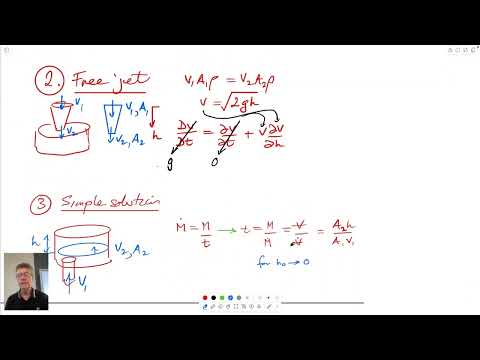
- For a constant-density free jet, increasing fall speed requires decreasing area so that A·V remains constant along the jet.
- The continuity constraint ρ1V1A1 = ρ2V2A2 relates upstream and downstream velocities and can eliminate an unknown when paired with Bernoulli’s equation.
- The Reynolds transport framework carries over from mass to momentum: choosing momentum as the extensive property makes velocity the intensive property and requires accounting for vector components and forces.
Chapters
0:00
Three Control-Volume Types and the Beaker-Filling Problem
- Elsworth introduces filling a 16-ounce glass at 1 ounce per second: the intuitive fill time is 16 seconds.
- The lecture compares a static non-deforming control volume, a moving rigid one, and a moving deforming one.
- Examples include flow through a fixed pipe, a translating jet engine, and an expanding balloon.
3:00
Mass Accumulation and the Sign Convention for Flux
- For mass conservation, the extensive property is mass and its intensive property is 1.
- Accumulation in a control volume can result from increasing volume, changing density, or both.
- The balance combines density and volume changes with mass flux across the control surface; inflow is negative and outflow is positive.
8:00
Moving Boundaries Require Relative Fluid Velocity
- Elsworth uses a moving boat and fire hose to distinguish the water velocity seen from shore from its velocity relative to the boat.
- The stationary-observer velocity is the vector sum of control-surface velocity and fluid velocity relative to the surface.
- For a translating rigid control volume, opposite sides sweep equal areas with opposite signs, so the net contribution from uniform surface motion cancels.
13:00
A Falling Jet Narrows as Its Speed Increases
- Gravity accelerates the free jet as it falls, increasing its speed with vertical distance.
- For constant-density water, continuity requires the product of cross-sectional area and velocity to remain constant, so the jet narrows.
- The beaker problem is recast as water entering through an area A1 at velocity V1 and raising a free surface of area A2.
17:30
Fixed Control Volume: Deriving the Beaker Fill Time
- With a stationary control volume at the beaker, control-surface velocity and control-volume change are both zero.
- The inlet mass rate is −ρV1A1 and the rising-water outlet term is +ρV2A2; balancing them relates the inlet flow to the rise rate.
- Using beaker volume A2H and inlet volumetric flow V1A1 gives the fill time as A2H/(V1A1), matching volume divided by flow rate.
21:00
Moving Rigid Control Volume: Tracking the Rising Surface
- The second construction moves a non-deforming control volume upward with the beaker’s rising water surface.
- Mass flow must be evaluated relative to the moving boundary, rather than using only the fluid’s stationary-frame velocity.
- The moving-boundary formulation again leads to the same fill-time result when the inlet flow and swept volume are accounted for.
25:00
Deforming Control Volume: Letting the Volume Expand
- In the third construction, the control volume’s lower edge stays at the beaker bottom while its upper boundary rises and the enclosed volume expands.
- When the upper boundary follows the water surface, fluid has no relative flow across that boundary; the inlet supplies the growing control-volume contents.
- Setting the volume growth rate equal to V1A1 and using volume A2H reproduces the same fill time as the fixed and moving rigid cases.
30:00
Continuity in Bernoulli Problems and the Momentum Preview
- The familiar continuity relation ρ1V1A1 = ρ2V2A2 is the practical mass-balance constraint used alongside Bernoulli’s equation.
- For a fixed control surface, fluid velocity across the boundary is its ordinary velocity; for a moving surface, it is relative velocity.
- Elsworth previews momentum conservation using a water jet striking a person or a Pelton wheel, where jet momentum transfer produces force and turbine rotation.
- Changing the conserved extensive property from mass to momentum gives B = mv and intensive property b = v, making the resulting balance vector-valued.
Summary, takeaways, and chapters were generated by AI from the video's transcript and may contain errors. The video belongs to its creator, Derek Elsworth.