7:3 Conservation of Linear & Rotational Momentum - Static and Moving Control Volume
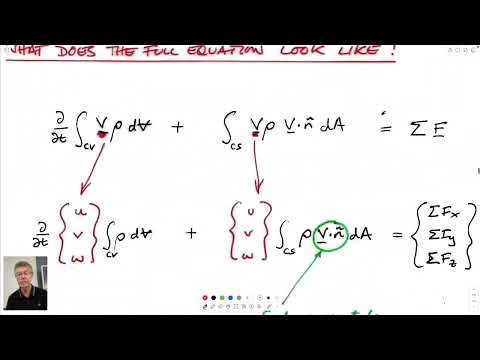 Watch on YouTube →
Overview
Derek Elsworth reviews linear momentum balances for static and moving control volumes, emphasizing how relative flow velocity, control-surface velocity, and signed mass flow determine which terms can be simplified. He then derives angular-momentum balance for a three-nozzle rotating sprinkler, showing how tangential velocity components produce torque and why useful power lies between the zero-speed, maximum-torque condition and the free-running, zero-torque condition.
Key takeaways
- For a steady translating control volume with constant VCS, the signed mass-flow rates sum to zero, allowing the control-surface-velocity contribution to cancel from the linear momentum balance.
- For an unsteady control volume with net mass loss, such as a discharging gas bottle, the VCS momentum-flux term cannot be discarded.
- Angular-momentum flux depends on the cross product of radius and velocity, so only the tangential component of outlet velocity contributes to torque about the rotation axis.
- For the three-nozzle sprinkler, each outlet carries mass flow ρQ/3, and the relevant tangential velocities are W cos θ and Rω.
- A stationary rotor can experience maximum torque but produces no power; a free-running rotor has zero resisting torque, so useful output requires an intermediate operating condition.
- The worked sprinkler example predicts maximum torque falls from 231 N·m at 0° to 200 N·m at 30° and 116 N·m at 60°, reaching zero at 90°.
Chapters
0:00
Review Materials and Searchable Lecture Transcripts
- Derek Elsworth notes that a searchable transcript can link keywords to locations in lecture recordings.
- The transcript tool could help locate concepts such as signed mass flow, but calculation practice remains central to the course.
4:00
Linear Momentum for Moving Control Volumes
- The static-frame fluid velocity is the sum of velocity relative to the control surface, W, and control-surface velocity, VCS.
- For a translating control volume, the momentum-flux term uses the static velocity W + VCS multiplied by signed mass flow rate.
- The balance applies component by component in x, y, and z; the examples include a vane, a jet lever, and a discharging gas bottle.
11:00
When Steady Flow Cancels the Control-Surface Term
- In steady flow, signed mass flow rates sum to zero; if VCS is constant over the boundary, its contribution cancels from the momentum-flux sum.
- For an unsteady system such as a gas bottle losing charge, net mass flow is nonzero, so the VCS term must remain.
- Inflow and outflow mass-flow signs come from the surface-normal dot product, while Cartesian momentum components follow the chosen positive axes.
12:40
Angular Momentum Adds a Lever Arm to Momentum Balance
- Angular momentum is formed from the cross product of position radius and linear momentum; the corresponding flux term uses radius crossed with velocity.
- The force moment is torque, measured as force times lever arm, while rotational power is torque multiplied by angular speed in radians per second.
- Tangential speed is related to angular speed by Vθ = Rω; one revolution per second equals 2π radians per second.
20:00
Three-Nozzle Sprinkler: Select the Tangential Flow
- The sprinkler has three outlets at radius R, each carrying one-third of total volumetric flow Q.
- Only the outlet-velocity component tangent to the rotation contributes to angular-momentum transfer; for an outlet angle θ, that component is W cos θ.
- The rotating control surface has tangential speed VCS = Rω, which must be included because its speed varies around the rotating boundary.
32:00
Sprinkler Torque Balance and Operating Limits
- Mass flow per nozzle is ρQ/3, and the torque balance combines the tangential relative velocity W cos θ with control-surface speed Rω.
- Holding the sprinkler stationary gives zero rotational speed and maximum holding torque, but therefore zero power output.
- With no resisting torque, the sprinkler reaches its free-running speed; torque and power output are then zero, so useful power requires an intermediate load.
37:00
Outlet Angle Changes Maximum Torque
- The worked comparison gives maximum torques of 231 N·m at 0°, 200 N·m at 30°, and 116 N·m at 60°.
- At 90°, the tangential outlet-velocity component is zero, so the model predicts no rotation-driving torque.
- A generator provides an intermediate resisting torque, slowing the rotor below free-running speed so mechanical power can be converted to electricity.
40:00
From Sprinklers to Turbines and Engines
- The same momentum-transfer principle applies to turbines such as the Pelton wheel and Francis turbine.
- A piston and connecting rod transfer linear motion to a crankshaft, illustrating another conversion from linear to rotational motion.
- The lecture closes by moving from momentum conservation toward the course's next conservation law: energy.
Summary, takeaways, and chapters were generated by AI from the video's transcript and may contain errors. The video belongs to its creator, Derek Elsworth.