3:3 Fluid Forces on Structures - Forces on Curved Structures, Buoyancy and Stability
 Watch on YouTube →
Overview
Derek Elsworth extends hydrostatic force analysis from flat plates to curved structures, showing how to resolve pressure into horizontal and vertical components and locate the resulting forces. He derives Archimedes’ principle, applies it to buoy design and stability, and closes with a submerged-block manometer example before previewing pressure changes in accelerating fluids.
Key takeaways
- For a curved submerged surface, calculate the horizontal load from its vertical projection and the vertical load from the weight of the fluid above the surface, then combine the components as vectors.
- The buoyant force is the weight of displaced fluid, Fᵦ = γVdisplaced, and its line of action passes through the centroid of that displaced volume.
- A hurricane pressure deficit of 5 kPa supports about 0.5 m of sea-level rise, so wind-driven water transport is needed to explain storm surges of roughly 2–3 m.
- A Tainter gate’s curved face directs pressure forces toward its pivot, minimizing the net moment about the fulcrum.
- Floating stability depends on how the center of buoyancy shifts when a vessel tilts relative to its fixed center of gravity; a keel helps by lowering the center of gravity.
- Pressure added above a submerged object increases pressure on both its top and bottom, so it does not change the buoyant force, which depends on displaced volume.
Chapters
0:00
Submarine Ballast and Shipwrecks Illustrate Buoyancy
- A submarine controls its buoyancy by pumping water into ballast tanks or expelling it with compressed gas.
- An emergency surfacing maneuver makes a submarine positively buoyant by displacing ballast water.
- The Costa Concordia grounding and salvage demonstrate how buoyancy and applied forces can affect a large ship’s position and recovery.
6:00
Storm-Surge Pressure Estimates and the Glomar Explorer
- A hurricane eye pressure deficit of about 50 millibars, or 5 kPa, corresponds to roughly 0.5 m of water-level rise—not the 2–3 m seen in many storm surges.
- Wind-driven circulation pushes water toward the coast and helps explain storm surges beyond the pressure effect.
- The CIA’s Glomar Explorer operation used a ship designed with a seabed-lifting system to recover part of a sunken Soviet submarine.
9:41
Flat-Plate Hydrostatic Forces and Center of Pressure
- The resultant force on a flat submerged plate equals average pressure at the plate’s centroid multiplied by its area.
- The center of pressure lies below the centroid for an inclined or vertical plate; its offset can be found using the parallel-axis theorem.
- For a rectangular plate, the centroidal second moment of area includes the standard result b·a³/12.
16:07
Curved-Surface Forces: Pipe Sections and Tainter Gates
- For a curved surface, resolve the hydrostatic load into a horizontal force on its vertical projection and a vertical force related to the fluid’s weight.
- In the half-filled drain-pipe example, the calculated components are 281 lb horizontally and 441 lb vertically.
- Pressure forces on a Tainter gate follow radial lines toward its pivot, so their resultant creates no net moment about that fulcrum.
24:00
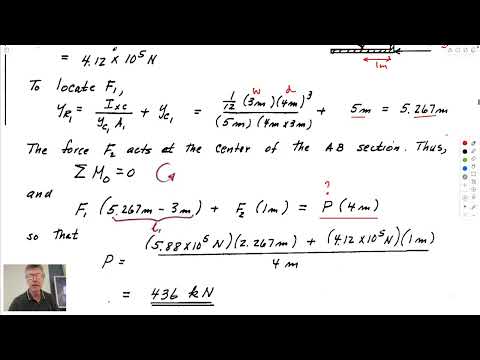
Finding the Restraining Force on a Curved Oil Barrier
- A free-body diagram separates the curved barrier’s horizontal pressure forces from vertical forces due to weight.
- The horizontal pressure distribution can be compared by using equal-pressure points at the same elevation in a connected fluid.
- Because the barrier’s two sides have different pressure areas, the net lateral load is the difference between the opposing distributions.
28:16
Archimedes’ Principle from Pressure Differences
- Hydrostatic pressure increases with depth according to p = γz, making the force on an object’s bottom larger than the force on its top.
- For a container filled with the surrounding fluid, pressure forces and the contained fluid’s weight balance; removing that fluid leaves a net upward buoyant force.
- The buoyant force equals the weight of displaced fluid, Fᵦ = γVdisplaced, and acts through the centroid of the displaced volume.
34:00
Buoy Tether Loads from Displaced Water
- A buoy’s free-body diagram balances upward buoyancy against its downward weight and the tether’s tensile force.
- Buoyancy is calculated as the displaced water’s unit weight multiplied by displaced volume.
- The center of buoyancy is the centroid of the displaced volume; air inside a steel buoy contributes little weight compared with water.
36:47
Center of Gravity and Buoyancy Determine Stability
- For a fully submerged body, the relative positions of its center of gravity and center of buoyancy determine whether a small tilt produces a restoring or overturning moment.
- A low center of gravity, such as one created by a boat’s keel, helps produce a restoring moment.
- For a floating vessel, tilting changes the displaced-volume shape and shifts the center of buoyancy, while the vessel’s center of gravity stays tied to its mass distribution.
42:52
Submerged Brick and Inclined Manometer Pressure
- A submerged brick’s effective downward load is reduced by buoyancy, calculated from water’s unit weight and the brick’s displaced volume.
- Adding air pressure above the fluid raises pressure on both the object’s upper and lower surfaces, leaving the buoyant-force difference unchanged.
- The inclined mercury manometer relates gauge pressure to a vertical height difference; for an incline at 30°, the vertical rise is the measured length multiplied by sin 30°.
49:45
Next Topic: Pressure Distributions in Accelerating Fluids
- The next lesson applies the pressure relations to fluids accelerating horizontally or vertically.
- An elevator accelerating downward reduces the pressure gradient compared with a static fluid column; upward acceleration increases it.
- The same acceleration effects explain changes in how heavy a person feels during elevator motion.
Summary, takeaways, and chapters were generated by AI from the video's transcript and may contain errors. The video belongs to its creator, Derek Elsworth.