4:3 Fluid Dynamics - Bernoulli Equation - Normal to Streamlines
 Watch on YouTube →
Overview
Derek Elsworth derives the normal-to-streamline form of Bernoulli’s equation to explain how curved fluid paths change pressure, contrasting it with the familiar energy equation along a streamline. Using flat-flow pressure, flow over a curved surface, and fluid following a loop, he connects curvature and speed to pressure deficits and the contact condition V²/R ≥ g, then previews course topics and exam logistics.
Key takeaways
- For straight streamlines, the curvature term vanishes because R approaches infinity, leaving the hydrostatic pressure relation p = ρgH.
- For curved flow, the normal pressure gradient must provide centripetal acceleration; its magnitude therefore depends on fluid density, speed squared, and radius of curvature.
- At a curved crest, faster flow or a tighter radius reduces pressure below the hydrostatic value, potentially making the fluid feel effectively weightless.
- Fluid following the top of a loop must move fast enough that V²/R is at least g at the limiting contact condition.
- A mass-based force balance on a small fluid parcel provides an intuitive alternative to deriving the curved-flow result from the normal Bernoulli equation.
- Bernoulli’s equation assumes ideal flow without energy loss; real systems require energy accounting for dissipation such as friction, heat, and sound.
Chapters
0:00
Niagara Falls Kayaks and the Plan for Curved-Flow Bernoulli
- Elsworth uses a kayak going over Niagara Falls to note that it travels approximately with the water beneath it, then contrasts the danger with an earlier 1901 barrel descent.
- He frames the lecture around Bernoulli behavior normal to streamlines, extending the earlier along-streamline treatment to rotational flow.
- A car looping around a track and water following a curved conduit introduce the shared requirement for sufficient speed to maintain contact with the curved path.
7:30
Reviewing Bernoulli Along a Streamline
- The integrated Bernoulli equation relates pressure, elevation, and velocity between upstream and downstream points for an ideal flow.
- Elsworth recalls the jet-engine example: with the impact velocity set to zero and the other terms known, the pressure on the truck can be calculated.
- Dividing by unit weight expresses the terms as head: velocity head V²/(2g), elevation z, and pressure head p/(ρg).
12:00
Newton’s Second Law and Pressure Normal to Streamlines
- A streamline has a tangential direction s and a normal direction n; the lecture seeks pressure changes between points across n.
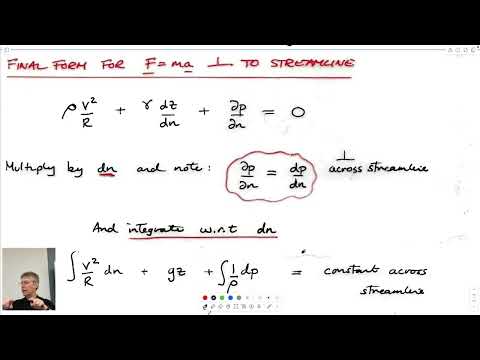
- For curved flow, constant speed still means changing velocity because the direction changes, producing centripetal acceleration V²/R.
- The normal momentum balance connects pressure variation to curvature, unlike the straight-streamline case where curvature effects vanish.
14:30
Comparing Pressure Across Flat and Curved Flow
- Elsworth writes the normal-flow relation at two locations and equates the pressure, elevation, and curvature contributions.
- For flat flow, the radius of curvature is effectively infinite, so the V²/R term disappears.
- The remaining pressure difference is hydrostatic: pressure rises with depth according to p = ρgH.
17:30
How Curvature Reduces Pressure Beneath a Flowing Surface
- For flow over a curved crest, the radius changes the normal pressure balance; assuming approximately constant velocity and radius over depth H gives a curvature correction proportional to ρV²H/R.
- At depth H, the pressure is less than the static-fluid value ρgH because part of the pressure balance supplies centripetal acceleration.
- The pressure reduction grows with larger V or smaller R; Elsworth compares the sensation to feeling lighter when a car crests a hill.
25:00
Pressure and Contact Conditions in a Curved Conduit
- For fluid following the upper curve of a conduit, atmospheric pressure is specified at the free surface while pressure at the curved boundary is the unknown.
- The normal pressure distribution includes both the hydrostatic elevation change and the curvature contribution associated with V²/R.
- Maintaining contact at the top requires the boundary pressure to remain at least atmospheric; the same curved-flow balance explains increased pressure in a trough.
30:00
The Loop-the-Loop Criterion and Force-Balance Interpretation
- Treating a small fluid parcel as a mass gives weight mg and required centripetal force mV²/R; equating them at the top yields the limiting condition V²/R = g.
- A speed above the threshold or a smaller loop radius increases centripetal acceleration and helps keep the parcel against the upper surface.
- Elsworth emphasizes that fluid mechanics can often be understood by treating water like a moving object acted on by gravity, inertia, and pressure forces.
34:00
Upcoming Bernoulli Lessons, Conservation Laws, and Exam Guidance
- Elsworth previews online lessons on Bernoulli applications and Pitot tubes, followed by control-volume conservation of mass, momentum, and energy.
- He distinguishes ideal Bernoulli flow, which assumes no energy loss, from real flows that dissipate energy through effects such as friction, heat, and sound.
- He tells students to consult the posted review for the three-part exam schedule, and explains that next week’s online lessons and quizzes remain available asynchronously through Sunday.
Summary, takeaways, and chapters were generated by AI from the video's transcript and may contain errors. The video belongs to its creator, Derek Elsworth.