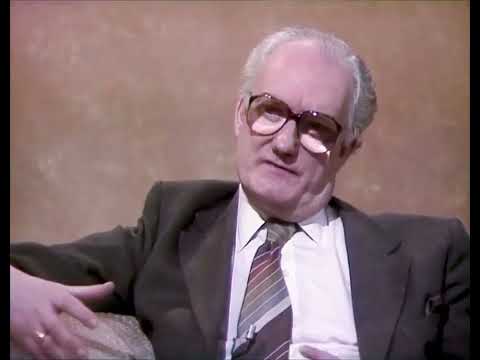
The Great Philosophers: Friedrich Nietzsche J P Stern & Bryan Magee 1987
 Watch on YouTube →
Overview
In a discussion with Bryan Magee, J. P. Stern explains Nietzsche’s project of revaluing Western values after the “death of God,” challenging Christian morality, secular moral rules, herd values, and the Socratic elevation of reason. Stern connects Nietzsche’s positive ideals, including the will to power, the Superman, eternal recurrence, and an aesthetic understanding of life, while stressing the difficulty of his aphoristic style and the limits of reading him as a precursor to fascism.
Key takeaways
- Nietzsche’s “death of God” argument is not merely a claim about atheism: it means Western values have lost their external foundation and must be re-examined and recreated.
- Nietzsche attacks pity-based morality when it makes the weak dependent on outside support, but Stern distinguishes that from compassion and generosity freely expressed by a strong person.
- The will to power includes self-mastery as well as self-assertion: Nietzsche’s ideal requires overcoming one’s own comfort and weakness, not simply dominating others.
- Eternal recurrence works as an ethical test: a person should live so that they could affirm the same life and choices infinitely many times.
- Nietzsche’s aphorisms blend metaphor with conceptual argument, so interpreting images such as the Superman as literal political doctrine risks distorting his ideas.
- Nietzsche influenced modern writers and was appropriated by fascist movements, but Stern notes that his ideals of inward discipline and generosity are incompatible with Nazi violence.
Chapters
0:00
Nietzsche’s Career and the Problem of the Death of God
- Friedrich Nietzsche was born in Saxony in 1844, became a classics professor in his mid-20s, then left academia for 16 years of largely isolated writing.
- His major works include The Birth of Tragedy, Human, All Too Human, The Gay Science, Beyond Good and Evil, and Thus Spoke Zarathustra.
- Bryan Magee frames Nietzsche’s central challenge: without belief in God or a transcendent world, people must create rather than inherit their values.
- Nietzsche collapsed into mental illness in January 1889 and died in 1900; a planned synthesis of his ideas remained unfinished.
5:00
Four Targets of Nietzsche’s Revaluation of Values
- J. P. Stern identifies four targets: Christian morality, secular moral systems, the herd values of the majority, and traditions associated with Socrates.
- Nietzsche attacks Christianity for elevating pity and support for the weak, but Stern distinguishes this from compassion arising freely from a strong person.
- He rejects universal rules such as Kant’s categorical imperative, arguing that moral standards should not be generalized across different individuals.
- In The Birth of Tragedy, Nietzsche idealizes pre-Socratic Greek tragedy and criticizes Socrates, Plato, and Euripides for displacing strength and beauty with rationalism.
10:00
Genealogy, Psychology, and the Limits of Knowledge
- Nietzsche investigates the origins of values, as in On the Genealogy of Morality, on the premise that a value’s origin reveals something about its character.
- Stern compares this psychological approach with Freud’s later work, while noting that Nietzsche emphasized the unconscious without creating Freud’s systematic model of the psyche.
- Nietzsche distrusted philosophical systems and argued that different people and civilizations may need different kinds of knowledge.
- His idea that knowledge can overwhelm or damage a civilization challenges the assumption that every form of knowledge should always be pursued.
15:20
Nietzsche’s Positive Ideal: Affirming Life and Becoming Oneself
- After criticizing inherited moral foundations, Nietzsche’s basic positive instruction is to become oneself fully and live adventurously.
- He treats truth, rationality, and moral standards as subordinate to life, and argues that some knowledge may need to be limited for human flourishing.
- Nietzsche’s admiration for exceptional figures such as Goethe and Napoleon reflects his ideal of individuals who create and embody their own standards.
- Stern notes a major unresolved difficulty: Nietzsche offers little workable guidance for social and political life, especially when individual self-assertion conflicts with others.
23:20
Will to Power and the Superman Beyond Nazi Caricature
- Nietzsche reverses Schopenhauer’s negative account of the will, presenting the will to power as a source of strength and cultural vitality.
- The will to power is not only outward domination: it also means disciplining oneself and overcoming comfort, weakness, and self-indulgence.
- The Superman represents a person capable of living Nietzsche’s affirmative values fully, not the racist “blonde beast” later associated with Nazi propaganda.
- Stern describes the ideal as a form of unrepressed selfhood, with generosity and freedom from ressentiment rather than grudging hostility toward others’ success.
28:35
Eternal Recurrence as a Test of Life-Affirmation
- Nietzsche’s eternal recurrence imagines every event and life repeating infinitely, including the same conversation and circumstances.
- Stern treats the idea chiefly as a moral experiment: would a person be willing to affirm their actions and choices again without end?
- The doctrine expresses Nietzsche’s demand to say yes to life, rather than functioning only as a literal cosmological theory.
- Nietzsche described himself in a letter as a quill being tried by a higher power, revealing tension between his ideal of self-assertion and his own sense of vulnerability.
34:20
Nietzsche’s Metaphorical Style and Aesthetic Justification of Life
- Stern says Nietzsche’s prose operates between metaphor and literal argument, combining abstract concepts with vivid images that can be misread if taken entirely literally.
- Nietzsche’s aphoristic style draws on writers including Montaigne, Pascal, and La Rochefoucauld.
- In The Birth of Tragedy, Nietzsche argues that human existence and the world are justified aesthetically, through the shaping of suffering and impermanence into tragedy.
- Ancient Greek tragedy faces life’s transience and dependence on forces beyond human control by making them part of a powerful artistic drama.
39:00
Nietzsche’s Literary Influence and Complicated Relation to Fascism
- W. B. Yeats’s poetry changed after he read Nietzsche around 1902, moving toward what Yeats called a poetry of “blood and mire.”
- Stern traces Nietzschean influence in D. H. Lawrence, as well as continental writers including Luigi Pirandello, Thomas Mann, André Malraux, and August Strindberg.
- Stern accepts that Nietzsche entered some fascist and National Socialist intellectual circles; Benito Mussolini read him, while Adolf Hitler’s familiarity appears to have been largely with well-known phrases.
- Nietzsche’s emphasis on self-control, inner struggle, and generosity conflicts with the murderous ideologies of the Third Reich, and Stern cautions against treating his work as a political panacea.
Summary, takeaways, and chapters were generated by AI from the video's transcript and may contain errors. The video belongs to its creator, Bitesize Philosophy.