The Ambassadors: Great Art Explained
 Watch on YouTube →
Overview
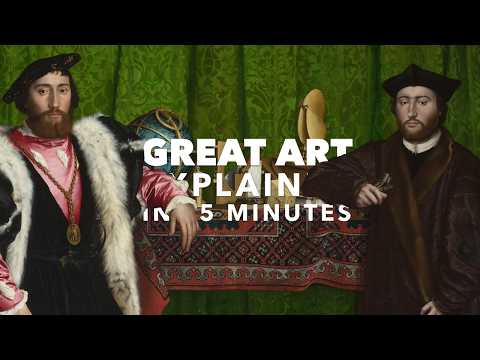
Hans Holbein the Younger’s 1533 painting The Ambassadors portrays French diplomats Jean de Dinteville and Georges de Selve amid Henry VIII’s break with Rome and Europe’s Reformation-era upheaval. Its scientific instruments, broken musical symbols, anamorphic skull, and nearly hidden crucifix turn a diplomatic portrait into a reflection on knowledge, political and religious division, mortality, and faith.
Key takeaways
- Holbein uses portrait objects as intellectual and political signs: the instruments and books in The Ambassadors communicate more than the sitters’ appearance.
- The painting’s upper shelf suggests confidence in measuring the heavens, while the broken lute, missing flute, open book on division, and Luther hymns evoke political and religious disorder.
- The possible date of 11 April 1533 connects the shepherd’s dial to Anne Boleyn’s recognition as queen and to Good Friday, joining Tudor politics with Christian observance.
- The anamorphic skull requires a change in viewing angle, turning perspective into a practical encounter with the memento mori that Dinteville also wore as a tiny badge.
- Holbein’s hidden crucifix complicates the skull’s message: death is certain, but the painting leaves room for Christian hope in resurrection.
Chapters
- Born in Augsburg in 1497 to painter Hans Holbein the Elder, Hans Holbein the Younger developed the meticulous realism of the Northern Renaissance.
- Holbein’s 1523 portraits of Erasmus helped the scholar promote his image and introduced Holbein’s work to influential English patrons.
- After painting Sir Thomas More and other English figures in 1526, Holbein returned to England in 1532, where his foreign status let him move among rival court factions.
- Erasmus’s humanist view of portraiture shaped Holbein’s use of books, globes, and instruments to convey a sitter’s intellect and ambitions.
- Henry VIII’s effort to annul his marriage to Catherine of Aragon stalled after Rome was sacked in 1527 and Pope Clement VII came under pressure from Charles V.
- French ambassador Jean de Dinteville was in England to gather intelligence and strengthen ties with Henry VIII while France balanced relations with Rome and the Habsburg Empire.
- Georges de Selve, Bishop of Lavaur and a diplomat seeking religious reconciliation, joined Dinteville in London during a decisive few weeks in 1533.
- The men sat for Holbein as Anne Boleyn was recognized as queen, but the painting’s precise commission remains uncertain; Dinteville probably owned it.
- The nearly life-size oil painting, made on ten oak boards, positions the two men around a two-tiered table beneath a green damask curtain.
- Dinteville represents the active life of politics and public service, wearing costly satin and lynx fur, the Order of Saint Michael, and a dagger marked with his age, 29.
- De Selve represents contemplation and scholarship; the book beneath his arm records that he was 24, while his cloak’s sable trim signals his status.
- The men’s near-mirrored poses evoke the Renaissance ideal of friendship as a second self, an idea associated with Aristotle and Erasmus.
- The upper shelf’s celestial globe, sundials, and torquetum express Renaissance confidence that observation and mathematics could explain the heavens.
- A shepherd’s dial may indicate 11 April 1533, the day Anne Boleyn was formally acknowledged as queen and Good Friday fell.
- The lower shelf includes an upside-down terrestrial globe, a broken-string lute, a missing flute, and an arithmetic book opened to division.
- A German hymn book contains works by Martin Luther, an especially charged detail in a portrait of Catholic diplomats confronting the possibility of permanent Christian division.
- Holbein’s distorted skull is an anamorphic image: it becomes recognizable when viewed from an oblique angle and functions as a memento mori.
- The skull contrasts with the painting’s globes, books, instruments, and wealth, none of which can measure how much life Dinteville or de Selve has left.
- A small crucifix partly hidden at the upper left balances the skull’s reminder of death with the Christian promise of resurrection.
- Holbein’s image endures as both a portrait and a record of a world in transition; the closing segment also promotes James Payne’s National Gallery audio tour on VoiceMap.
Transcript excerpt
0:00 Hello, my name is James [music] Payne and I'm very excited to launch a self-guided audio tour of the National Gallery in London. Details at the end of this video. In 1533, all eyes were on London. Henry VIII was about to break with [music] the Catholic Church, marry Anne Boleyn, and change the course of English history forever. Spies gathered intelligence, diplomats traded secrets, and alliances shifted by the day. At the heart of this political storm, two French ambassadors were immortalized by Hans Holbein in what has become one of the most mysterious paintings of the Renaissance. At first glance, it is simply a portrait of two wealthy diplomats. Look closer and it reveals hidden symbols, coded messages,
0:49 and unsettling clues about power, religion, knowledge, and death. But who were these men? Why was the painting commissioned? And could this extraordinary image have done more than record history? Could it have helped shape it? Behind it all stood Hans Holbein the Younger, an ambitious German immigrant whose outsider's eye transformed Tudor England into some of the most unforgettable images in Western art. The great irony is that many of the pictures we think of as defining English history were painted by someone who wasn't English at all. The Ambassadors isn't just one of the greatest portraits ever painted. It may also be one of the most politically dangerous. Hans Holbein the Younger was born in
1:55 Augsburg in southern Germany during the winter of 1497 into a family of painters. His father, Hans Holbein the Elder, ran one of the city's most respected workshops, producing religious altarpieces for churches and wealthy patrons across the region. Hans and his older brother, Ambrosius, were part of the family studio. The workshop was busy and well-regarded, but despite its success, the Holbein family
This is the start of the transcript. Save this video free for the whole transcript, searchable and time-coded.
Related notes
Summary, takeaways, and chapters were generated by AI from the video's transcript and may contain errors. The video belongs to its creator, Great Art Explained.