The Brady 6: Journey of the Legend NO ONE Wanted!
 Watch on YouTube →
Overview
Tom Brady’s rise from a lightly recruited Michigan backup to the 199th pick in the 2000 NFL Draft shows how college competition, preparation, resilience, and opportunity can outweigh scouting measurements. The documentary follows the six quarterbacks drafted before Brady, contrasts their varied careers with his New England success, and traces how he turned a fourth-string rookie role into three Super Bowl titles and a unanimous 2010 MVP award.
Key takeaways
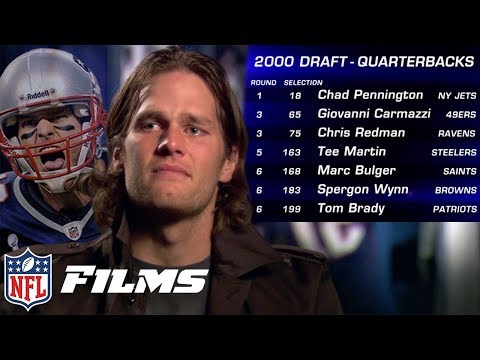
- Brady was selected 199th in the 2000 NFL Draft after six quarterbacks, including first-round pick Chad Pennington, because evaluators questioned his size, speed, mobility, and arm strength.
- At Michigan, Brady overcame competition from Brian Griese and highly touted Drew Henson, then solidified his starting role with late-game performances against Michigan State, Penn State, and Alabama.
- Brady entered the 2001 season behind Drew Bledsoe, but Bledsoe’s injury gave him the starting job, which Brady kept while leading New England to its first Super Bowl title.
- The six quarterbacks drafted before Brady had sharply different outcomes: Pennington and Marc Bulger became successful starters, while Tee Martin, Giovanni Carmazzi, Spergon Wynn, and Chris Redman had more limited NFL careers.
- Brady’s success was not predicted even by the Patriots, who waited until the sixth round to draft him; his preparation, resilience, and performance under pressure proved more important than measurable athletic traits.
- In 2007 Brady threw 50 touchdown passes and led New England to a 16-0 regular season, and in 2010 he became the first unanimous NFL MVP.
Chapters
0:00
Tom Brady’s Unlikely Path from High School Backup to Michigan Starter
- Brady did not play football until high school and initially backed up a team that went 0-8 without scoring a touchdown.
- At Michigan, Brady joined a crowded quarterback depth chart that included Brian Griese and Scott Dreisbach.
- After losing a close competition to senior Griese, Brady considered transferring, then told coach Lloyd Carr he would stay and prove himself.
5:00
Drew Henson’s Challenge and Brady’s Michigan Comebacks
- Highly recruited sophomore Drew Henson had superior athletic measurements, forcing Carr to split playing time with Brady during Brady’s senior season.
- After Michigan fell 17 points behind Michigan State, Brady threw for 241 yards in the final 18 minutes; his performance helped settle the quarterback competition.
- Brady led late rallies against Penn State and Alabama, including Michigan’s comeback from a 14-0 deficit in the Orange Bowl.
10:00
Scouting Doubts, Pick 199, and Giovanni Carmazzi’s Brief NFL Career
- Brady’s draft report cited his thin build, limited mobility, modest arm strength, and lack of a tight spiral; one evaluator ranked him 576th among quarterbacks assessed over 32 years.
- The Patriots selected Brady 199th overall in the sixth round after choosing five players earlier, while already having Drew Bledsoe and several quarterbacks on the roster.
- San Francisco drafted Giovanni Carmazzi ahead of Brady, valuing his speed, strength, and athletic ability, but Carmazzi never played in a regular-season game and was released after two seasons.
- Robert Kraft recalled Brady introducing himself as the organization’s best decision, despite being a sixth-round pick.
16:00
Spergon Wynn, Tee Martin, and the Cost of a Difficult First Opportunity
- Cleveland selected Spergon Wynn, whose senior-year completion rate was 47.8 percent, despite Brady completing more than 62 percent of his passes at Michigan.
- Wynn expected to sit behind Tim Couch and Ty Detmer, then entered against the eventual champion Baltimore Ravens and lost 44-7.
- Tee Martin had won a national championship at Tennessee but appeared in only three NFL games and completed six passes.
- As a Patriots rookie, Brady was the fourth quarterback and occupied a roster spot despite not playing.
22:00
Brady Replaces Drew Bledsoe and Wins Super Bowl XXXVI
- Brady believed he could beat Pro Bowl quarterback Drew Bledsoe and had outperformed backup Damon Huard during the 2001 preseason.
- After Bledsoe was injured by Mo Lewis, Brady took over and led New England to the AFC East title.
- The controversial Tuck Rule kept the Patriots alive against Oakland, and Brady then drove New England into position for the winning field goal against the Rams in Super Bowl XXXVI.
- Brady’s first championship established the late-game composure that became central to his reputation as a comeback quarterback.
28:00
Chad Pennington’s Injuries and Marc Bulger’s Pro Bowl Peak
- First-round pick Chad Pennington led the Jets to a division title in 2002, but Brady won seven of their next eight meetings.
- Two shoulder surgeries within eight months damaged Pennington’s throwing arm and threatened his career.
- Marc Bulger became a starter after Kurt Warner was injured, reached 1,000 completions faster than any quarterback at the time, and earned two Pro Bowl selections.
- Bulger’s performance depended heavily on the supporting cast around him, while Brady led New England deep into the 2006 playoffs with a largely rebuilt receiving group.
34:00
The Henson Counterfactual and Brady’s Record-Setting 2007 Season
- Drew Henson’s athletic promise and baseball career kept him in competition with Brady at Michigan, but he left football for the Yankees before returning to the NFL with Dallas.
- Henson’s first Cowboys start came on Thanksgiving in 2004; after a second-quarter interception returned for a touchdown, Bill Parcells replaced him.
- Brady’s disciplined practice habits and preparation helped him become a three-time champion while Henson’s NFL opportunity quickly closed.
- In 2007 Brady threw a then-record 50 touchdown passes and led the Patriots to a 16-0 regular season before losing Super Bowl XLII.
40:00
The Draft-Day Wait and the Other Five Quarterbacks’ Paths
- As quarterbacks were selected through the fourth, fifth, and sixth rounds, Brady left the house with a baseball bat to escape the mounting tension.
- The Patriots finally called with the 199th pick, prompting relief for Brady and his family after they feared he might have to become an insurance salesman.
- By 2010, Marc Bulger was a Ravens backup, Chris Redman was returning as an Atlanta backup, and Chad Pennington was recovering from another shoulder surgery.
- Tee Martin had become a college coach, Spergon Wynn worked as an energy trader, and Carmazzi lived on a farm and described himself as a yoga-practicing farmer.
44:00
A Unanimous MVP and the Work Behind Brady’s Longevity
- Brady became the first unanimous NFL MVP in 2010, a decade after being selected 199th in the 2000 draft.
- The documentary argues that evaluators missed Brady’s resilience, competitive drive, and capacity to learn, qualities not captured by combine times or arm-strength tests.
- Brady said he still wanted to earn his place every day, using the feeling that teams might not want him as motivation.
- His career is presented as a product not of a single lucky break, but of embracing struggle and continuing to prepare after winning championships.
Summary, takeaways, and chapters were generated by AI from the video's transcript and may contain errors. The video belongs to its creator, NFL Films.