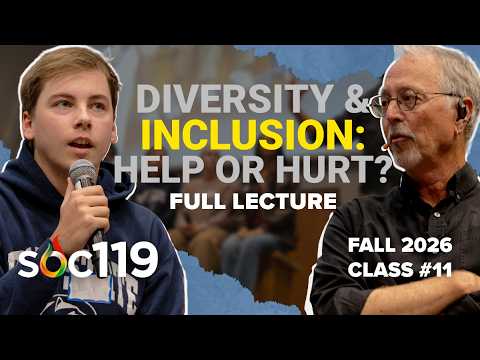
How Much DEI Do You Want? | 26FA Class #11 Full Lecture
 Watch on YouTube →
Overview
SOC 119’s class, led by Sam Richards, examines when diversity, equity, and inclusion (DEI) expands opportunity and perspective—and when quotas, tokenism, or performative marketing can create new unfairness. Students including Devin, Jade, Raj, and Adese debate meritocracy, belonging, workplace value, and perceptions of qualification; a survey of 1,500 Americans found 25% supported limiting campus DEI activities, 36% opposed limits, and 39% were neutral.
Key takeaways
- DEI can be experienced as tokenism when an organization displays demographic variety in publicity but does not provide meaningful inclusion, support, or advancement.
- Students argue that merit and diversity are not necessarily opposites: a candidate can be qualified while also bringing a perspective relevant to colleagues or clients.
- Perceptions of DEI can undermine beneficiaries’ credibility, because observers may question whether an achievement reflects skill or demographic preference.
- The class survey of 1,500 Americans found substantial uncertainty about campus DEI: 25% supported limits, 36% opposed them, and 39% were neutral.
- Authentic representation matters: students condemned Stanford’s reported AI-edited marketing image for manufacturing demographic diversity instead of showing actual people.
- Bias can arise before qualifications are compared; Richards cites research on applicants receiving different responses depending on whether their names are perceived as belonging to different groups.
Chapters
0:00
Penn State Students Define DEI and Its Public Reputation
- Students Raj, Devin, Jade, and Adese introduce their backgrounds and describe DEI as diversity, equity, and inclusion.
- Students note that DEI is often portrayed as unfairly favoring unqualified applicants or hiring people to make an organization look inclusive.
- Adese frames DEI more positively as giving people equal opportunity and reducing discrimination across institutions.
5:00
Meritocracy, Hiring Advantages, and the Case for Multiple Perspectives
- Students describe a common criticism: DEI may override merit by giving minority applicants an advantage over more-qualified candidates.
- A hypothetical competition for a teaching-assistant role raises the concern that selecting someone to fill a demographic gap could feel like tokenism.
- Jade argues that varied lived experiences can improve decisions, even in a numbers-focused workplace such as a four-person accounting firm.
10:00
Lived Experience, Client Trust, and Who Adds a Distinct Viewpoint
- Jade suggests that different backgrounds can help colleagues notice issues others miss, such as changes affecting same-sex couples in tax rules.
- Adese describes Nigerian ancestry, growing up in predominantly white parts of Arizona, and attending high school in El Paso as sources of varied experience.
- The discussion distinguishes learning about another culture from how people are perceived and treated when they enter a public-facing workplace.
15:00
When Demographic Hiring Becomes Tokenism
- Raj says choosing him mainly as a “brown guy” to fill a perceived gap could make him feel tokenized rather than valued for his qualifications.
- Students criticize brochure-style diversity when organizations display a mix of identities without doing the work to include people meaningfully.
- Jade argues that DEI concerns the hiring process—including who gets interviewed—not only the person ultimately selected.
20:00
Learning Across Difference at Penn State and in the Workplace
- Devin says a campus can offer access to different cultures through student organizations, conversations, and experiences such as trying halal food.
- Sam Richards pushes back on the idea that learning ends after graduation, arguing that global work and client relationships require ongoing learning.
- Devin sees cultural knowledge as especially relevant to global companies, while questioning whether every small, U.S.-focused business needs the same range.
25:00
DEI, Belonging, and Anxiety About Being Judged as Unqualified
- Students say they have not personally felt DEI was forced on them, but discuss fears that beneficiaries may be seen as receiving a “free handout.”
- Adese distinguishes getting into an organization from belonging and advancing there, pointing to the need for support after hiring.
- When asked about doubts tied to DEI, Adese says she can demonstrate her skills but cannot control other people’s assumptions.
30:00
Merit, Nepotism, and Whether Campus Inclusion Excludes White Men
- Devin acknowledges concern that being a white man could affect opportunity, while also recognizing that diversity can improve learning and collaboration.
- Jade says selection should depend on the situation: a candidate’s perspective may matter for a particular client or role, rather than serving as a general bonus.
- Richards contrasts the ideal of meritocracy with the practical importance of connections, such as meeting Penn State professors, advisors, and alumni to find internships.
35:00
Campus DEI Survey: 25% Support Limits and 39% Are Neutral
- A survey of 1,500 Americans found 25% supported legislation limiting campus DEI activities, 36% opposed limits, and 39% were neutral.
- Devin suggests neutrality may reflect uncertainty because “DEI” covers many approaches, from welcoming inclusion to policies perceived as forced.
- Students discuss how performative programs can undermine their purpose when organizations promote diversity for appearance rather than genuine inclusion.
40:00
Group Differences in DEI Attitudes and Concerns About Qualification
- Students predict that support for limiting DEI will differ by group; Devin reasons that some Black applicants may worry their achievements will be attributed to race rather than merit.
- The survey discussion indicates that BIPOC respondents were more supportive of limits than students initially expected, while white respondents and LGBTQ respondents were around 20% in the presented results.
- Raj notes that DEI can affect the people it is intended to help if their credentials are routinely questioned.
45:00
Stanford’s AI-Edited Marketing Image and Authentic Representation
- A student describes a Stanford marketing image that used AI editing to alter people’s race, gender, and body type compared with the original photograph.
- The class criticizes fabricated representation: if Stanford wants to show campus diversity, it should use genuine images of its diverse community.
- A student asks about affirmative action after the Supreme Court’s 2023 decision restricting race-conscious admissions; Richards notes that the legal ruling does not eliminate all possible discrimination.
50:00
Discrimination and the Risk of DEI Recreating the Problem It Addresses
- A student uses the example of a qualified Black, nonbinary Nigerian pilot to question whether hiring can be a simple contest of credentials when bias may affect selection.
- Devin says DEI arose in response to discrimination but can itself become discriminatory if taken to an extreme.
- Students argue that forced or cosmetic initiatives can provoke resentment and leave minority employees feeling represented only for appearances.
55:00
Reparations Class, Wealth Gaps, and How Students Read an Instructor’s Intent
- Richards asks students to connect a prior class on reparations to DEI and whether presenting specific perspectives amounts to imposing them.
- Jade says the class’s multiple participants helped show that people who experience discrimination can still hold different views.
- Devin interprets discussion of the average wealth gap between white and Black households as a possible rationale for DEI, while Richards clarifies that this was not his stated purpose.
1:00:00
Equality, Equity, Hiring Bias, and the Impact of Applicants’ Names
- Richards notes that his course has also covered poverty among white Americans, discrimination against Irish and Italian Americans, and perceptions of white men.
- Raj warns that equity programs can spotlight beneficiaries in ways that amplify mistakes and reinforce stereotypes.
- Jade describes evidence that applicants’ names can affect responses, while Richards gives Adese’s name as an example of how perceived identity may influence hiring.
- The closing argument connects DEI to addressing name-based discrimination without assuming that any single policy can resolve every fairness trade-off.
Summary, takeaways, and chapters were generated by AI from the video's transcript and may contain errors. The video belongs to its creator, SOC 119.