SN2 Reaction Mechanism Explained | Transition State, Walden Inversion & Factors Affecting SN2
 Watch on YouTube →
Overview
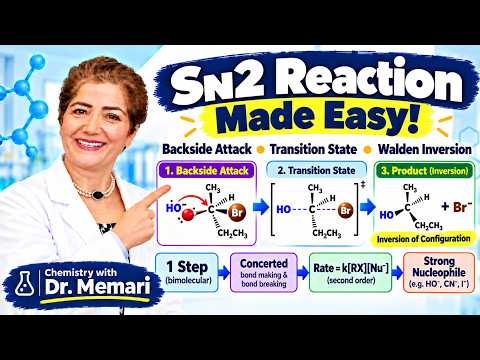
The lesson explains the SN2 mechanism as a concerted, one-step nucleophilic substitution: a nucleophile attacks the carbon from the side opposite the leaving group while the carbon-leaving-group bond breaks, creating a transition state but no intermediate. It connects the bimolecular rate law, k[Nu][RX], to the reaction’s dependence on nucleophile strength, leaving-group ability, and steric hindrance, and describes the resulting Walden inversion at a chiral center.
Key takeaways
- SN2 is concerted: the nucleophile-carbon bond forms while the carbon-leaving-group bond breaks, producing a transition state rather than a discrete intermediate.
- The SN2 rate law, k[Nu][RX], makes reaction rate dependent on both nucleophile concentration and alkyl halide concentration.
- Steric hindrance strongly limits SN2: methyl substrates react fastest, followed by primary and secondary substrates, while tertiary substrates are generally unreactive by this pathway.
- Backside attack causes Walden inversion at a chiral center, reversing its spatial arrangement; the resulting R or S label can depend on priority assignments.
- A better leaving group speeds SN2: the halide trend is I⁻ > Br⁻ > Cl⁻ > F⁻, with the lesson’s comparison reporting relative rates of 30,000, 10,000, 200, and 1.
- Anionic nucleophiles such as OH⁻ and CH₃O⁻ are stronger than neutral H₂O and CH₃OH, generally making them more effective in SN2 reactions.
Chapters
- Hydroxide acts as a nucleophile because it is electron-rich and attacks the electron-poor carbon bonded to bromine.
- Carbon cannot exceed four bonds, so the C–Br bond breaks as the C–OH bond forms.
- Both the nucleophile and alkyl halide participate in one transition state; the mechanism has no intermediate.
- The rate law is k[OH⁻][alkyl halide], consistent with both reactants affecting the reaction rate.
- The nucleophile attacks from the side opposite the leaving group, rather than approaching from the same side.
- Steric crowding around the carbon bearing the halide obstructs nucleophilic attack and slows the reaction.
- The substrate reactivity order is methyl > primary > secondary; tertiary alkyl halides are too hindered for ordinary SN2 reactions.
- The lesson identifies strong nucleophiles, good leaving groups, and low substrate hindrance as the central rate factors.
- SN2 means bimolecular nucleophilic substitution, referring to the two reactants involved in the rate-determining step.
- A chiral carbon undergoes inversion because backside attack places the incoming nucleophile opposite the departing group.
- This stereochemical change is called Walden inversion, also compared to an umbrella turning inside out.
- The spatial configuration inverts; an R-to-S or S-to-R label change depends on the substituent priority order.
- The halide leaving-group order is I⁻ > Br⁻ > Cl⁻ > F⁻, reflecting greater stability of larger anions after departure.
- Reported relative rates for the halide comparison are 30,000 for iodide, 10,000 for bromide, 200 for chloride, and 1 for fluoride.
- Anionic nucleophiles such as hydroxide and methoxide are stronger than their neutral counterparts, water and methanol.
- Greater nucleophile strength and better leaving-group ability increase SN2 rates, provided the substrate allows backside access.
Transcript excerpt
0:00 is. What is OH by nature? How would you classify it? Is it electrophile or nucleophile? Nucleophile. Why is it nucleophile? Because it has is electron rich, it has negative charge, it's looking for nucleus, and why nucleus? Because nucleus has positive charge. So, that's kind of symbolic name for it, right? Nucleophile is looking for some a center with positive charge. Uh because we all know that when there is chemical reaction, it open only happens at the surface of the the atom, not the nucleus of the atom. But, that's a symbolic name for it, nucleophile. Where would the attack start? Where would it end? And we usually draw an arrow, right? Where should I start with? Where should I start with? Go into the carbon. So, I need to start from the electron rich to electron poor. This carbon
0:50 is electron poor. That is electron rich because it has a negative charge. Okay? And this arrow, it shows that a new bond is going to form. If this new bond forms, can carbon tolerate a new bond? Why not? Already has four bonds. And carbon is in level two of the periodic table, cannot have more than four bonds, cannot handle more than eight electrons because it has only S and P uh subshell. S takes two, P takes six electrons, and that's it, no more than four bonds. Carbon is tetravalent, cannot have more than four bonds. That's just make sure you don't draw any carbon with five bonds or more than eight electrons, So, what should happen? The weakest bond has to break. Or in this case, leaving group has to leave. Halides, they are acting as good leaving group.
1:43 When it's attached to carbon, they can leave easily. Why they can leave easily? Because
This is the start of the transcript. Save this video free for the whole transcript, searchable and time-coded.
Related notes
Summary, takeaways, and chapters were generated by AI from the video's transcript and may contain errors. The video belongs to its creator, Chemistry with Dr. Memari.