Bromination of Propane: Why Bromination Gives 97% Secondary Product | Selectivity&Transition States
 Watch on YouTube →
Overview
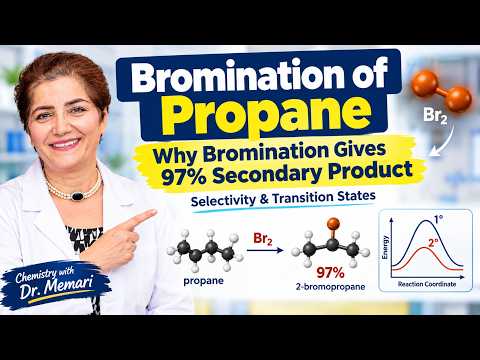
Propane bromination produces about 97% 2-bromopropane and 3% 1-bromopropane because bromine preferentially abstracts a hydrogen that forms the more stable secondary radical. The explanation contrasts endothermic, selective bromination with exothermic, less selective chlorination: under the Hammond postulate, bromination has a product-like transition state that reflects radical stability more strongly.
Key takeaways
- Monobromination of propane yields approximately 97% 2-bromopropane and 3% 1-bromopropane, favoring substitution at a secondary carbon.
- Bromination is endothermic and highly selective, whereas chlorination is exothermic and more reactive but less selective.
- The late, product-like transition state in endothermic bromination makes radical stability especially influential in determining which hydrogen is abstracted.
- The secondary propyl radical is more stable than the primary propyl radical, supporting formation of 2-bromopropane as the major product.
- For an alkane with tertiary hydrogens, bromination generally favors abstraction that forms a tertiary radical because it is more stable.
Chapters
- Replacing one propane hydrogen with bromine can form 1-bromopropane, CH3CH2CH2Br, or 2-bromopropane, CH3CHBrCH3.
- Unlike methane and ethane monobromination, propane provides distinct primary and secondary hydrogen sites, producing two constitutional isomers.
- A simple count of available hydrogens would not predict the observed product ratio.
- The stated product distribution is about 97% 2-bromopropane from secondary radical formation and 3% 1-bromopropane from primary radical formation.
- Bromination is endothermic and less reactive than chlorination, so it is more selective during hydrogen abstraction.
- The preference for the more stable secondary propyl radical explains why the secondary product dominates.
- The Hammond postulate links bromination's endothermic hydrogen-abstraction step to a late, product-like transition state.
- Because that transition state resembles the radical products, the relative stability of secondary and primary radicals strongly affects the reaction rate.
- Exothermic chlorination has an earlier, reactant-like transition state and is less sensitive to radical stability, giving a less extreme product preference.
- When a tertiary hydrogen is available, bromination is predicted to favor abstraction that forms the more stable tertiary radical.
Transcript excerpt
0:00 uh bromination versus the chlorination. What is bromination? Can someone tell me what would be bromination confusion from alkane is going to be replaced by >> bromine. So what are your reactants? If you start with the first member of the alkane is going to be CH4 plus Br2 and it's going to give us CH3 Br one product. So we cannot compare much right? If I start with ethil with monobroination I also get one product and I can't compare much but I can compare this with the chlorination. Bromination is endothermic reaction. Chlorination is exothermic because chlorine is more reactive than broine. Go to propane plus the R2. How many react how many products will I get? How many products for bonation?
0:51 >> Two. two. What are the products? Can someone tell me? >> CH3 >> CH3 >> CH2 >> Br >> CH2 Br and >> CH3 >> CH3 >> CH >> CH um >> Br and CH3 Do you remember the 40% 60%. What do you think will happen here? >> The first one would be 40 and this one would be >> 60. Yes. Would you be surprised if I say forget about 60 this is 97%. What? >> 97% versus this 3% only from primary 97% is going to be secondary. >> Why
1:38 isn't this giving me a secondary free radical and this is a primary free radical? Yes, for chlorination I had the same situation. But how come is 97% here? There must be another factor. What is the other factor? The other factor is that bromine is very selective. very selective and this is u endothermic type reaction endothermic type reaction you have to spend the energy the more endothermic probably more selective right when you want to buy like a dress you go and buy
This is the start of the transcript. Save this video free for the whole transcript, searchable and time-coded.
Related notes
Summary, takeaways, and chapters were generated by AI from the video's transcript and may contain errors. The video belongs to its creator, Chemistry with Dr. Memari.