Alkane Conformations & Newman Projections: Staggered, Eclipsed, Gauche & Anti | Organic Chemistry
 Watch on YouTube →
Overview
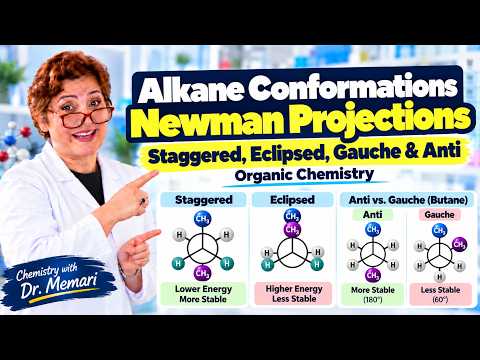
Alkane conformations arise from rotation around carbon-carbon single bonds, with steric crowding making eclipsed arrangements higher in energy than staggered ones. Newman projections show the relative positions of groups on two selected carbons; applying them to butane distinguishes totally eclipsed, eclipsed, gauche, and anti conformations, with anti lowest in energy and totally eclipsed highest.
Key takeaways
- A Newman projection looks down a selected carbon-carbon bond, using a dot for the front carbon and a circle for the rear carbon to show substituent alignment.
- Ethane and propane alternate between staggered energy minima and eclipsed energy maxima as their carbon-carbon single bonds rotate.
- Propane’s eclipsed conformations have more steric crowding than ethane’s because a methyl group interacts with neighboring hydrogens.
- For butane viewed along C2-C3, the totally eclipsed conformation places the two methyl groups directly over one another and is the highest-energy arrangement.
- Butane’s anti conformation places its methyl groups 180 degrees apart, minimizing their steric interaction and giving the lowest energy; gauche is staggered but has the methyl groups closer together.
Chapters
- Methane’s carbon is sp3-hybridized and tetrahedral, setting the geometric pattern for simple alkanes.
- Rotation around ethane’s carbon-carbon single bond interconverts conformations, but steric interactions make some arrangements more stable than others.
- In an eclipsed conformation, the front and rear carbon’s C-H bonds overlap in a view down the C-C bond; in a staggered conformation, those bonds are offset.
- A Newman projection represents the front carbon as a central point and the rear carbon as a circle, with attached groups drawn to show their relative positions.
- For propane, choose two adjacent carbons and look directly down their bond to classify the conformation as eclipsed or staggered.
- Propane’s eclipsed arrangement adds methyl-hydrogen crowding to the hydrogen-hydrogen interactions present in ethane.
- The rotational energy profile alternates between higher-energy eclipsed positions and lower-energy staggered positions as the bond rotates.
- The energy difference between eclipsed and staggered forms is greater for propane than for ethane because a methyl group occupies more space than hydrogen.
- Analyze butane by looking down the bond between its central carbons, C2 and C3, where each carbon bears a methyl group.
- In the totally eclipsed conformation, the two methyl groups overlap, creating the greatest steric repulsion and the highest energy.
- In an eclipsed conformation, each methyl group overlaps a hydrogen rather than the other methyl group, making it less unfavorable than the totally eclipsed form.
- Staggered butane includes gauche, with the methyl groups relatively close, and anti, with the methyl groups opposite one another and farthest apart.
- The butane Newman projection distinguishes total methyl-methyl overlap from methyl-hydrogen overlap in eclipsed arrangements.
- A staggered projection with one CH3 group above and the other below represents anti butane, the lowest-energy conformation.
- The energy ordering is anti lowest, followed by gauche and eclipsed conformations, with totally eclipsed highest.
- The same conformational analysis applies to longer open-chain alkanes by selecting a carbon-carbon bond and viewing along it.
Transcript excerpt
0:01 Okay, we looked at the molecular formula, structural formula, condensed structural formula, line angle formula, and now we are going to look at the 3D structure for some simple alkan molecules. What's the first member of the alkan family? First member, >> methane. >> One carbon and four hydrogen. What's hybridization for uh carbon in methane >> sp3 and why is sp3 >> because it's all single bond we have four electron group and four electron group it mean sp3 and the shape of the molecule is tetra hedra this is a
0:52 tetrahedral we only have one molecule of methane it doesn't matter how I Like if I rotate anywhere still is tetrahedral. Second member of the alkan family. What's the second member? >> Ethane. >> How many carbon and how many hydrogens? >> Two carbon. And that is going to make one carbonarbon bond. Okay. Now we have one carbonarbon bond for ethane. This is the molecule of ethine. 3D structure for it rotation around carbon carbon single bond it's free of energy the energy needed is not zero but it's
1:43 provided as on temperature so we can rotate still we have a do you remember the vs >> electron pair repulsion Bless shell electron pair repulsion that determines the shape of the molecule. Electron repulsion is a big deal for organic for the inorganic molecules because they repel each other. When it comes to organic molecule steric hindrance it's a big deal. What's ster hindrance is that the groups they don't want to be bothered or too close to another group. So we're not dealing with electrons. We
2:31 are dealing with groups. And the smallest group could be hydrogen attached to carbon. Then we could have metal group, ethyl group or larger group. When we have this bond between carbon carbon, it can
This is the start of the transcript. Save this video free for the whole transcript, searchable and time-coded.
Related notes
Summary, takeaways, and chapters were generated by AI from the video's transcript and may contain errors. The video belongs to its creator, Chemistry with Dr. Memari.