Chlorination of Propane: Major & Minor Products Explained | Organic Chemistry
 Watch on YouTube →
Overview
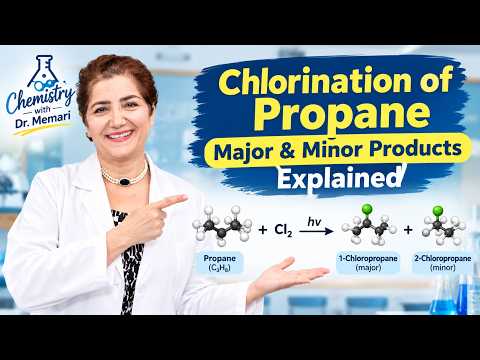
Propane monochlorination produces 1-chloropropane and 2-chloropropane, with the secondary-radical pathway yielding about 60% 2-chloropropane despite there being only two secondary hydrogens versus six primary hydrogens. The lesson connects this product distribution to radical stability and activation energy, explaining that more stable secondary and tertiary radicals form more readily than primary and methyl radicals.
Key takeaways
- Propane monochlorination produces roughly 60% 2-chloropropane and 40% 1-chloropropane, even though propane has only two secondary hydrogens and six primary hydrogens.
- Per hydrogen, the secondary site gives about 30% product compared with about 6.7% per primary hydrogen, making secondary hydrogen abstraction approximately 4.5 times as productive under the stated conditions.
- The radical stability trend is tertiary greater than secondary greater than primary greater than methyl, and greater stability corresponds to easier radical formation.
- For a multistep reaction, the slow step determines the overall rate; a smaller activation-energy barrier generally means a faster reaction.
- Alkyl groups stabilize electron-deficient radical centers by donating electron density, which helps account for the preference for substitution at propane's secondary carbon.
Chapters
- A reaction pathway with a smaller activation energy proceeds faster because more molecules can reach the transition state.
- For a two-step mechanism, the slower first step controls the overall rate when it is the rate-determining step.
- The rate law for an elementary step reflects the reactants involved in that step; doubling a reactant with first-order dependence doubles the rate.
- Monochlorination of ethane gives one constitutional product because replacing a hydrogen on either carbon produces the same chloroethane.
- Propane has two distinct hydrogen environments, producing 1-chloropropane from six primary hydrogens and 2-chloropropane from two secondary hydrogens.
- The measured product distribution is about 40% 1-chloropropane and 60% 2-chloropropane, so the secondary site is more reactive per hydrogen.
- Dividing by the number of available hydrogens gives about 6.7% product per primary hydrogen versus 30% per secondary hydrogen.
- Hydrogen abstraction at propane's secondary carbon forms a secondary radical, which is more stable and forms faster than the primary radical leading to 1-chloropropane.
- The stated radical stability order is tertiary greater than secondary greater than primary greater than methyl.
- More stable radical intermediates require less energy to form, helping explain why their corresponding substitution products are favored.
- Alkyl groups stabilize an electron-deficient radical center by donating electron density; a tertiary radical has three neighboring alkyl groups, compared with two for secondary and one for primary.
Transcript excerpt
0:00 G EA and what about this line here? >> Activation >> also activation energy. What's the difference in labeling? That would be activation energy one. This would be activation energy two. Activation energy for the first step of the reaction. Activation energy for second step of the reaction. So that's the basically the difference between the two step and the one step. Some similarity. This reaction is exothermic or endothermic. Exothermic products they have less energy than the react we have. Okay. What limits the rate of this reaction A or B? What is going to tell me the reaction is going to be slow or fast? >> Activation.
0:46 >> The amount of the activation energy. So the smaller the value for activation energy, the faster the reaction. Because every molecule or most of the molecules they will have enough energy to pass the transition state and go to the product. So which one is slower or which one is faster between A and B? >> A is faster. >> A is faster because activation energy for A is smaller than activation energy for B. Now when it comes to U diagram C for this reaction, which step or both steps is going to determine the rate of the reaction? Which one? >> The first step. >> Both of them. First step or the second step. >> First, >> first step. First step will determine
1:34 the rate of this reaction. And that is correct. Um for a reaction that is like one step reaction the rate or general or rate law equals K concentration of reactant A concentration of reactant B because what happens in the in the transition state both of them are engaged both reactants are engaged when it comes to two-step reaction the rate of the reaction is
This is the start of the transcript. Save this video free for the whole transcript, searchable and time-coded.
Related notes
Summary, takeaways, and chapters were generated by AI from the video's transcript and may contain errors. The video belongs to its creator, Chemistry with Dr. Memari.