SN1 Reaction Mechanism Made Easy! | Protic vs. Aprotic Solvents Explained
 Watch on YouTube →
Overview
The lesson explains how solvent type, substrate structure, nucleophile strength, and leaving-group ability determine whether a substitution proceeds by SN1 or SN2. It walks through SN1 carbocation formation and rate law, contrasts it with SN2 backside attack, and connects the mechanisms to substrate preferences, solvent examples such as water and acetone, and stereochemical outcomes.
Key takeaways
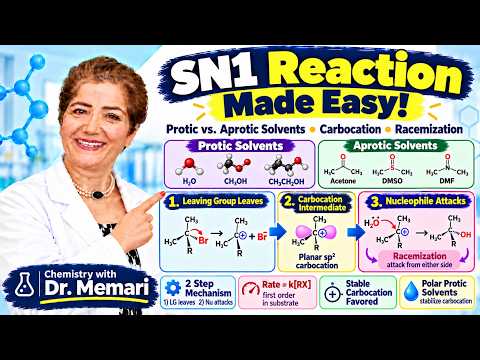
- SN1 rate depends on alkyl halide concentration alone, rate = k[RX], because leaving-group departure and carbocation formation occur before nucleophile attack.
- Tertiary alkyl halides favor SN1 because tertiary carbocations are more stable than primary carbocations; primary alkyl halides generally favor SN2 because they are less sterically hindered.
- Water and alcohols are polar protic solvents that stabilize ions and favor SN1, while acetone is polar aprotic and is a common solvent type for SN2.
- For a secondary substrate, weak nucleophiles such as water and polar protic solvents favor SN1, whereas strong nucleophiles such as hydroxide favor SN2.
- SN1 attack on a planar sp2 carbocation can occur from either face and often racemizes a chiral center; SN2 backside attack produces inversion.
- A better leaving group speeds both SN1 and SN2, while resonance stabilization can make allylic carbocations more favorable for SN1.
Chapters
- Methanol, ethanol, and water are polar protic solvents because they contain O-H bonds; polar protic solvents stabilize ions and favor SN1.
- Acetone is polar aprotic: its C=O bond makes it polar, but it has no hydrogen attached to oxygen or nitrogen.
- Dimethyl sulfide and dimethyl sulfoxide are aprotic, with the sulfoxide more polar; polar aprotic solvents are preferred for SN2.
- A polar protic solvent stabilizes the carbocation intermediate formed in SN1, while SN2 benefits from a polar aprotic environment that leaves the nucleophile more reactive.
- SN1 proceeds in two steps: the leaving group departs first to form a carbocation, then a nucleophile attacks.
- The rate-determining ionization depends on the alkyl halide concentration, giving the rate law rate = k[RX]; nucleophile concentration is not part of the SN1 rate law.
- Tertiary carbocations form more readily than primary carbocations because surrounding alkyl groups donate electron density and stabilize the positive charge.
- When neutral water attacks a carbocation, the resulting oxygen-bearing intermediate remains positively charged until a base or solvent removes H+.
- Primary alkyl halides generally favor SN2 because the less hindered carbon gives a nucleophile room for backside attack; tertiary substrates generally favor SN1 because they form stable carbocations.
- Secondary substrates require weighing other conditions: water as a weak nucleophile and a polar protic solvent favor SN1, while hydroxide as a strong nucleophile favors SN2.
- SN2 is a concerted substitution: the nucleophile attacks as the leaving group departs, so a crowded substrate or bulky nucleophile slows the reaction through steric hindrance.
- A good leaving group accelerates both SN1 and SN2 because departure is required in each mechanism, though it does not by itself determine which pathway dominates.
- An SN1 carbocation is approximately sp2-hybridized and planar, allowing nucleophilic attack from either face and often producing racemization at a chiral center.
- An SN2 nucleophile attacks from the side opposite the attached leaving group, causing inversion of configuration at the reacting carbon.
- A neutral nucleophile such as water requires a later proton-transfer step to remove H+ and produce a neutral substitution product.
- Allylic substrates can stabilize a carbocation by resonance; for these cases, nucleophile strength helps distinguish pathways, with weak nucleophiles favoring SN1.
Transcript excerpt
0:00 H H H H H H H H H H H H H H H H H H H H H H H H H H H H H H H H H H H H H H H H HL and then Okay, these are some of the sample examples for solvents. Okay, the first one like methanol or ethanol, it's a proteic solvent and it is polar. Um it's polar because you have the oxygen and then pairs of unshared electron oxygen you have polar bond. It's protic because hydrogen is attached to highly electrogative element oxygen. H2O is >> polar. Protic or aproic? Protic because again same same what about acetone? That's acetone. Is it polar or nonpolar? >> What makes it polar?
0:49 >> The carbon oxygen that we bond. Is it polar? Is it proteic or aproic? >> Aroic. Even though this molecule contains oxygen and it has plenty of hydrogen's but it's aproic because the hydrogen's are not ionizable. Hydrogen is only ionizable if it's attached to oxygen or nitrogen or so forth. Dimethyl sulfide is another one is a polar solvent. Protic or aotroic? >> Aroic. What about this? Also a >> also arroic. What is polar? Which one is more polar? Sulfide or suloxide? Suloxide is going to be more polar. So we have proteic versus aproic. Now for SN2 which one is better which uh solvents are preferred for SN2 type reaction are polar aproic. For SN1 which we will talk about it soon is polar
1:41 proteic solvent. Why polar proteic solvent is good for SN1? Because for SN1 which is two-step reaction is not biomolecular. Bi molecular means two molecules involved in transition state both nucleophile and alkalhalide but SN1 is actually two-step reaction and when it's two-step reaction you get
This is the start of the transcript. Save this video free for the whole transcript, searchable and time-coded.
Related notes
Summary, takeaways, and chapters were generated by AI from the video's transcript and may contain errors. The video belongs to its creator, Chemistry with Dr. Memari.