12:1 External Flows - Drag and Lift and Congruence with Internal Flows, Re and Eu
 Watch on YouTube →
Overview
Derek Elsworth connects external-flow drag and lift to the internal pipe-flow concepts of Reynolds number, Euler number, and model similarity. He explains how boundary-layer separation, pressure distributions, and viscous shear create forces on objects, then previews using drag and lift coefficients to analyze applications such as aircraft, cars, plates, and a person falling at terminal velocity.
Key takeaways
- External-flow model tests are transferable to a prototype when geometric similarity is maintained and the relevant Reynolds and Euler numbers are matched.
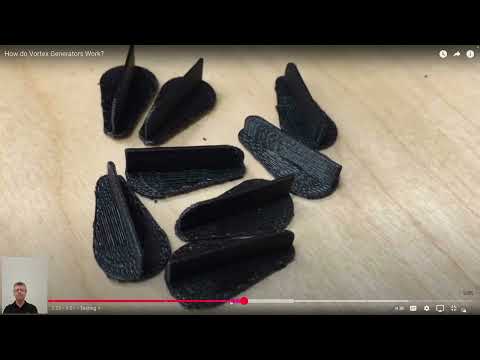
- Vortex generators delay boundary-layer separation by mixing higher-energy outer flow into slower near-surface air, helping aircraft retain control at lower speeds.
- External-flow drag combines pressure forces from stagnation and wake formation with viscous shear along the object's surface; their relative importance changes with Reynolds number.
- Drag and lift coefficients convert measured forces into dimensionless values that can be applied to similar objects under matching flow conditions.
- For circular pipes, laminar Darcy friction factor is 64/Re, while turbulent friction depends on Reynolds number and relative roughness; this changes how head loss scales with velocity.
- A sphere's terminal velocity can be estimated by balancing its weight against aerodynamic drag, using a drag coefficient appropriate to its Reynolds-number regime.
Chapters
- The opening story describes exiting an aircraft at 260 mph and seeing the Earth's curvature from high altitude.
- Specialist equipment included GPS units, an oxygen system, and a container system; the oxygen setup addressed breathing-valve problems at altitude.
- The opening reflection connects ambitious goals with persistence and working alongside talented people.
- Smoke streaklines in a wind tunnel reveal how airflow changes as an airfoil's angle of attack increases.
- At higher angles of attack, flow separates and the airfoil stalls, reducing lift.
- The airflow over the wing travels faster than the flow beneath it; the lecture relates the resulting pressure difference to Bernoulli's principle.
- Wind tunnels can measure vehicle drag with realistic details such as spinning wheels, while body shape and wheel cowls can reduce aerodynamic resistance.
- Tell-tales on a wing or sail indicate local airflow direction and help reveal when flow is no longer attached.
- As aircraft speed drops, lift decreases and airflow can stall, motivating devices that preserve control at low speeds.
- Small vortex generators mix higher-energy air from outside the boundary layer into the slower air near a wing surface.
- This mixing helps keep airflow attached farther along the wing and can delay stall, improving low-speed control.
- A demonstration of 3D-printed generators on a car's rear window showed more orderly tell-tale motion, but the change could increase rear-wheel lift and reduce traction.
- An autogyro's rotor turns in forward airflow and functions like a wing; unlike a helicopter, it does not lift off vertically under rotor power.
- Geometric similarity requires corresponding model and prototype dimensions, such as length-to-diameter ratios, to match.
- Kinematic similarity is represented by matching Reynolds numbers, which depend on fluid density, velocity, characteristic length, and viscosity.
- Dynamic similarity uses the Euler number, a pressure-to-inertial-force ratio related to the friction factor in pipe-flow analysis.
- External flow around a cylinder or sphere changes regime with Reynolds number, shifting the dominant contribution from viscous drag toward pressure drag.
- For circular pipes in laminar flow, the Darcy friction factor follows 64/Re; turbulent-flow friction also depends on relative roughness.
- Major head loss uses the Darcy-Weisbach form, including friction factor, pipe length, hydraulic diameter, and velocity squared.
- Minor losses are represented with a loss coefficient multiplied by velocity squared over 2g.
- Because the laminar friction factor varies inversely with Reynolds number, laminar head loss scales with velocity; turbulent head loss generally retains a velocity-squared dependence.
- Parallel pipes share the same head loss while total flow divides across branches; series pipes carry equal flow and add their head losses.
- Branched networks use flow continuity, such as Q1 = Q2 + Q3, together with energy balances between junctions or reservoirs.
- Dimensional analysis reduces pipe-flow behavior to dimensionless groups, including Reynolds number, relative roughness, and length-to-diameter ratio.
- For external flow, a cylinder or other body sits in an otherwise unchanged far-field stream, so analysis focuses on force on the object rather than flow rate through a conduit.
- Drag acts parallel to the flow, while lift acts perpendicular to it; negative lift can press a car's tires onto the road.
- Wind-tunnel experiments can measure forces on a sphere, cylinder, car, or airfoil at selected Reynolds numbers.
- A force measurement can use a deflecting support with known elasticity or a strain gauge, then be converted into a dimensionless drag or lift coefficient.
- The coefficients allow results from a model to apply to a geometrically similar prototype when the relevant similarity conditions are met.
- At low Reynolds numbers, viscous shear along a surface can dominate drag; at higher Reynolds numbers, pressure differences and the wake become more important.
- Flow stagnating at an object's front transfers momentum to it, while a low-pressure separated wake behind it contributes pressure drag.
- An airfoil experiences both pressure forces normal to its surface and shear forces tangential to it.
- The boundary layer is the region where velocity rises from approximately zero at the surface to the far-field flow speed.
- Pressure and shear stress act in different directions on each small surface element, so their contributions must be resolved into flow-parallel drag and flow-normal lift.
- Integrating these components over an airfoil or curved structure gives total lift and drag when the pressure and shear distributions are known.
- A semicircular Quonset hut provides a practical example: wind pressure can create uplift large enough to threaten its foundation.
- A plate facing into the flow mainly experiences pressure drag, while a plate aligned with the flow has a longer surface exposed to viscous shear.
- The drag coefficient varies with Reynolds number, behaving approximately like 1/Re in a laminar regime before flattening at higher Reynolds numbers.
- Golf-ball dimples encourage boundary-layer transition and can delay separation, reducing drag under suitable conditions.
- Drag-coefficient charts support practical estimates for spheres, including terminal velocity when aerodynamic drag balances gravity.
- Changes in drag around regime transitions can include effects such as alternating vortex shedding and the Von Kármán vortex street.
Transcript excerpt
0:01 I actually exited at 260 mph so it's the fastest they I've ever exited anyone out of their aircraft without a shoot I guess when I was exiting aircraft I can see for over 250 mil radius so it's quite humbling the sky is dark blue you you start to see the curvature of the earth and you start to get a perspective on the world [Music] it's about terminal velocity as well if you fall out of a plane going downwards I had some very specialist kit on board from my container system um to
0:51 the GPS units to my oxygen system now traditionally oxygen systems that altitude have problems with res Val and they breathe um and we solve that problem does have a parachute this old uh truck came along with this old guy he must have been in his late '70s and he leaned out of the window he said where have you come from and I said um I've come from 35,000 ft he said okay enjoy all Greetings oh it's a motivational movie these Ambitions um you know however high or middle whatever they are that you want to go after um it's very rare that you can achieve the one so you need to make sure you collect brilliant people
1:39 around you and if you really work hard enough and you're passionate about something you can make anything as you so there you go topic of today external flows so good that didn't work yesterday this is good to so spend a bit of time orienting ourselves this morning it's got a few minutes to go I think this has no sound so we've talked about wind tunnels for
2:34 buildings uh also for air foils perhaps not so current these days apparently 777
This is the start of the transcript. Save this video free for the whole transcript, searchable and time-coded.
Related notes
Summary, takeaways, and chapters were generated by AI from the video's transcript and may contain errors. The video belongs to its creator, Derek Elsworth.