12:2 External Flows - Drag and Lift, Viscous and Pressure Drag/Lift, Dependence on Re
 Watch on YouTube →
Overview
Derek Elsworth explains how external-flow forces divide into pressure drag and viscous shear drag, and how their relative magnitudes depend on Reynolds number and object geometry. He connects force integration and Buckingham Pi analysis to drag and lift coefficients, then applies them to flow measurement, particle settling, aircraft wakes, golf-ball dimples, and vortex-induced bridge motion.
Key takeaways
- External-flow drag is the sum of pressure and viscous contributions, but the dominant contribution changes with Reynolds number and whether the flow separates.
- The drag coefficient, defined using one-half density times velocity squared times reference area, lets wind-tunnel measurements predict forces on similar objects at matching Reynolds numbers.
- A pressure drop across an orifice or Venturi constriction provides a way to infer pipe flow rate, with Venturi meters generally requiring a smaller correction because their transitions are smoother.
- Terminal velocity can be calculated by balancing an object's weight against buoyancy and drag; the lecture estimates a turbulent drag coefficient near 0.4 for a falling person.
- Golf-ball dimples promote earlier turbulent transition, delay flow separation, and reduce drag compared with a smooth ball under suitable conditions.
- Alternating vortex shedding can impose periodic loads on structures; when those loads align with a structure's natural frequency, oscillation amplitudes can grow.
Chapters
- The opening discussion references Felix Baumgartner's high-altitude freefall from about 128,000 feet as an example of an object moving through an external flow.
- Fine-grained soil particle sizes can be estimated by timing how long particles settle through water in a graduated cylinder.
- Settling behavior also appears in fluid phenomena such as dense fluid blobs moving through less-dense fluid and hailstones growing through repeated cloud updrafts.
- Derek Elsworth describes alternating vortices forming behind the Tacoma Narrows Bridge deck and producing periodic forces that can excite structural motion.
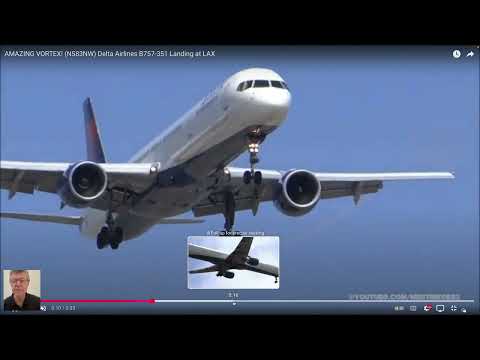
- A wingtip vortex can persist behind an aircraft; the lecture cites wake turbulence from a Boeing 757 as a hazard to a smaller aircraft following too closely.
- Winglets reduce flow around wingtips, while leading-edge devices and trailing-edge flaps increase wing curvature and lift for takeoff and landing.
- An orifice meter estimates flow rate from the pressure drop caused when a restriction accelerates the fluid; its correction factor depends on the restriction and Reynolds number.
- A Venturi meter uses a gradual narrowing and smoother flow transition, so its correction factor is closer to one than an orifice meter's.
- Mechanical alternatives include impellers, spinner logs in wells, nutating flow meters, and diaphragm gas meters that measure gas in repeated volume increments.
- Drag acts along the incoming flow direction, while lift is perpendicular; both can arise from pressure forces normal to a surface and viscous shear forces parallel to it.
- For an inclined surface element, pressure and shear contributions are resolved into the flow direction using their orientation, then integrated over the surface.
- For a flat plate aligned with the flow, the lecture uses a boundary-layer shear relation proportional to x to the power of negative one-half and integrates it over both faces.
- A plate facing the flow develops high pressure on its front and suction, or negative gauge pressure, on its rear; these pressure effects add to produce drag.
- Symmetry makes the opposing shear contributions on the front and rear cancel in the idealized plate example, leaving pressure drag as the net force.
- The required force calculation depends on knowing the pressure and shear-stress distributions, which are not generally available as closed-form solutions.
- At low speeds, flow can remain attached around a cylinder and produce substantial viscous shear; as speed rises, separation and a wake increase the role of pressure drag.
- Separated flow can shed alternating vortices, creating unsteady forces on objects such as cylinders and bridge decks.
- Streamlined shapes, including tapered cycling helmets, reduce separation and the drag associated with a large wake.
- Forces on an object are organized using drag force, frontal area, characteristic length, far-field velocity, density, and viscosity.
- Buckingham Pi analysis produces dimensionless groups corresponding to Reynolds number and a force coefficient equivalent to a pressure ratio such as the Euler number.
- Wind-tunnel measurements can map drag coefficient against Reynolds number, allowing the results to be applied to geometrically similar flows in the same regime.
- The drag coefficient is defined as drag force divided by one-half density times velocity squared times reference area.
- For a falling person or particle, terminal velocity follows from balancing weight against buoyancy plus drag.
- The lecture uses a turbulent drag coefficient near 0.4 as an example and notes that the resulting human terminal speed in air is roughly 200 miles per hour.
- Alternating vortices shed from opposite sides of a bridge deck create periodic forces that can repeatedly pluck the structure.
- When vortex-shedding frequency approaches a bridge's natural frequency, oscillations can build, as illustrated by the Tacoma Narrows Bridge discussion.
- The lecture relates shedding frequency to flow speed, characteristic diameter, and fluid properties through a dimensionless Reynolds-number-based relationship.
Transcript excerpt
0:06 five one of them all right let's see what we got going oh we can roll into this slowly few
1:22 minutes to go another Red Bull deal I guess does anyone here drink that stuff never had that what is it just sugary Coke Cola pretty high you can see the curvature of the earth I'm not sure maybe 100,000 ft I'm not sure oh yeah 128k 128,000 [Music] [Laughter] ft a leap of
2:21 faith looks like he could do a good job pulling out of plane uh so yeah I don't know I I don't know what the uh I guess the the point was to be the highest free jump I suppose not not really sure but it certainly was so well we've seen that one before actually yeah we have seen that one before some of the more mundane things that you use external flows for and not very different um from Felix bomgardner I guess is it actually working that's a little bizarre should I refresh it what's going
3:17 on oh yeah so what should I be doing anyone excellent maybe apparently not as well okay one of the more mundane things that we use external flows for is uh getting the gradation of fine grained soils uh it's difficult to cve them to have a SI that's small enough mesh to get it through and so one thing you can do is you can put it in water and let it settle and you can calculate how long it takes to settle in a graduated cylinder and the the rate at which it falls is proportional to the diameter of the particles
4:04 so see if this works yeah and this is just interesting to watch I thought um yeah ink falling in a blob of
This is the start of the transcript. Save this video free for the whole transcript, searchable and time-coded.
Related notes
Summary, takeaways, and chapters were generated by AI from the video's transcript and may contain errors. The video belongs to its creator, Derek Elsworth.