Princeton Intro to Robotics (Fall 2026) | Lecture 15: SLAM with VGGT
Overview
Princeton’s SLAM lecture explains how VGGT maps uncalibrated RGB image sequences to camera intrinsics and poses, depth maps, world-coordinate point maps, and learned correspondence features. It covers VGGT’s training recipe, including more than 10 million frames, a 1.2-billion-parameter vision transformer, and uncertainty-weighted losses, then compares its speed and reconstruction quality with classical SLAM and introduces MapAnything’s metric-scale estimates and extensions for large, semantic maps.
Key takeaways
- VGGT can infer camera intrinsics, poses, depth, and 3D point maps directly from uncalibrated RGB sequences, anchoring its reconstructed world frame to the first image.
- VGGT’s training depends on diverse supervision: at least 10 million frames from sensorized captures, curated COLMAP reconstructions, and synthetic datasets such as Hypersim and PointOdyssey.
- The 1.2-billion-parameter VGGT uses 24 layers of alternating global and frame-level attention; omitting frame-index embeddings makes its outputs equivariant to input-view reordering up to a coordinate transform.
- The original VGGT paper found that bundle-adjustment post-processing improves feed-forward reconstructions, showing that learned geometry and classical optimization can complement rather than replace each other.
- MapAnything addresses VGGT’s arbitrary global scale by producing metric estimates, enabling approximate measurements from ordinary phone video without prior camera calibration.
- Robust large-scale robotic mapping still requires more than local reconstruction: maps may need loop closure and global alignment, while navigation benefits from adding semantic labels to geometric point clouds.
Chapters
- VGGT takes a sequence of RGB images without requiring prior camera calibration.
- It estimates camera intrinsics, including focal length or field of view, and extrinsics, represented by orientation and translation.
- Its per-pixel outputs include depth, 3D point maps, and learned features for matching corresponding scene points across views.
- Point-map coordinates use the first image as the world-frame anchor, so repeated views of one physical point should yield consistent XYZ coordinates.
- Classical bundle adjustment jointly estimates 3D landmark locations and camera poses by minimizing reprojection error across images.
- A visibility term excludes landmarks that are occluded or absent from a particular image.
- Traditional nonlinear optimization can be brittle and may converge to a poor local solution from an imperfect initialization.
- VGGT learns a direct image-to-geometry mapping instead of explicitly solving bundle adjustment during its basic inference pass.
- The training collection contains at least 10 million frames from thousands of scenes, combining public and proprietary sources.
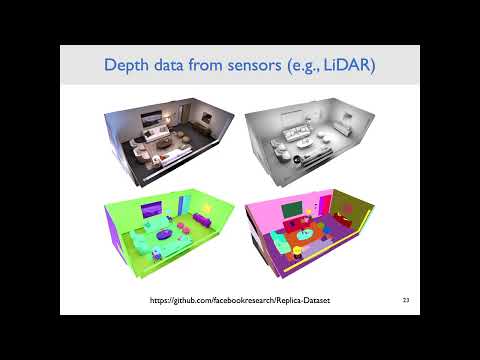
- Sensorized datasets use equipment such as LiDAR, multiple cameras, and AprilTags to obtain dense depth and accurate camera trajectories.
- Curated classical reconstructions, including COLMAP-derived maps from DL3DV, add varied indoor and outdoor scenes after quality filtering.
- Synthetic datasets such as Hypersim and PointOdyssey provide rendered RGB, depth, and dynamic-object examples with known geometry.
- The model patchifies images and uses pretrained DINO features as input representations, then processes them with camera and image tokens.
- A camera head decodes intrinsics and extrinsics, while image tokens produce depth maps, point maps, and correspondence features.
- VGGT alternates global attention across images for scene-level coherence with frame-level attention for within-image features.
- Without frame-index embeddings, the architecture is permutation-equivariant: reordering input views preserves the reconstruction up to a change of world-frame coordinates.
- The approximately 1.2-billion-parameter model has 24 alternating-attention layers and is trained against four output-related losses.
- A Huber loss supervises predicted camera intrinsics and extrinsics against ground-truth calibration and poses.
- Depth-map and point-map losses compare predictions with labeled geometry and weight pixels according to predicted uncertainty.
- A lower-weight point-tracking loss trains learned features by penalizing errors between tracked image locations and ground-truth correspondences.
- Chamfer distance evaluates two point clouds by averaging nearest-neighbor distances in both directions, without requiring equal point counts.
- VGGT outperforms its predecessor DUSt3R on multi-view depth estimation and is competitive with methods that assume known camera parameters.
- The VGGT paper reports further gains from applying bundle adjustment after the feed-forward prediction, despite the network’s aim of avoiding explicit optimization.
- For camera tracking, the lecture contrasts roughly 0.2-second VGGT inference with about 15 seconds for COLMAP on the cited comparison, and also shows fine-tuning for dynamic point tracking and novel-view synthesis.
- VGGT estimates geometry only up to a global scale, so its distances are not inherently in meters.
- MapAnything addresses metric accuracy by predicting scale-aware depth and supporting measurements in real-world units.
- A Hugging Face GPU demo reconstructs a roughly 12-second iPhone video without camera calibration, showing the room’s point cloud and sampled camera poses.
- The demo provides per-view depth and surface normals, with example measurements of about 1.8 meters between room points and 2.25 meters across a blackboard.
- A realistic painting can mislead single-view depth estimation because the image alone may not reveal that the depicted scene is flat.
- Multiple views can provide geometric evidence that a painting is a planar surface rather than a 3D scene.
- For large environments, systems build local VGGT maps and combine them with loop closure or bundle-adjustment techniques to improve global consistency.
- VGGT-SLAM 2.0, associated with Luca Carlone’s MIT group in the lecture, is presented as an example of this larger-scene direction.
- Geometric maps provide obstacle and distance information, while semantic mapping identifies objects and places such as kitchens.
- Combining VGGT point-cloud geometry with semantic labels can support a home robot asked to navigate to a kitchen and retrieve a drink.
- Geometric-semantic mapping remains an active research area because robots need both scene meaning and collision-relevant structure.
Transcript excerpt
0:10 All right, I think we'll go ahead and get started. So today is actually our last lecture on this second module on slam. In the next lecture, we'll start our discussion of machine learning for robotics. I guess in some sense we've already started because this last part of slam actually involves quite a bit of learning as we'll see today. In the last lecture, I introduced VGGT. This is the main method that we're talking about when it comes to visual slam. This is a pretty recent paper, so just from about a year and a half ago that they released it. And it's from folks at Meta and the University of Oxford. Maybe just as a quick reminder, I guess this was the demo. So you take some sequence of images from any camera and then VGGT will create a map for you in
0:58 the form of a point cloud and it'll tell you where the camera went in the scene in the different points in time. And I just want to kind of quickly recap the problem definition we had when we talked about visual slam. So the inputs are pretty simple. So just a sequence of capital N RGB images that you give to the system. And I guess the key kind of property of VGGT and systems like it is that you don't make any assumptions about the camera. So you don't have to do some camera calibration beforehand. You can if you want to, and that can help potentially improve some of the results, but there's no necessity to to do that. And the outputs, so there were four outputs that we talked about. So the
1:46 first one is camera intrinsics and extrinsics. So VGGT will basically estimate what the properties of your camera are. So it's focal length or
This is the start of the transcript. Save this video free for the whole transcript, searchable and time-coded.
In this course
Related notes
Summary, takeaways, and chapters were generated by AI from the video's transcript and may contain errors. The video belongs to its creator, Introduction to Robotics @ Princeton.