Princeton Intro to Robotics (Fall 2026) | Lecture 1
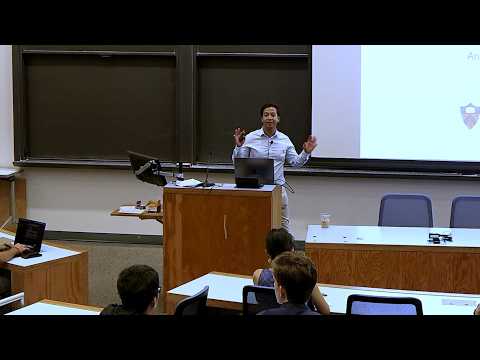 Watch on YouTube →
Overview
Ani Majumdar introduces Princeton’s robotics course through current systems such as Gemini Robotics 2, Waymo, and delivery drones, then frames robotics as embodied, programmable systems that sense, compute, and act amid uncertainty. The course combines planning and control, localization and mapping, and robot learning with hands-on Crazyflie drone work; it also establishes grading, hardware-team, and generative-AI policies.
Key takeaways
- Majumdar defines a robot as an embodied agent programmable for physical tasks, but examples such as dishwashers and teleoperated surgical systems show why autonomy and task complexity make the boundary contested.
- Robotic systems follow a sense-compute-act feedback loop: Crazyflie’s IMU, optical-flow camera, and height sensor provide estimates that its controller uses to command motors.
- Uncertainty is a common reason for robotics failures, spanning localization errors, partial observability, inaccurate robot-state estimates, sim-to-real mismatch, and predictions about human intent.
- Princeton’s course builds toward a team project in which four-person groups use camera-based imitation learning to navigate Crazyflie drones through semi-random obstacles.
- The course grade is split evenly between a 40% share for weekly problem sets, a 30% in-person term exam, and a 30% team drone project; late assignments lose 10% per day.
- Majumdar permits AI for concept explanations, Python syntax, past-assignment review, and team hardware work, while emphasizing that confident AI answers can still contain subtle technical errors.
Chapters
- Ani Majumdar highlights generalist manipulation research at Princeton’s Intelligent Robot Motion Lab and Google DeepMind’s Gemini Robotics 2 vision-language-action model.
- Recent deployments include Waymo robotaxis, Amazon Prime Air deliveries, and 1X humanoid robots offered for about $20,000, with some 1X systems teleoperated by humans.
- Rapid deployment raises social concerns, including job displacement, privacy in homes, military uses, and how autonomous systems align with human values.
- Majumdar’s working definition is an embodied agent that can be programmed to perform physical tasks, while other definitions emphasize autonomy, complexity, or versatility.
- The history spans the Greek myth of Talos, the 1700s Mechanical Turk, and Karel Čapek’s R.U.R., which introduced the word robot from the Czech term for labor.
- George Devol and Joseph Engelberger developed Unimate in the 1950s, an early industrial manipulator with recognizable components of a modern robot.
- Boston Dynamics’ Atlas and the course’s camera-equipped Crazyflie drone are clear examples because they are embodied, programmable, and capable of physical tasks.
- A dishwasher tests the boundaries of autonomy and task variety: it works independently after loading but performs a narrow task and depends on human setup.
- A smart door performs a physical action, while a home assistant may only qualify when connected to devices; the teleoperated da Vinci surgical system is still a major commercial robot.
- A robotic system needs actuators to change its environment, sensors to observe the robot or world, and computation to convert measurements into commands.
- The Crazyflie uses propellers and motors as actuators, an inertial measurement unit for orientation and acceleration, and downward-facing optical flow plus a height sensor to estimate motion relative to the ground.
- The course covers geometric motion planning, dynamics and control, localization and mapping, then robot learning methods including imitation learning, flow matching, reinforcement learning, and world models.
- Moravec’s paradox captures why actions that feel natural to people, such as manipulating objects, running, or driving, can be difficult to automate.
- An Amazon Prime Air drone dropped a package into a swimming pool, prompting possible explanations involving GPS localization, visual recognition, and user-specified drop-off points.
- A humanoid robot’s failed lift could involve incorrect state estimates, control or task-switching errors, or a simulation-to-reality gap after reinforcement learning and domain randomization.
- A Waymo collision with a human-driven car illustrates partial observability and uncertainty about another driver’s intentions; uncertainty also affects dynamics, maps, data, and learned rewards.
- The course replaces earlier drones with Crazyflie brushless models, upgraded batteries and motors, and digital FPV cameras; students are asked to report hardware faults promptly.
- The final project aims to fly autonomously through a semi-random obstacle course using camera images sent to a laptop and a navigation policy trained through imitation learning.
- Hardware work is done in teams of four, with cross-major teams encouraged; the course plans to make drones available in two lab spaces.
- Four teaching assistants come from mechanical and aerospace engineering, architecture, and computer science; John Po helps maintain drone hardware and lab setups.
- The listed preparation includes multivariable calculus, linear algebra, basic probability, differential equations, and programming, but Majumdar describes the list as deliberately conservative.
- Python is the course’s only programming language; students need conceptual familiarity with differential equations and numerical integration, while probability fundamentals will be refreshed.
- Weekly problem sets account for 40% of the grade and combine individual theory and programming work with team-based hardware implementation.
- An in-person term exam, planned for roughly November, counts for 30%; the team drone final project counts for the remaining 30%.
- Late work loses 10% per day and is not accepted after one week; documented illness or family emergencies may receive exceptions.
- Collaboration and study groups are encouraged, but individual submissions must reflect each student’s own understanding; hardware submissions are made once per team.
- Majumdar describes a tension between learning to use coding agents and maintaining the discipline to learn robotics fundamentals.
- He contrasts an inevitabilist view that advanced AI makes learning unnecessary with a blanket refusal to use AI, leaving students to decide where they stand.
- A Claude exchange about LLM mid-training confidently reversed its technical conclusion after Majumdar cited a relevant paper, illustrating why users must check AI reasoning against domain knowledge.
- Permitted AI uses include reviewing past assignments, explaining technical concepts, checking Python syntax, and unrestricted use of coding agents on team hardware assignments.
- Majumdar argues that the physical testing loop makes drone work a useful setting for evaluating AI tools’ strengths and limits; other proposed uses should be discussed with course staff.
- There is no required textbook; references include Principles of Robot Autonomy, Steven LaValle’s Planning Algorithms, and Probabilistic Robotics by Sebastian Thrun, Wolfram Burgard, and Dieter Fox.
- Gradescope and Ed Discussion support course work and questions, with public discussion preferred unless a matter is confidential.
- Robotics 345 serves about 60 undergraduates and Robotics 549 about 12 graduate students; lectures and many assignments are shared, while graduate work includes additional or different problems.
- The drone course uses netted arenas in two Princeton lab spaces, including the E-Quad, with obstacles set up for testing and flight work.
- The next lecture begins technical instruction with planning and control, starting with geometric motion planning.
Transcript excerpt
0:10 All right, I think we're going to go ahead and get started. Uh, sorry for the the delay. We had some technical issues. Uh, we're actually having the lectures re-recorded uh this year. Uh, so they'll be a sort of public resource. We'll put them up on YouTube uh periodically in a in a couple of weeks. Um, so just a quick agenda for for the lecture today. Uh so the main uh topic for the day is to introduce uh some kind of uh motivation and introduction uh to the course content uh and the technical topics that we're going to cover uh in this introduction to robotics course. Uh and then I'll end with some basic course logistics uh assignments, exams, uh things of that nature. Uh I also spend uh about 20% of my time uh working as a research scientist at at Google DeepMind. Uh there's an office here in Princeton. I also spend some time uh in
0:57 New York City. Uh I'll say a little bit about uh some of the >> uh some of the uh topics that I work on uh uh at Google DeepMind. Uh and then yeah I guess finally my my first name is uh my full first name is somewhat challenging to pronounce. Uh so I usually just go by Ani. Uh so yeah just feel free to to call me Ani. Uh if professor Majunar or something like that is better uh you can you can kind of uh go with that. But Ani is also kind of perfectly acceptable. Uh so I thought I'd start uh the lecture today by giving you a a snapshot uh of where I see the the field of robotics today. Uh and I'll start off with a a very biased point of
This is the start of the transcript. Save this video free for the whole transcript, searchable and time-coded.
Related notes
Summary, takeaways, and chapters were generated by AI from the video's transcript and may contain errors. The video belongs to its creator, Introduction to Robotics @ Princeton.