Intro to Chemical Rxns and Balancing Equations
 Watch on YouTube →
Overview
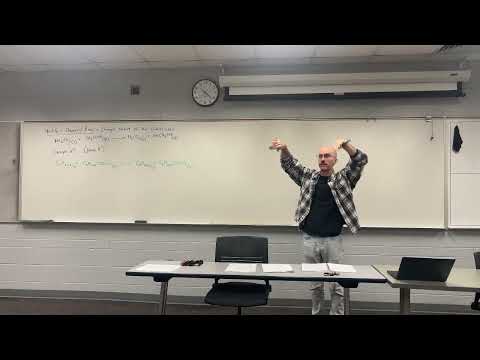
John Flood introduces chemical reactions as changes in chemical identity, distinguishes them from physical interactions, and builds the unit’s core framework: conservation of matter, balanced equations, chemical phases, and precipitation, acid-base, and redox reactions. Worked examples include carbonate and acetic acid, combustion of C2H2, octane, ethanol, and isopropanol, plus copper and nitric acid; balancing uses coefficients rather than altered subscripts, with fractions cleared by multiplying the entire equation.
Key takeaways
- A balanced chemical equation conserves every element by changing coefficients only; changing subscripts changes the identity of the chemicals.
- Balanced coefficients give the lowest whole-number particle or mole ratio, and a fractional coefficient can be cleared by multiplying every coefficient in the equation by the same factor.
- For combustion of carbon- and hydrogen-containing compounds, balancing carbon and hydrogen before oxygen often makes the final oxygen coefficient easier to determine.
- After changing a coefficient, recount every element in that compound from scratch; a coefficient on CO2 affects both carbon and oxygen, while one on H2O affects hydrogen and oxygen.
- An intact polyatomic ion such as sulfate or nitrate can be balanced as a unit when it appears unchanged on both sides of an equation.
- Neutralization reactions are a specific kind of acid-base reaction and produce water and a salt; acid-base reactions more broadly involve proton transfer.
Chapters
0:00
The New Equation Sheet Signals a Shift to Chemical Reactions
- John Flood contrasts the expanded equation sheet with the first eight weeks of the semester, framing Unit 6 as a continuation of the course foundation.
- The semester’s next focus is chemicals, their reactions, and the properties that can be studied.
2:32
Potassium Iodide and Copper Sulfate Form a New Precipitate
- A potassium iodide solution and copper sulfate solution produce a yellow-gold solid, distinct from the white and blue starting materials.
- The solids dissolve into ions that travel through the solvent; copper and iodide ions form the precipitating product while other ions remain in solution.
- A Unit 6 goal is to identify the precipitate’s formula and distinguish it from the ions that do not form a solid.
5:42
Reaction Demonstrations Highlight Chemical Hazards and Heat
- A demonstration involving bleach and hydrochloric acid changes two clear liquids into a yellow solution, illustrating that a visible change can signal a reaction.
- John warns that mixing household chemicals can produce dangerous substances, including potentially lethal chloroform, and cautions against treating such mixtures casually.
- Heating copper above evaporating acetone produces an exothermic reaction that makes the copper glow more brightly.
8:17
Copper and Nitric Acid Produce Nitrogen Dioxide
- Copper reacts with nitric acid to form copper(II) ions and reddish-brown nitrogen dioxide gas, with pressure changes pushing gas through a tube.
- The copper is reacting and being oxidized, not simply dissolving like salt or sugar; the resulting copper ions can dissolve in the liquid.
- Adding water dilutes the concentrated green solution into a blue copper nitrate solution.
10:17
Crystal Reactions Motivate the Unit’s Chemical Questions
- A further demonstration shows dissolved starting materials meeting in solution and forming a new solid with a different color.
- John notes that the crystal colors and solubilities are chemically plausible, even though he cannot establish whether the social-media clip was AI-generated.
- At 11:41, he formally introduces Unit 6 as a study of chemical reactions.
11:41
Chemical Reactions Change Chemical Identity
- Baking soda and aqueous acetic acid provide an acid-base example: the acid donates H+ and the base accepts it.
- The board example describes carbonate reacting with acetic acid to form carbonic acid and sodium acetate.
- John defines a chemical reaction by a change in the nature of the chemicals, not merely by mixing substances.
15:00
Soap Carries Grease Through Water Without Reacting
- Grease and soap can interact physically without changing their chemical identities, so the appropriate description is no chemical reaction.
- Soap molecules form micelles, with water-interacting regions facing outward and grease-interacting regions enclosing grease inside.
- The micelle structure lets soap carry water-insoluble grease through water.
18:15
Conservation of Matter Requires Balanced Coefficients
- An unbalanced carbonate-acetic acid equation appears to gain hydrogen and lose sodium, which violates conservation of matter.
- Adding a coefficient of 2 before sodium acetate balances sodium; adding 2 before acetic acid then balances acetate.
- Coefficients change the amount of each chemical, while changing subscripts would change the chemical identity.
21:48
Read Equations as Mole Ratios and Include Decomposition Products
- The balanced equation can be read as 1 mole of sodium carbonate reacting with 2 moles of acetic acid to form 1 mole of carbonic acid and 2 moles of sodium acetate.
- Carbonic acid is unstable in the example and decomposes into water and carbon dioxide, explaining the bubbles in the baking-soda demonstration.
- Scaling an equation from individual particles to moles preserves the same coefficient ratios.
24:28
Reactants, Products, Coefficients, and Equation Phases
- A chemical equation places reactants to the left of the reaction arrow and products to the right.
- Balanced equations use the lowest whole-number ratio of coefficients, a ratio distinct from the subscripts used in an empirical formula.
- The four phase labels are solid, liquid, gas, and aqueous; phase notation can be included when useful.
27:06
Why Aqueous Is Different From Solid, Liquid, and Gas
- Sugar looks different as a white granular solid and as a dissolved substance, because aqueous sugar molecules interact with water rather than with one another as a solid lattice.
- Sugar decomposes before ordinary boiling can turn it into a gas, illustrating that some substances cannot be observed in every phase under typical conditions.
- John treats aqueous as a distinct chemical-equation phase and advises students to pay attention to phase labels.
30:04
Correct Equations by Checking Balance and Phase Consistency
- Students inspect two equations for corrections; one needs its water coefficient changed from 3 to 6 before the coefficients can be simplified.
- The corrected hydrochloric acid and calcium hydroxide equation is 2 HCl + Ca(OH)2 → 2 H2O + CaCl2.
- A second equation is already balanced, but reporting a phase for only one substance is inconsistent; report all relevant phases or none.
36:55
Three Reaction Families: Precipitation, Acid-Base, and Redox
- Precipitation reactions, often called double-displacement reactions, form a solid, although not every double displacement produces a precipitate.
- Acid-base reactions transfer protons from an acid to a base; neutralization is a subset that produces water and salt.
- Redox reactions involve oxidation and reduction, often described as electron-transfer reactions; John cautions that reaction categories can overlap.
42:11
Balance Equations Without Changing Chemical Formulas
- John recommends checking whether an equation is balanced before using it to solve a problem, including on tests and exams.
- Conservation of mass is enforced with coefficients; changing a subscript changes the substance and is not a valid balancing step.
- For molecular substances, retain the molecular formula rather than simplifying it to an empirical formula.
45:39
Combustion Strategy and Fractional Oxygen Coefficients
- For combustion of carbon- and hydrogen-containing compounds, balance carbon and hydrogen before balancing oxygen.
- The first worked reaction uses C2H2 + O2 → CO2 + H2O; balancing carbon and hydrogen leaves 2.5 O2.
- Multiplying every coefficient by 2 clears the fraction and gives the whole-number equation 2 C2H2 + 5 O2 → 4 CO2 + 2 H2O.
54:36
Practice Balancing Combustion Equations and Track Every Change
- Students work through additional combustion equations and use fractional coefficients when that simplifies the oxygen count.
- John emphasizes recounting every element affected by a new coefficient, such as both carbon and oxygen when changing CO2.
- An unshown coefficient is 1, so changing it to 3 increases the count by 2 rather than adding 3 to the previous total.
1:09:07
Octane Combustion Balances to 25 Oxygen Molecules
- For octane, C8H18, balancing carbon and hydrogen gives 8 CO2 and 9 H2O when starting with 1 octane.
- Those products contain 25 oxygen atoms, requiring 12.5 O2; multiplying all coefficients by 2 removes the fraction.
- The final equation is 2 C8H18 + 25 O2 → 16 CO2 + 18 H2O, and John flags coefficient-multiplication errors as a common source of miscounts.
1:15:03
Ethanol and Isopropanol Combustion Require Different Oxygen Counts
- Ethanol combustion balances as C2H6O + 3 O2 → 2 CO2 + 3 H2O; the oxygen already in ethanol matters when counting products.
- For isopropanol, 2 C3H8O + 9 O2 → 6 CO2 + 8 H2O; a 4.5 O2 intermediate is cleared by multiplying the whole equation by 2.
- When oxygen occurs in both the fuel and O2, recount from scratch after each coefficient change rather than adding new counts to old ones.
1:25:08
Incomplete Combustion, Carbon Monoxide, and Polyatomic Ions
- Incomplete combustion can produce carbon monoxide instead of carbon dioxide; catalytic converters further oxidize CO, and carbon monoxide detectors help protect homes.
- In Cu + H2SO4 → H2 + CuSO4, elemental copper is neutral while copper in copper sulfate is Cu2+; the equation is balanced as written.
- When sulfate or another polyatomic ion remains intact on both sides, balance it as a unit rather than separately counting its sulfur and oxygen atoms.
1:31:36
Balance Nitric Acid and Magnesium Hydroxide as a Neutralization
- Nitrate remains intact as a polyatomic ion, so it can be counted as a unit while hydrogen, magnesium, and other necessary elements are balanced.
- The balanced equation is 2 HNO3 + Mg(OH)2 → 2 H2O + Mg(NO3)2.
- Nitric acid donates acidic protons and hydroxide accepts them; magnesium acts as a spectator ion in the acid-base interpretation.
1:38:42
Phosphoric Acid Neutralization and the Unit’s Next Topics
- Phosphoric acid is triprotic, with three acidic hydrogens; balancing sodium and hydroxide yields H3PO4 + 3 NaOH → Na3PO4 + 3 H2O.
- The neutralization examples share two products: water and a salt.
- John previews further work on identifying acids and bases, net ionic equations for precipitation, and oxidation states for redox reactions.
Summary, takeaways, and chapters were generated by AI from the video's transcript and may contain errors. The video belongs to its creator, John Flood Chemistry.