Syllabus and Fundamental Forces (1210 F26)
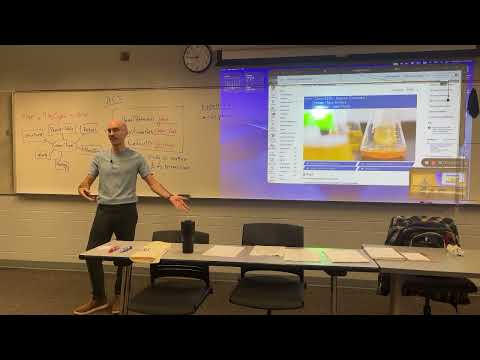 Watch on YouTube →
Overview
John Flood Chemistry introduces the course’s workload, AI-supported study assignments, class policies, and assessment systems, then connects chemistry to the four fundamental forces. A central course theme is to use AI and course resources as study aids without outsourcing problem-solving, while understanding that electromagnetism governs chemical interactions and that gravity, the weak force, and the strong force explain broader physical phenomena.
Key takeaways
- The course’s AI assignments are optional and designed to build prompting and problem-solving habits; students can substitute existing RealChem reading problems or Canvas worksheet questions.
- Students should use AI to target specific learning objectives and generate practice, then solve chemistry problems by hand rather than letting AI replace exam-relevant skills.
- The stated grading structure is 10% participation, 20% homework, 30% Canvas unit tests, and 40% testing-center exams; late work is accepted for low-stakes homework and pre-reading quizzes.
- Canvas unit tests use a remotely monitored LockDown Browser session, allow a two-sided cheat sheet, and provide a two-hour window for roughly 50 multiple-choice questions.
- RealChem green reading checkmarks are not graded; the consequential work is the module and unit checkpoints, which allow three targeted attempts and retain the highest score.
- Electromagnetism is the course’s central physical framework: electric and magnetic effects underpin chemical interactions, while light is electromagnetic radiation and the strong and weak forces explain nuclear binding and radioactive change.
Chapters
0:00
Course Workload and the NSF AI Study-Partner Project
- John Flood estimates that the course may feel like up to 16 hours of outside work per week, but students spending that long and still falling behind should discuss their study priorities with him.
- Flood and course designer Ryan received a $500,000 National Science Foundation grant to study AI as a general chemistry study partner and its effects on student success and persistence.
- The course includes AI-related assignments, but AI is optional: students can use existing RealChem reading problems or Canvas worksheets instead.
5:00
Using DOT and Other AI Tools Without Outsourcing Chemistry
- Students may use DOT, the AI built into RealChem, Microsoft Copilot, or another AI tool; none is required for the course.
- Assignments aim to teach useful prompting and prevent students from giving AI the problem-solving practice they need for exams.
- Flood recommends using unit learning objectives to request targeted practice, such as three conceptual problems and seven increasingly difficult practical problems.
- If an AI assignment takes more than about an hour because the tool will not produce useful problems, students should seek a better workflow or an alternative.
8:30
OpenStax, RealChem, and Chemistry’s Reach Beyond the Classroom
- RealChem hosts OpenStax textbook material, an open educational resource, alongside paid online homework; Flood estimates the platform fee at about $40 after a two-week trial.
- The class frames chemistry as the study of matter and its interactions, spanning structures, mathematics, nanotechnology, geology, and redox reactions.
- Flood describes chemistry-department ACS clubs, including Chemistry Club, premedical, pre-pharmacy, predental, and nanoscience groups.
- Students interested in research can ask Flood about chemistry or geochemistry projects, including analysis of rock samples from Dry Gulch Creek and opportunities to present at an ACS national conference.
14:30
Shared Classroom Expectations: Phones, Music, and Food
- Flood calls the class a shared classroom and asks students to communicate when classroom expectations need adjustment.
- Cell phones are acceptable if use does not disrupt classmates; students should keep phone audio off and address distracting behavior directly or with Flood.
- Students may listen to music through headphones, though Flood expects them to participate in planned activities.
- Food and drinks are welcome in the classroom, with Flood joking that especially good-smelling food might earn a request for a bite.
19:00
Attendance, Four Flexible Absences, and Cold Calling
- Attendance and pre-reading quizzes together count for 10% participation; Flood proposes four unexcused absences that do not count against students in that category.
- Students may arrive late or leave early, and Flood asks for attendance communication only if students choose to provide it.
- Flood seeks permission to cold-call students while allowing them to pass or redirect the question.
- He argues that a wrong answer can reveal a misconception shared by classmates and give the class a chance to correct it.
25:00
Note-Taking, Lecture Recordings, and Calculator Preparation
- Class worksheets support activities but are not substitutes for students’ own notes; Flood recommends copying board work and organizing worksheets with notes.
- Students may photograph the board, and Flood tries to make time before erasing; lecture recordings are helpful but not guaranteed because of possible technical failures.
- Any calculator is permitted at the testing center for this chemistry course, despite restrictions that may apply in mathematics courses.
- Students should bring the calculator they plan to use on exams to class and learn its functions in advance.
33:00
Worksheet-Based Classes and Collaborative Learning
- Most class meetings alternate between Flood’s board-based explanations and sections of an in-class worksheet.
- Worksheets are often designed for group work, so students are encouraged to build relationships and discuss chemistry with classmates.
- The class is intended to include active practice rather than consist entirely of lecture.
42:00
Late-Work Rules and the Four Main Grade Categories
- Flood accepts late RealChem homework and pre-reading quizzes, describing them as low-stakes assignments intended to support learning.
- The stated grade breakdown is 10% participation, 20% homework, 30% unit tests, and 40% exams.
- RealChem module checkpoints and unit checkpoints count as homework; Flood warns students not to postpone all homework until finals.
- Multiple homework attempts let students revisit material and improve scores before the cumulative final.
46:00
Canvas Unit Tests, LockDown Browser, and Cheat Sheets
- Canvas unit tests are mid-stakes assessments taken remotely through LockDown Browser, which records the student using a camera and microphone.
- Each unit test has a two-hour limit and roughly 50 multiple-choice questions; the testing window spans several days, so students should calendar it early.
- Students may use a cheat sheet on unit tests but may not use the internet, textbook, or class notes during the test.
- Flood says students can use two sides of a cheat sheet and recommends taking at least one of the two practice-test attempts before the actual test.
53:00
Testing-Center Exams, Review Sessions, and the STEM Center
- The 40% exam category is taken at a testing center without a student-provided cheat sheet; the center supplies a periodic table and the applicable equations sheet.
- Flood describes the midterm and final as three-hour exams and plans review sessions during class time rather than teaching new material in those periods.
- A final class meeting will include a 50-minute ACS standardized exam and additional final review.
- The campus STEM Center offers chemistry tutoring and exam reviews; Flood encourages students to visit and log in with their S number to support continued funding.
1:00:00
Pre-Reading Quizzes, RealChem Navigation, and Checkpoint Priorities
- Pre-reading quizzes are untimed, allow unlimited attempts, and are designed to surface questions before class; students can still earn points if they take the quiz before completing the reading.
- Canvas provides reminders for RealChem work, but students must open RealChem and find assignments themselves because there are no direct links to individual assignments.
- Flood recommends bookmarking the Canvas RealChem registration page rather than RealChem itself.
- RealChem reading-page green checkmarks are not graded; students should prioritize graded module and unit checkpoints, which offer three targeted attempts and retain the highest score.
1:08:00
Gravity as Curved Spacetime and Gravitational Lensing
- Flood contrasts Newtonian gravity as attraction between masses with the general-relativistic account of matter curving spacetime, making motion through that curvature feel like gravitational pull.
- Gravitational lensing provides evidence that light is affected by gravity: a dense foreground galaxy can bend light from a background galaxy into multiple apparent images.
- Flood emphasizes that light has no rest mass yet travels through curved spacetime, so gravity is not limited to objects with mass.
- He introduces protons, neutrons, and electrons as the particles that make up ordinary matter’s mass.
1:14:00
The Weak Nuclear Force and Carbon-14 Decay
- Carbon-14 contains six protons and eight neutrons; its radioactive decay produces nitrogen-14, which contains seven protons and seven neutrons.
- The transformation changes a neutron into a proton while keeping the mass number at 14, illustrating the weak nuclear force.
- Flood describes protons as two up quarks and one down quark, and neutrons as one up quark and two down quarks.
- Up quarks carry +2/3 electric charge and down quarks carry −1/3, giving protons a net +1 charge and neutrons a net zero charge.
1:17:00
The Strong Nuclear Force Holds the Helium-4 Nucleus Together
- Flood models a helium-4 nucleus as two protons and two neutrons packed into a small space.
- Because both protons are positively charged, they electrically repel one another; the strong nuclear force holds the nucleus together at close range.
- The classroom magnet demonstration makes the competition between attraction and repulsion tangible before Flood connects proton repulsion to electromagnetism.
1:20:00
Electromagnetism: Electric Charge, Magnetic Fields, and Chemistry
- Flood presents electromagnetism as the force underlying the chemistry studied in the course and compares chemical interactions to the magnets students hold.
- Electric charges repel like charges and attract opposite charges; magnetic poles likewise repel like poles and attract opposite poles.
- Moving charges generate magnetic fields: Flood uses car alternators and wireless phone charging as practical examples.
- He discusses electron spin and paired electrons as an illustration of magnetic effects between charged particles, alongside the broader electric interaction.
1:23:10
Light as Electromagnetic Radiation and Preparation for the First Unit
- Flood identifies light as electromagnetic radiation carrying linked electric and magnetic fields through spacetime.
- Because electromagnetism governs chemical interactions and light interacts with matter, the course will study both light and electromagnetic phenomena.
- Students are asked to review Unit Zero and class expectations before the next meeting, when the first chemistry unit begins.
Summary, takeaways, and chapters were generated by AI from the video's transcript and may contain errors. The video belongs to its creator, John Flood Chemistry.