Peru - Life at extreme altitudes above 4,000 meters | DW Documentary
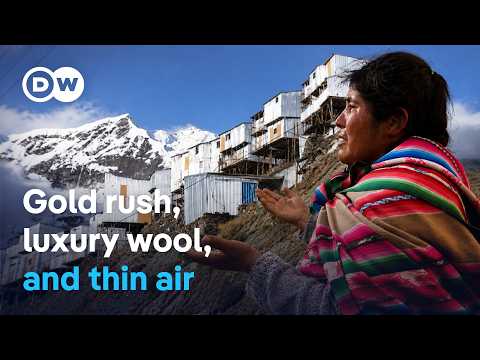 Watch on YouTube →
Overview
Across Peru’s high Andes, communities balance life above 4,000 meters with religious tradition, dangerous work, and scarce resources. La Rinconada, at 5,300 meters, illustrates the costs of the gold boom: informal mining exposes workers to explosions and mercury, while pollution threatens glacier-fed water and Lake Titicaca; research led by French scientist Samuel Vergès examines how residents’ bodies adapt to thin air.
Key takeaways
- At 5,300 meters, La Rinconada’s miners face unstable tunnels, unlicensed dynamite, and toxic blast fumes, while Arnaldo earned only 348 soles for a week of work.
- Gold extraction contaminates the same glacier-fed water La Rinconada residents depend on: mercury enters waterways and ultimately threatens Lake Titicaca.
- Samuel Vergès’s research links high-altitude adaptation to unusually high red blood cell counts, but the resulting thicker blood can make the heart work harder.
- Vicuña wool earns far more than ordinary wool, but sustainable income depends on strict annual shearing limits, careful animal handling, and traceable collection.
- Cusco’s nearly 3,500-meter elevation can cause life-threatening illness in visitors, and its altitude clinic treats up to 150 people monthly.
Chapters
0:00
Jim’s Qoyllur Rit’i Pilgrimage to the Glacier
- In Paucar Tambo, 30-year-old Jim undergoes an initiation to join the Pablitos brotherhood, including a ritual using bull’s blood.
- Pilgrims climb from 3,000 meters to the Qoyllur Rit’i shrine at nearly 4,700 meters, walking 10 kilometers over nine hours in freezing conditions.
- Catholic and Indigenous Andean beliefs meet at the sacred rock; Jim’s brotherhood then ascends to the Colque Punku Glacier, above 5,000 meters.
4:30
La Rinconada: A Gold-Rush Town Above 5,300 Meters
- La Rinconada is the world’s highest permanent settlement, with oxygen levels around half those at sea level and nighttime temperatures reaching minus 25°C.
- Arnaldo, his wife Victoria, and their daughter live in a two-room home without heating or hot water; rent is 450 soles a month.
- The early-2000s rise in gold prices drew thousands of people, but the fast-growing town still lacks proper sewage and wastewater treatment.
- Arnaldo chews coca leaves to manage hunger, fatigue, and altitude while working in mines run by small contractors under two cooperatives.
10:00
Informal Mining, Mercury, and Arnaldo’s Small Gold Payout
- Under the cachorreo system, miners receive no regular salary and keep the gold they find on one workday each week.
- Arnaldo drills with a 20-kilogram machine and sets dynamite charges in unsafe tunnels; blasts create toxic fumes that miners say can kill.
- Women such as Jessica, a single mother, are barred from mine interiors by local belief and work as pallaqueras, sorting discarded rock for traces of gold.
- At a mill, Arnaldo uses toxic mercury to separate gold, then receives 348 soles, about 85 euros, for 1.5 grams after a week of dangerous work.
20:00
Vicuña Wool: High-Value Fiber and Community Conservation
- Peru has more than four million alpacas, while vicuña fiber is rarer and prized by luxury fashion houses for its softness and fineness.
- Vicuñas remain wild by law; community herders drive them into corrals with long ropes and colored flags, then shear only animals with enough wool.
- Of 750 vicuñas gathered in one roundup, only about a third had fleece long enough to shear; animals are shorn once a year and retain protective wool.
- The community records and sorts each fleece for legal traceability and quality, collecting about 45 kilograms worth roughly 13,500 euros that year.
26:40
Police Confront Violence and Illegal Explosives in La Rinconada
- Robberies and armed attacks accompany the gold boom; reported violence averages two deaths a month, and clashes between rival mining groups killed three people in early 2025.
- Major Aranda leads heightened police patrols in a town with only a few dozen officers and deep mistrust between residents and law enforcement.
- A search of a shop uncovered more than 500 sticks of dynamite and around 1.5 tons of ammonium nitrate, enough explosive material to destroy a neighborhood.
- The shop owner later received a three-year suspended prison sentence for selling explosives without a license.
31:30
Altitude Sickness in Cusco and the Clinic’s Hyperbaric Chamber
- Cusco sits nearly 3,500 meters above sea level, where visitors can develop severe altitude-related breathing problems.
- A clinic treats up to 150 tourists a month; Argentine visitor Camilla needed oxygen after vomiting, developing a headache, and struggling to breathe.
- Doctors use a hyperbaric chamber for an hour to raise air pressure and help patients absorb oxygen; untreated severe altitude sickness can be life-threatening.
34:15
Samuel Vergès Studies High-Altitude Adaptation in La Rinconada
- Local residents play soccer at 5,300 meters, while visitors often struggle to catch their breath.
- French scientist Samuel Vergès has led a research team studying La Rinconada residents for six years, including their cardiovascular health and altitude adaptation.
- Residents produce unusually high numbers of red blood cells to carry oxygen, but thicker blood and increased heart strain may eventually contribute to illness.
- The research team also provides rare free medical examinations in a settlement with no local doctors or cardiologists.
38:00
Glacier Water, Mercury, and Lake Titicaca’s Pollution Crisis
- La Rinconada draws drinking water from glacier ice, where miners spread dark gravel and sand to accelerate melting and create streams.
- Mining wastewater and mercury can contaminate those streams; researchers report nearly one in five miners show signs of mercury exposure.
- Experts estimate about 15 tons of mercury enter waterways in Peru’s Puno region each year, with pollution flowing toward Lake Titicaca.
- Around Lake Titicaca, residents report illness and contaminated drinking water; one Ministry of Health study found elevated mercury and arsenic exposure in 83 percent of a village’s residents.
Summary, takeaways, and chapters were generated by AI from the video's transcript and may contain errors. The video belongs to its creator, DW Documentary.