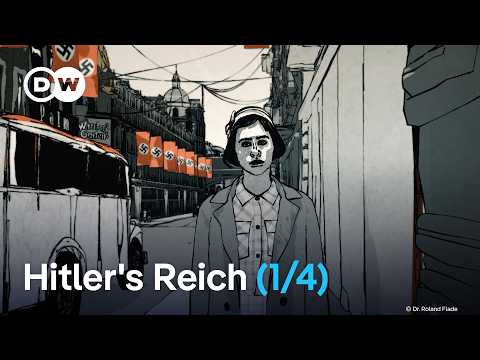
Hitler's Reich - Diaries of Nazi supporters, opponents and victims (1/4) | DW Documentary
 Watch on YouTube →
Overview
Eight German diaries trace how Nazi rule reshaped daily life from Hitler’s appointment as chancellor in 1933 through the Nuremberg Laws of 1935. The accounts contrast Franz’s committed Hitler Youth activism and Louise Solmitz’s early enthusiasm with Jewish teacher Willy Cohn’s persecution, Matthias Mies’s uneasy accommodation, and the growing exclusion of Gisela Solmitz and other victims.
Key takeaways
- Nazi rule gained support through both political mobilization and emotional spectacle: Louise Solmitz celebrated a torchlit procession of about 20,000 brownshirts before later questioning Hitler’s persecution of Jews.
- The Reichstag fire accelerated dictatorship: emergency measures suspended civil liberties, and Willy Cohn recorded how criticism and political dissent became dangerous.
- Racial persecution reached families who had considered themselves fully German; Gisela Solmitz learned that her father’s Jewish ancestry made her subject to exclusion despite her upbringing and beliefs.
- Accommodation often advanced incrementally: Matthias Mies resisted the Hitler salute, gave it at a council meeting in 1933, and later excluded Jewish customers from his inn.
- Nazi youth organizations offered belonging and activities while teaching racial hierarchy; Inge joined the League of German Girls partly because she feared exclusion from organized social life.
- The 1935 Nuremberg Laws turned antisemitic ideology into formal exclusion, threatening Jewish Germans’ citizenship, employment, and family relationships.
Chapters
0:00
Eight Diaries Introduce Germany Under Hitler
- The accounts span the perspectives of Nazi supporters, political opponents, Jewish victims, and people caught between allegiance and fear.
- The opening questions frame the diaries around Hitler’s rise in 1933, the outbreak of war in 1939, and what Germans believed by 1945.
1:10
Franz Joins the Nazi Movement as Louise Solmitz Welcomes Hitler
- Franz, a 20-year-old Nazi Party member and Hitler Youth activist, celebrated Hitler’s appointment as chancellor on January 30, 1933.
- In Hamburg, Louise Solmitz and her 12-year-old daughter Gisela were swept up in a torchlit procession of roughly 20,000 brownshirts.
- Louise’s diary recorded both the rally’s emotional appeal and antisemitic chants, while she worried that Hitler lacked moderation.
10:00
Willy Cohn Records the Reichstag Fire and the End of Civil Liberties
- Willy Cohn, a Jewish history teacher and Social Democratic Party member in Breslau, documented antisemitic propaganda and attacks on the SPD.
- After the Reichstag fire in February 1933, emergency measures suspended basic rights, including freedom of assembly, press, and expression.
- Cohn described the new atmosphere as one where dissent could be treated as treason and punished by death.
14:00
The March 1933 Election and the First Anti-Jewish Boycott
- Louise Solmitz celebrated the Nazi-led electoral victory on March 5, 1933, as a patriotic triumph.
- In Wittlich, Matthias Mies recorded SA troops marking Jewish businesses with signs urging customers to avoid them.
- Although Mies condemned the boycott as barbaric, Louise’s diary shows her enthusiasm for Hitler beginning to falter over the persecution.
21:30
Gisela Solmitz Learns Her Family Has Jewish Roots
- Louise’s husband, Friedrich, had Jewish ancestry despite being baptized Christian; the family had kept that history from Gisela.
- When Gisela’s school demanded proof of Aryan descent in May 1933, the child learned that Nazi racial rules placed her outside the community she believed she belonged to.
- Louise faced a conflict between her love for her husband and daughter and her continuing belief that Hitler’s racial principles were correct.
25:00
Concentration Camp Prisoners Arrive as Matthias Mies Makes a Nazi Salute
- Mies saw trains carrying prisoners to Wittlich Prison and recorded the grim condition of people held in protective custody.
- After the Catholic Center Party dissolved in July 1933, Mies lost his council seat and weighed cooperating with the Nazis.
- In September, he raised his arm and gave the Hitler salute at a council meeting, despite having previously resisted it.
28:00
Inge Finds Belonging in Nazi Youth Organizations
- Inge, a 19-year-old gardener from a poor family, began a diary in September 1933 as she sought independence and a life beyond her family’s financial hardship.
- She joined the League of German Girls because she feared that young people outside Nazi organizations would become outsiders.
- The group offered friendship, sport, music, and social activities while promoting physical toughness and the exclusion of people labeled inferior.
32:00
Nazi Youth Culture and the 1934 Consolidation of Hitler’s Power
- Gisela’s exclusion from Hitler Youth contrasted with Inge’s growing involvement in Nazi youth life and Franz’s work as a Hitler Youth instructor.
- During the 1934 purge, Hitler’s regime killed SA leader Ernst Röhm and other perceived rivals; following President Paul von Hindenburg’s death, Hitler assumed sole power.
- Louise Solmitz joined crowds greeting Hitler in Hamburg, describing the event as a fairy tale even as Nazi influence spread into ordinary life.
38:00
Willy Cohn’s Family Seeks Safety While Matthias Mies Excludes Jewish Customers
- Willy Cohn’s sons left Germany for safety, including a son who emigrated to Palestine; Cohn continued supporting his family after being dismissed from teaching.
- In 1935, Mies asked Jewish customers to stop coming to his inn, which had become a rare local refuge after other restaurants excluded them.
- The diaries show persecution becoming social and economic routine, reinforced by antisemitic signs, newspapers, and public abuse.
43:00
The Nuremberg Laws Make Gisela Solmitz an Outcast
- In September 1935, Louise and Gisela anxiously awaited the Nuremberg Laws, which stripped Jews of citizenship rights and criminalized marriage between Jews and people of German or related blood.
- Louise feared Gisela would have no prospects for work, marriage, or a future; Gisela voiced fear that she might die unnaturally.
- Inge welcomed the racial laws as a defense of so-called blood purity, while Mies bought a swastika flag after it became the flag of the Reich.
Summary, takeaways, and chapters were generated by AI from the video's transcript and may contain errors. The video belongs to its creator, DW Documentary.