NumberLinePartB(1D KinematicNotation) jjPHY203 FA26
 Watch on YouTube →
Overview
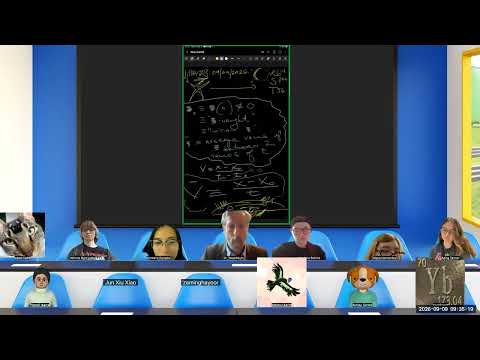
Dr. Yaverbaum reviews Homework 1 and introduces one-dimensional kinematics by connecting motion concepts to mathematical notation: displacement is final position minus initial position, and average velocity is displacement divided by elapsed time. He also explains the five-step solution format, revision and presentation expectations, and how to state a complete physics answer, using an 8-second example with a displacement of -9 feet.
Key takeaways
- Displacement is a signed change in position: final position minus initial position, so moving from +4 feet to -5 feet produces -9 feet of displacement.
- With the initial time defined as t₀ = 0, average velocity is displacement divided by elapsed time; the 8-second example gives -9/8 feet per second.
- A subscript 0 identifies a variable’s value at the start of an experiment, not a value that must be zero; an initial position can be +4 feet while t₀ is zero.
- The five-step method separates problem facts from general principles, then applies those principles to the facts; Dr. Yaverbaum identifies Step 3 as the crucial bridge to calculation.
- A strong final answer is a complete, unit-labeled statement tied to the question’s conditions, not an isolated number, and should be visibly highlighted.
- For any round trip that returns to its starting point, displacement and average velocity are zero even when total distance and average speed are nonzero.
Chapters
0:00
Opening, Homework Review Plans, and Class Logistics
- Dr. Yaverbaum welcomes students and explains that class will continue reviewing Homework 1 before moving to later sheets.
- He invites questions through the chat or raised hands and says that homework reviews will become faster as the class gains experience.
5:09
Homework 1 Revisions and Late-Submission Rules
- Students who submitted a reasonable first draft on time may revise repeatedly to earn back points, with no revision deadline.
- A revision must be a complete, self-sufficient new document, while the original draft remains available in Google Classroom.
- Late first drafts can still receive a score, but do not qualify for the ongoing revision opportunity.
11:07
Correcting the GDP Rubric and Explaining Revision Expectations
- A student identifies a reversed score scale in the Part 1, STP3 GDP rubric, where the labels did not match the point values.
- Dr. Yaverbaum acknowledges the rubric error, explains that Classroom would not allow edits after grades were released, and says future rubrics were corrected.
- Revised work does not need a separate explanation of every correction, but must stand alone as a polished final draft.
18:22
Self-Sufficient Documents and Readable Scientific Presentation
- A formal submission should identify its author and topic, and should orient readers rather than beginning abruptly with calculations.
- Scientific work should combine text, diagrams, equations, labels, and visual spacing instead of presenting a dense block of symbols.
- Small handwriting should be dark and spaced out so readers can inspect it without excessive zooming.
25:50
Physics Diagrams Define Variables and Coordinate Systems
- A diagram should label every variable and constant that later appears in the analysis, so readers can identify what each symbol represents.
- Diagrams establish coordinate conventions, such as which direction is positive on an axis.
- For later questions using an existing diagram, students may refer to a diagram above instead of redrawing it, but must direct the reader to it.
33:49
Organize Five-Step Solutions in Series, Not in Parallel
- Present each question through the expected five-step structure rather than listing every question and principle before beginning the solutions.
- Frontloading all steps for several problems increases the reader’s cognitive load and forces repeated page-flipping.
- Homework 2B, the train-of-thought assignment, is an exception: it does not require the five-step method, though it still requires a self-sufficient document.
38:32
Physics Equations as Precise Statements, Not Memorized Formulas
- Dr. Yaverbaum frames equations as compact expressions of meaningful claims, rather than arbitrary formulas to memorize.
- A triple equals sign denotes equality by definition, while a double equals sign represents equality established by a condition or discovery.
- A subscript 0, read as “naught,” means a variable’s value at the experiment’s start, when the stopwatch begins; it does not mean that the variable itself equals zero.
44:47
Displacement and Average Velocity in Symbolic Notation
- The difference between final and initial positions, x - x₀, is displacement; it describes a change over an interval, not a position at one instant.
- The initial time t₀ is zero by definition, while an initial position such as x₀ can be positive, negative, or zero.
- Average velocity is defined as displacement divided by elapsed time: v̄ ≡ (x - x₀)/t when t₀ = 0.
48:57
Setting the Number-Line Direction and Identifying Question 2
- The Homework 1 number line takes rightward as positive and leftward as negative, a chosen convention that must remain consistent.
- The class identifies Question 2 as asking for total displacement over the interval from t = 0 to t = 8 seconds.
- Dr. Yaverbaum situates the material within one-dimensional kinematics, the study of motion along a single axis.
52:50
Using Step 3 Principles to Set Up Step 4
- Step 3 states a general principle, such as displacement being final position minus initial position; Step 4 applies it to the particular problem.
- For the 8-second example, the instructor identifies a final position of -5 feet and an initial position of +4 feet.
- Dr. Yaverbaum describes Step 3 as the key reasoning step that helps students move beyond not knowing how to start a calculation.
58:50
Calculating the 8-Second Displacement
- Applying displacement = final position - initial position gives -5 feet - (+4 feet) = -9 feet.
- The example shows how a general definition from Step 3 becomes a numerical result when applied to the problem’s positions.
- A correct numerical value alone may not satisfy the final-answer criterion if it is not clearly identified and presented as the answer.
1:02:58
Circle a Complete, Unit-Labeled Answer
- A final answer should state the condition and the result, for example, “From t = 0 to t = 8 seconds, the displacement was -9 feet.”
- Dr. Yaverbaum asks students to circle or otherwise highlight the complete statement, not just the number -9.
- Including an equals sign or a clear sentence with units makes the result understandable without requiring readers to reconstruct the question.
1:09:16
Checking Average Speed and Average Velocity
- For the full 8-second journey, the stated average speed is 21 feet divided by 8 seconds.
- Average speed and distance are scalar quantities, while average velocity and displacement include direction and are vector quantities.
- The corresponding average velocity uses the -9-foot displacement over 8 seconds, or -9/8 feet per second.
1:12:46
Round Trips, Zero Displacement, and Homework Part 3
- Any completed round trip ends at its starting position, so its displacement and average velocity are zero regardless of the distance traveled or speed.
- Dr. Yaverbaum gives two Part 3 results to revisit: x = -2t and an average velocity of 0 feet per second.
- The class is asked to bring unresolved questions to the next meeting, where Homework 1 review will continue.
1:15:41
Class Wrap-Up and Follow-Up Discussion
- Dr. Yaverbaum closes the session at about 76 minutes and says the class will continue the Homework 1 discussion on Monday.
- Students are invited to stay after the formal end of class with questions before the recording concludes.
Summary, takeaways, and chapters were generated by AI from the video's transcript and may contain errors. The video belongs to its creator, Dr. Yaverbaum.