Mansa Musa: The Life Of The 'Richest Man In History'
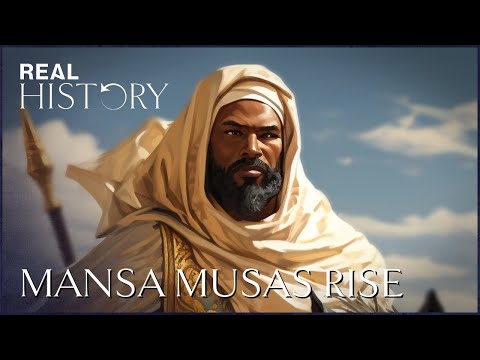 Watch on YouTube →
Overview
Mansa Musa ruled the Mali Empire during its 14th-century peak, using control of trans-Saharan trade, a large military, and pragmatic diplomacy to expand and secure his realm. His 1324 pilgrimage to Mecca, accompanied by a reported 60,000 people and so much gold that prices fell in Cairo, raised Mali’s profile abroad; after returning, he helped develop Gao and Timbuktu as centers of trade, Islamic learning, and architecture. The account also weighs the uncertain evidence behind claims that Musa was history’s richest ruler and traces how succession disputes and lost territory weakened the empire after his death.
Key takeaways
- Musa’s wealth came from Mali’s control of gold and salt production and the trade routes linking West Africa with North Africa, not simply from personal hoarding.
- The reported 1324 Hajj entourage of 60,000 people made Musa’s pilgrimage a political and logistical display as well as a religious journey.
- Musa’s gold gifts in Cairo reportedly depressed gold prices for years, showing how his pilgrimage could affect markets beyond Mali.
- Musa’s expansion of Gao and investment in Timbuktu connected political power with trade, mosque construction, and Islamic scholarship.
- The often-cited $400 billion modern estimate is not a reliable measurement of Musa’s fortune; the sources do not establish his gold reserves with precision.
- Mali’s later decline involved contested succession, rebellion, and the independence of vassal states, rather than a single event after Musa’s death.
Chapters
- Musa was born around 1280 in West Africa; the account identifies his father as Faga Laye and his mother as Kanku, whose life is poorly documented.
- Mali emerged after Sundiata Keita defeated the Sosso ruler Sumanguru at the Battle of Kirina in 1235.
- Sundiata’s empire drew strength from its Upper Niger location, trade routes, military organization, and laws remembered as the Kurukan Fuga.
- After Sundiata’s death, rulers including Mansa Uli, Wati, Khalifa, and Sakura contested power amid succession rules that did not require direct descent.
- A great council helped govern the empire and succession, while subject kingdoms paid tribute in goods such as rice, millet, and weapons.
- Mali’s gold system reserved gold nuggets for the Mansa, while miners retained gold dust, making control of the mines central to royal wealth.
- Mansa Muhammad ibn Qu is said to have sent an initial fleet west across the Atlantic, then led a second expedition himself around 1312.
- Before departing, Muhammad appointed Musa as caretaker ruler; the fleet never returned, leaving Musa to become Mansa.
- The claim that the fleet reached the Americas remains unproven, and the account also notes that there is no solid evidence Musa arranged its disappearance.
- Musa built support by reversing an order against southern miners when their strike threatened gold production, while enforcing a harsh policy against banditry on trade routes.
- Mali’s wealth grew through taxes on trans-Saharan and river trade, including routes linking Saharan salt mines with gold-producing regions.
- The account estimates an army of about 100,000, including 10,000 cavalry, and describes campaigns that expanded territory and captured thousands of people.
- Musa set out for Mecca around 1324 with a reported entourage of 60,000, including 12,000 personal servants and 8,000 soldiers.
- About 80 camels reportedly carried 80 pounds of gold each, alongside extensive supplies of food, water, tents, tools, and clothing.
- The caravan crossed the Sahara, where extreme heat, freezing nights, scarce water, and the need to supply people and animals made the pilgrimage a major logistical operation.
- Musa entered Cairo in July 1324, met the Mamluk sultan, and gave gold generously during a stay of about three months.
- The influx of Malian gold reportedly lowered Cairo’s gold prices for years; Musa later tried to buy back some of the surplus.
- After visiting Medina, Musa completed the Hajj in Mecca, adopting the simple white garment worn by pilgrims and receiving the title of hajji.
- Musa began the return journey with scholars and architects, including Abu Ishaq al-Sahili, whom he hoped would contribute to Mali’s development.
- After spending much of his travelling gold, Musa reportedly borrowed money in Cairo at high interest to resupply the caravan.
- In 1325, news reached Musa that his general had taken Gao from the Songhai; Musa changed his route to secure the city’s submission personally.
- Musa incorporated Gao into Mali’s sphere of control, using tribute and control of military and foreign affairs while allowing local rulers to manage internal matters.
- In Gao, he commissioned a mosque that introduced a distinctive Sudano-Sahelian style using sun-dried bricks, thick walls, mud, and palm beams.
- Musa developed Timbuktu through the Djinguereber Mosque and a center of learning associated with Sankore, attracting scholars and strengthening the city’s role in trade and Islamic education.
- Back in Mali, Musa commissioned buildings in the capital and supported mosques as educational centers, drawing on scholars and expertise acquired during the Hajj.
- He remained ruler rather than retiring to Mecca, in part because his son Maghan’s leadership as caretaker appeared weak; Musa also repelled a Mossi attack on Timbuktu around 1330.
- Musa’s death is variously dated to 1332 or 1337; the account places it around age 57 and identifies Maghan as his successor.
- Songhai asserted independence around 1340, while raids by Mossi forces threatened Timbuktu and neighboring settlements.
- After Maghan, Musa’s brother Suleyman ruled until about 1359; a subsequent rebellion and civil conflict helped Jolof break away.
- Later attacks and territorial losses culminated in the sack of Niani in 1670 and the retreat of the Keita dynasty to Kangaba.
- A modern estimate of roughly $400 billion for Musa’s wealth is highly uncertain because it depends on disputed gold quantities and non-scientific historical accounts.
- Arabic accounts, Mandinka oral histories, and possible conflation with figures such as Fajigi and Fakoli complicate the reconstruction of Musa’s life.
- The 1375 Catalan Atlas depicts Musa with gold, while his development of Gao and Timbuktu helped sustain Mali’s cultural and scholarly legacy.
Summary, takeaways, and chapters were generated by AI from the video's transcript and may contain errors. The video belongs to its creator, Real History.