ZOO*3700 - Lecture 05 - Life History II
 Watch on YouTube →
Overview
Alex Smith develops life-history theory through the trade-offs between sexual and asexual reproduction, showing how gamete size, mate-finding costs, environmental instability, competition, and parasites shape reproductive strategies. Examples including Daphnia, aphids, the clam shrimp Eulimnadia texana, and snails parasitized by trematodes illustrate three explanations for sex—bet-hedging, competition, and the Red Queen hypothesis—before Smith emphasizes that thousands of life-history studies are concentrated in only a few animal phyla.
Key takeaways
- Anisogamy can be understood as a resolution to opposing gamete demands: small gametes can be produced in large numbers to compete for fusion, while large gametes carry resources for embryo development.
- Eulimnadia texana shifts from rapid parthenogenesis in filling ponds to mating and production of desiccation-resistant eggs as ponds dry, combining reproductive speed with persistence through harsh conditions.
- Sexual reproduction is costly because it requires mate-finding, gamete overproduction, and often courtship that raises predation risk; hermaphroditism can reduce mate-limitation in sparse or low-mobility populations.
- Bet-hedging predicts sex when environmental conditions become unstable, while the competition hypothesis links sex to resource saturation; Daphnia and aphids illustrate switches from rapid asexual reproduction to sexual reproduction.
- The Red Queen hypothesis predicts that parasite pressure favors genetic variation through sex; snail–trematode data generally show more sexual reproduction where parasitism is higher.
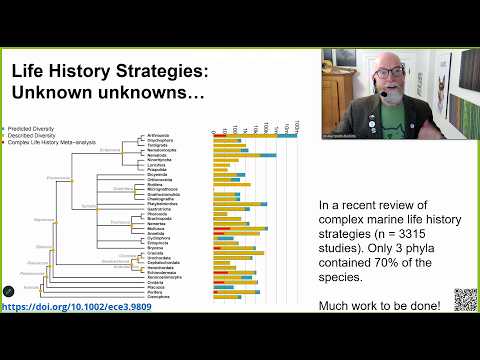
- Life-history research is unevenly distributed: about 3,000 studies cluster in a few animal phyla, leaving basic reproductive and developmental traits poorly documented for many species.
Chapters
0:00
Animal Diversity and the Class’s Favorite Invertebrate Phyla
- The opening phylogeny contrasts described animal diversity with predicted, still-unnamed species diversity on a logarithmic scale.
- The highlighted red bar represents students’ recorded favorite invertebrate phyla, not an estimate of species diversity.
- Alex Smith uses shifts in those preferences to track students’ growing enthusiasm for invertebrates such as mollusks and arthropods.
5:00
Life-History Trade-Offs Lead into Reproductive Strategies
- Life-history evolution treats energy as finite: investment in one biological process cannot be spent on another.
- The lecture extends earlier examples of fission and parthenogenesis in flatworms, Daphnia, and cnidarians.
- The central questions include sexual versus asexual reproduction, gonochorism versus hermaphroditism, and why sex evolves.
8:00
Why Anisogamy Produces Small Sperm and Large Eggs
- Sexual reproduction returns the lineage to a single-cell stage through germ cells such as eggs and sperm.
- A protogamete faces two opposing demands: being numerous enough to find and fuse with another gamete, and carrying resources to nourish an embryo.
- Anisogamy reflects these competing demands: many small gametes can compete for fertilization, while fewer large gametes provide more resources.
- The sperm-size literature includes extreme cases, such as fruit flies with sperm longer than their bodies, showing that simple predictions do not explain every lineage.
19:00
Gonochorism, Mate-Finding Costs, and Sexual Dimorphism
- Gonochorism assigns male and female gametes to separate individuals, which generally need to build and maintain only one type of reproductive equipment.
- The strategy carries a mate-finding cost, especially in dilute environments where an individual must encounter a compatible partner.
- Examples of extreme sexual dimorphism include female blanket octopuses that can be about 40,000 times larger than males.
- Across animal phyla, gonochorism is common in many bilaterians but less frequent among very small, colonial, or parasitic lineages.
23:00
Eulimnadia texana Switches Between Parthenogenesis and Sex
- The clam shrimp Eulimnadia texana inhabits ephemeral ponds across western and central North America.
- When ponds fill, hermaphroditic females can reproduce parthenogenetically, rapidly producing hundreds of offspring.
- As ponds dry, reproduction involving males produces desiccation-resistant eggs that persist in the soil until rains return.
- This flexible strategy illustrates how reproductive modes can form a continuum and respond to changing environmental conditions.
29:00
Hermaphroditism, Body Size, and Reproductive Assurance
- Androdioecy describes populations containing males and hermaphrodites; in the shrimp examples, hermaphrodites can mate or reproduce parthenogenetically.
- The distribution of sexual systems across Eulimnadia lineages suggests androdioecy arose independently multiple times rather than once followed by many losses.
- Comparisons among mollusks, echinoderms, and annelids associate gonochorism with larger body size more often than hermaphroditism.
- Hermaphroditism can provide reproductive assurance when individuals are sparse, dispersed poorly, or unlikely to encounter a mate.
34:00
The Energetic and Survival Costs of Sexual Reproduction
- Hermaphrodites can produce both male and female gametes, either simultaneously or sequentially, as in the sequential sex change seen in clownfish.
- Sexual reproduction can require costly mate searches, courtship displays, and overproduction of both eggs and sperm.
- Courtship structures or behaviors can increase predation risk, while offspring often face low survival and marine gamete release can be difficult to synchronize.
- These costs motivate explanations for why sex persists despite the speed and reproductive assurance that asexual reproduction can offer.
36:00
Bet-Hedging and Competition: Two Reasons to Switch to Sex
- Bet-hedging predicts that sex can help populations cope with unstable environments by reshuffling genetic variation before conditions deteriorate.
- Daphnia reproduce parthenogenetically when conditions are favorable, then produce males and resistant eggs as day length shortens, temperatures fall, and food quality declines.
- Rotifers can enter dormant states during desiccation; facultative sexual reproduction can add genetic variation before an environment becomes inhospitable.
- Aphids reproduce parthenogenetically through spring and summer, then shift toward sex as day length decreases and population density makes resources more limiting.
41:00
The Red Queen Hypothesis and Snail–Trematode Arms Races
- The Red Queen hypothesis proposes that hosts must keep evolving to avoid being overtaken by rapidly adapting parasites or predators.
- In the snail example, the proportion of males serves as a measure of sexual reproduction, while parasite prevalence measures the opposing pressure.
- The observed relationship is murky but generally supports the prediction that greater trematode parasitism is associated with more sex.
- Genetic reshuffling may help snails produce new combinations of traits that evade parasites, sustaining a co-evolutionary arms race.
46:00
Life-History Research Gaps and the Final Y-Model
- The Y-model presents life-history allocation as a split between finite resources directed toward growth or survival and fecundity.
- A meta-analysis of roughly 3,000 studies shows research concentrated in a few groups, especially arthropods and mollusks; three phyla account for about 70% of the studied cases.
- Useful traits to compare include spawning versus brooding, internal versus external fertilization, yolk investment, developmental mode, parental care, and reproductive timing.
- Planktotrophic larvae have low maternal investment and longer planktonic periods but often high mortality; lecithotrophic larvae rely on yolk, reflecting greater maternal investment and shorter planktonic periods.
52:00
Next Topics: Size-Related Challenges and Course Work
- The next lectures turn toward problems associated with being large, including mating, molting, and respiration.
- Case Study 2 opens the following day and is due before Monday’s lecture begins.
- Students should read the next lab materials; the Dairy Bush field trip and data collection are scheduled for the following week.
- The Friday lecture period is reserved for the invertebrate R experiment, whose deadline is approaching.
Summary, takeaways, and chapters were generated by AI from the video's transcript and may contain errors. The video belongs to its creator, Alex Smith.