ZOO*3700 Lecture 04 - Life History I
 Watch on YouTube →
Overview
Alex Smith uses invertebrate examples to explain life-history evolution: natural selection shapes how organisms allocate finite time and energy among growth, survival, and reproduction. Cricket wing morphs, parasitic flatworms, echinoderm larvae, caddisflies, and Daphnia illustrate trade-offs, environmental effects, body-size patterns, and reproductive strategies, including alternating sexual and asexual reproduction.
Key takeaways
- Life-history evolution is fundamentally about allocating a finite resource budget: greater reproductive investment can reduce resources for growth, maintenance, or energy storage.
- Cricket wing polymorphism makes the dispersal–reproduction trade-off visible: long-winged females invest more in flight muscles, while short-winged females have comparatively larger ovaries.
- Environmental pressures help shape life-history strategies: intense competition is associated with slower development and later reproduction, while high predation risk can favor rapid reproduction and larger litters.
- Body size alone can misrepresent an organism’s ecological experience: a large marine adult may spend much of its life as a larva in a low-Reynolds-number, viscous environment.
- Caddisfly experiments show that extra larval investment in rebuilding silk retreats can reduce adult dry thoracic mass, linking developmental costs to later traits.
- Facultative parthenogenesis in Daphnia combines rapid asexual reproduction in favorable conditions with sexual ephippia production that helps populations persist through adverse conditions.
Chapters
0:00
Course Context: Case Studies, Plankton, and Life-History Evolution
- Alex Smith explains that case-study answer keys are not released; students should compare reasoning with classmates before seeking one-on-one help.
- The lecture connects last week’s plankton topics—vertical migration, transparency, bioluminescence, and dimethyl sulfide (DMS)—to life-history evolution.
- The week’s themes are body size, lifespan, resource trade-offs, and invertebrate reproductive strategies.
5:12
Life-History Theory and the Finite Resource Budget
- Life history is the pattern of growth, survival, and reproductive events across an organism’s lifespan.
- Life-history theory predicts that ecology shapes correlations—and sometimes direct trade-offs—among traits affecting growth, survival, and reproduction.
- Using Reznick’s resource-allocation framing, an organism divides a finite budget among reproduction, growth, maintenance, and energy storage.
- Increasing investment in reproduction can leave fewer resources for growth, maintenance, or fat storage.
10:53
Cricket Wing Morphs Show Growth–Reproduction Trade-Offs
- Long-winged and short-winged crickets are alternative morphs within the same species, not separate species.
- Long-winged females invest more in flight muscles and dispersal capacity, while their ovaries are comparatively smaller.
- Short-winged females have comparatively smaller flight muscles and larger ovaries, illustrating an allocation trade-off between dispersal-related investment and egg production.
- The comparison is relative: neither morph lacks muscles or ovaries, but investment differs between strategies.
14:27
Slow and Fast Life Histories Reflect Ecological Pressures
- Intense competition is associated with slower strategies: longer development, later maturity, smaller litters, larger body size, longer lifespan, and repeated reproduction.
- High external mortality, such as predation, favors faster strategies: rapid development and reproduction, larger litters, and lower investment per offspring.
- These patterns form a continuum rather than a strict two-category division; the Lord of the Rings comparison is offered as an optional analogy.
- Life-history theory helps explain variation in body size, age at maturity, offspring number, and lifespan.
18:40
Body Size Links Host Biology, Parasites, and Larval Investment
- Body size is useful across ecology and zoology because it is noticeable, relatively easy to measure, and connected to movement and environmental scale.
- Parasitic flatworms generally become larger with host size; host diet, gut size, habitat, and metabolic state can also influence parasite size.
- Endothermic hosts can provide a more consistent growth environment than ectothermic hosts; the observed pattern was described mainly as a change in intercept rather than slope.
- Echinoderm larvae illustrate a size-related shift from planktotrophy, with larvae feeding in the plankton, toward lecithotrophy, with greater yolk or brooding investment.
30:12
Lifespan and Caddisfly Larvae Reveal Developmental Trade-Offs
- Invertebrate lifespans range from hours or days to hundreds of years, making survival and age at maturity important life-history traits.
- Caddisfly larvae build protective silk retreats incorporating substrate; experimentally forcing larvae to rebuild increases their metabolic investment.
- The rebuilding treatment reduced adult dry thoracic mass, showing how larval resource expenditure can constrain later adult traits.
- Because eggs generally require more resources than sperm, the lecture predicts that comparable larval costs could also reduce female reproductive investment.
36:29
Finite Time and Energy Constrain Reproductive Investment
- Both resources and lifespan are finite, and biological processes consume time as well as energy.
- As energy allocated to reproduction rises, energy available for growth tends to fall; producing more offspring also generally reduces investment per offspring.
- Ecological roles can modify the pattern: carers and provisioners may face different effects on long-term fecundity.
- Life-history traits reflect both intrinsic factors, such as physiology and development, and extrinsic factors, including ecology and age-specific mortality.
39:53
Marine Body-Size Data and the Reynolds-Number Scale
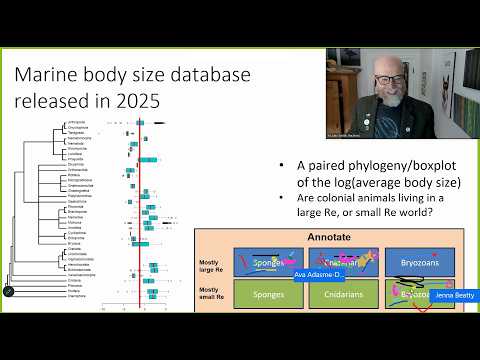
- A large marine-organism body-size database compiles measurements such as length, width, and diameter across many taxa.
- A rough size threshold separates organisms dominated by viscous forces at low Reynolds numbers from those more affected by inertial forces at larger Reynolds numbers.
- Adult-size records can obscure early-life ecology: a large adult may spend much of its lifespan as a small larva in a different physical regime.
- Logarithmic axes help display biological measurements spanning large size ranges; colonial sponges, cnidarians, and bryozoans also raise questions about colony versus individual size.
45:30
Asexual Reproduction: Parthenogenesis, Budding, and Fission
- Invertebrate asexual reproduction includes parthenogenesis, which produces diploid eggs, and budding, as in Hydra.
- Parthenogenesis can be obligate, as in some bdelloid rotifers where males have not been observed, or facultative, as in some Daphnia.
- Fission occurs in soft-bodied animals such as flatworms and sponges; subdivided planarians can regenerate into multiple animals.
- Colonial organisms complicate the definition of an individual, so bryozoans and similar taxa are often better understood as modular colonies than as isolated zooids.
48:31
Daphnia Alternate Asexual Growth with Sexual Resting Eggs
- Under favorable conditions, Daphnia commonly reproduce asexually, with diploid eggs developing directly into daughters.
- When conditions worsen—for example, with changes in temperature, light, productivity, or food availability—investment in males and sexual reproduction increases.
- Sexually produced eggs form ephippia, which can persist or disperse via water, wind, or attachment to animals, helping Daphnia endure unfavorable conditions.
- The lecture closes with course logistics: pre-Thanksgiving labs, including Dairy Bush sampling, move back one week; students should continue their R assignment and case-study preparation.
Summary, takeaways, and chapters were generated by AI from the video's transcript and may contain errors. The video belongs to its creator, Alex Smith.