Linear Algebra - Lecture 15 - Fall, 2026
 Watch on YouTube →
Overview
The lecture develops vector-space sums and direct sums, then shows how a vector’s coordinate vector depends on the chosen basis. It connects linear transformations to polynomial differentiation and to kernel, image, rank, and nullity, proves the dimension formula for sums of subspaces, and applies these ideas to projections and a map from R4 to R2.
Key takeaways
- A sum of subspaces is direct exactly when every vector in the sum has a unique decomposition into components from the subspaces; the XY-plane and z-axis give a direct-sum decomposition of R3.
- Coordinates are basis-dependent: the vector (7, -3) has coordinates (7, -3) in the standard basis, (2, 5) in ((1,1),(1,-1)), and (16/5, 1/5) in ((2,-1),(3,1)).
- Differentiation on polynomials of degree at most three has a one-dimensional kernel of constants and a three-dimensional image of polynomials of degree at most two, so its nullity plus rank equals four.
- For finite-dimensional subspaces W1 and W2, the dimension of their sum subtracts the overlap: dim(W1 + W2) = dim(W1) + dim(W2) - dim(W1 ∩ W2).
- The map (x1,x2,x3,x4) ↦ (x1+x2,x3+x4) has a two-dimensional kernel and image R2, and its standard matrix is [[1,1,0,0],[0,0,1,1]].
Chapters
- The intersection V1 ∩ V2 of two subspaces is a subspace because it contains the zero vector and is closed under addition and scalar multiplication.
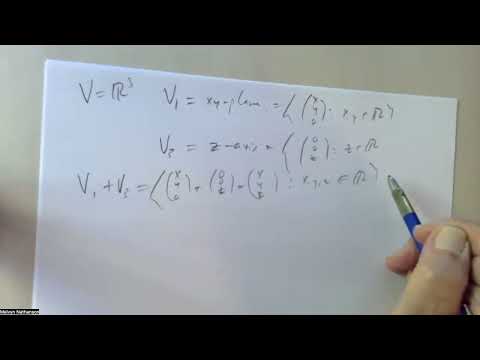
- In R3, the XY-plane consists of vectors with z = 0, while the XZ-plane has y = 0.
- Their intersection is the x-axis, where both y and z are zero.
- The sum V1 + V2 contains every vector expressible as v1 + v2, with v1 in the XY-plane and v2 in the XZ-plane.
- For example, (5, 2, 3) = (2, 2, 0) + (3, 0, 3), and other decompositions are possible.
- Because every vector in R3 can be written this way, the two planes sum to all of R3.
- The XY-plane plus the z-axis also equals R3, but each vector has a unique decomposition into one vector from each subspace.
- A sum is direct when every vector in the sum has exactly one such decomposition.
- The XY-plane and z-axis form a direct-sum decomposition of R3.
- For subspaces V1 through Vr, their sum consists of all vectors v1 + v2 + … + vr with each vi in its corresponding subspace.
- The sum contains zero by choosing the zero vector from every subspace.
- Closure follows because adding two such sums combines corresponding terms inside each subspace, and scalar multiplication preserves membership in every subspace.
- Given a basis e1, …, en for V, define Vi as the one-dimensional subspace spanned by ei.
- Every vector in V is a unique linear combination of the basis vectors, so V is the direct sum of these one-dimensional subspaces.
- The circled plus notation denotes a direct sum and emphasizes uniqueness of the component vectors.
- For a basis B = (e1, …, en), the coordinate vector of v records the unique coefficients in v = x1e1 + … + xnen.
- In the standard basis of R2, the vector (7, -3) has coordinate vector (7, -3).
- Coordinates describe a vector relative to a specified basis, rather than being an intrinsic list of numbers.
- For F = ((1,1), (1,-1)), writing (7, -3) = x(1,1) + y(1,-1) gives x + y = 7 and x - y = -3.
- Solving yields x = 2 and y = 5, so the coordinate vector in basis F is (2, 5).
- A coordinate vector of (7, -1) in F reconstructs the original vector as 7(1,1) - (1,-1) = (6, 8).
- For G = ((2,-1), (3,1)), expressing (7,3) as xg1 + yg2 leads to 2x + 3y = 7 and -x + y = 3.
- Solving gives x = -2/5 and y = 13/5; checking the linear combination recovers (7,3).
- The example illustrates why checking a computed coordinate vector by reconstruction can catch algebra errors.
- For v = (7, -3), the standard-basis coordinates are (7, -3), while the coordinates in F are (2, 5).
- In G = ((2,-1), (3,1)), the same vector has coordinates (16/5, 1/5).
- Each coordinate vector is unique for its basis, but changing the basis changes the coordinate values.
- A map T: V → W is linear when T(v + v′) = T(v) + T(v′) and T(cv) = cT(v).
- For an m × n matrix A, the map TA(v) = Av sends vectors in Rn to vectors in Rm.
- Matrix multiplication is one way to represent a linear transformation, but linear maps can also act on spaces such as polynomials.
- The real polynomials R[x] form a vector space under polynomial addition and scalar multiplication.
- Differentiation maps R[x] to itself: for example, D(x²) = 2x and D(7x³ - 11x² + 15x + 10) = 21x² - 22x + 15.
- The sum rule and constant-multiple rule for derivatives establish that D is linear; because it maps R[x] to itself, it is a linear operator.
- On polynomials of degree at most three, differentiation sends ax³ + bx² + cx + d to 3ax² + 2bx + c.
- The derivative is zero exactly when a = b = c = 0, so the kernel consists of constant polynomials.
- The kernel is spanned by the constant polynomial 1 and has dimension one, giving D nullity 1.
- Polynomials of degree at most three have basis (1, x, x², x³), so the domain has dimension four.
- Differentiation produces every polynomial of degree at most two, so its image is span(1, x, x²) and has dimension three.
- The example verifies rank-nullity: nullity 1 plus rank 3 equals the domain dimension 4.
- For finite-dimensional subspaces W1 and W2, dim(W1 + W2) = dim(W1) + dim(W2) - dim(W1 ∩ W2).
- The intersection must be subtracted because shared directions are counted in both individual dimensions.
- The proof begins with a basis for W1 ∩ W2 and extends it separately to bases for W1 and W2.
- The proposed basis for W1 + W2 includes the intersection basis once, plus the extra basis vectors used to extend it to W1 and W2.
- Those vectors span W1 + W2 because every vector in the sum combines a vector from W1 with one from W2.
- Linear independence follows by setting a combination to zero: membership in the intersection forces the added W1 and W2 coefficients to vanish, then the intersection-basis coefficients vanish too.
- Counting the resulting basis vectors gives dim(W1 + W2) = dim(W1) + dim(W2) - dim(W1 ∩ W2).
- The map T: R3 → R3 defined by T(x,y,z) = (x,y,0) projects vectors onto the XY-plane.
- Its kernel is the z-axis, span((0,0,1)), so its nullity is one.
- Its image is the XY-plane, a two-dimensional subspace, so its rank is two and rank-nullity gives 1 + 2 = 3.
- For T(x1,x2,x3,x4) = (x1 + x2, x3 + x4), the kernel consists of vectors (x1,-x1,x3,-x3).
- The kernel is spanned by (1,-1,0,0) and (0,0,1,-1), so nullity is two.
- Every (y1,y2) in R2 is attained by input (y1,0,y2,0), making the image R2 and the rank two.
- In standard bases, the map is represented by the 2 × 4 matrix [[1,1,0,0],[0,0,1,1]], and rank 2 plus nullity 2 equals dim(R4) = 4.
Transcript excerpt
0:04 So linear algebra lecture 15. So this is the beginning of the second half of the course where we deal with um you might call real linear algebra and in linear algebra we study the vector spaces. over a field and linear transformations between vector spaces. So
0:55 recall an example of a vector space not the only vector space is n dimensional uklidian space Rn column vectors with n coordinates but this is just a special case if you like the most important case but a special case of a vector space and uh so call vector space is a set with some operation we call vector addition and a second operation called scalar multiplication that satisfies very natural simple beautiful uh properties.
1:44 So let V be a vector space and again this is all review and let V1 and V2 be subspaces of V. So here's V. sitting inside V, you might have a vector space, a subspace V_sub_1, another subspace V2, and you have their intersection V1 intersect V2, which is the set of all vectors in V that belong to V1 and V2. So now you have to be familiar
2:32 with the standard mathematical notation. This is means a set of all vectors. This means in V is in the set capital V and we have two subspaces and the intersection is a subspace. Uh this is actually an exam problem uh because it's closed under vector addition and scaler multiplication. And we know that zero the zero vector belongs to every subspace. So the zero vector is in v1 and the zero vector is in v2. So the zero vector is in the intersection. So this is the intersection. So uh in general the intersection of subspaces is a
3:25 subspace. And again the nicest uh simple example
This is the start of the transcript. Save this video free for the whole transcript, searchable and time-coded.
Related notes
Summary, takeaways, and chapters were generated by AI from the video's transcript and may contain errors. The video belongs to its creator, Nathanson math lectures.