Linear Algebra - Lecture 14 - Midterm exam solutions
 Watch on YouTube →
Overview
The lecture works through 11 linear algebra midterm problems, from vector and matrix arithmetic to systems of equations, linear independence, spans, and subspaces. The central theorem is that a homogeneous system with fewer equations than variables has a nonzero solution; it supports the result that any N vectors in a space generated by M vectors are dependent when M < N.
Key takeaways
- A system with fewer homogeneous equations than variables has a nonzero solution; this follows by eliminating a variable and reducing to fewer equations in the remaining variables.
- If M vectors generate a space, any collection of N vectors in that space must be linearly dependent when M < N, because their combination coefficients satisfy M homogeneous equations in N unknowns.
- Row reduction exposes free variables and gives parametric descriptions of solution sets, such as the affine line obtained from the three-equation system.
- In R², two linearly independent vectors automatically form a basis, while a set containing only scalar multiples of one nonzero vector spans a one-dimensional subspace.
- A vector outside a subspace extends any linearly independent set within that subspace: a dependence involving the outside vector would force it to belong to the subspace.
- The intersection of any collection of subspaces is a subspace because zero belongs to every member and the intersection preserves closure under addition and scalar multiplication.
Chapters
- Computes 3(-2, 4, 0) + 5(0, 1, 6) + 2(-5, 0, 3) = (4, 17, 24) by scaling and adding coordinates.
- Adds matrices entry by entry and checks matrix-product dimensions before multiplying a 2 × 3 matrix by a 3 × 2 matrix.
- The product of a 2 × 3 matrix and a 3 × 2 matrix has dimensions 2 × 2.
- Rearranges 91x − 7y = 42 to obtain y = 13x − 6.
- Writes the solution set as (x, y) = (0, −6) + x(1, 13), an affine line in R².
- Distinguishes the translated solution set from its one-dimensional direction subspace, spanned by (1, 13).
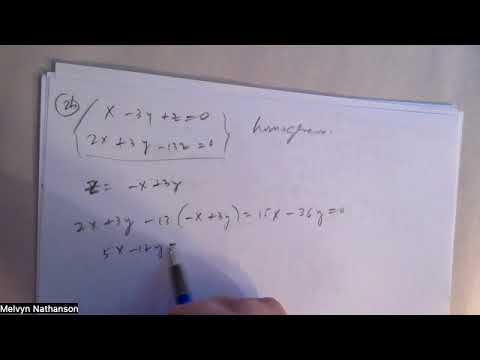
- Solves x − 3y + z = 0 and 2x + 3y − 13z = 0 by substitution, finding 12y = 5x and z = x/4.
- Expresses the solution space as all scalar multiples of (12, 5, 3).
- Checks that (12, 5, 3) satisfies both equations: 12 − 15 + 3 = 0 and 24 + 15 − 39 = 0.
- Uses row operations as an alternative method and reaches the same one-dimensional solution space.
- Tests vectors f₁ = (2, 1) and f₂ = (3, 2) by solving 2x + 3y = 0 and x + 2y = 0; only x = y = 0 works.
- Concludes that the two independent vectors form a basis for the two-dimensional space R².
- Finds e₁ = (1, 0) = 2f₁ − f₂ by solving the corresponding two-equation system.
- Reduces the augmented matrix with rows (1, 1, 2, 1), (2, −1, 3, −3), and (4, 1, 7, −1) to reduced row echelon form.
- Obtains rows (1, 0, 5/3, −2/3), (0, 1, 1/3, 5/3), and (0, 0, 0, 0), leaving z free.
- The resulting equations give x = −2/3 − (5/3)z and y = 5/3 − (1/3)z, an affine line of solutions.
- Assumes v₁ and v₂ are linearly independent and considers 4v₁ + 7v₂ alongside v₁ + 2v₂.
- A zero combination of the new vectors implies 4x + y = 0 and 7x + 2y = 0 by independence of v₁ and v₂.
- Solving those equations gives x = y = 0, proving the transformed pair is linearly independent.
- For S₁ = {(1, 1), (1, 2), (2, 1)}, the first two vectors are independent and span R², so S₁ spans a two-dimensional space.
- For S₂ = {(1, 1), (2, 2), (0, 0)}, the latter vectors add no new direction because (2, 2) = 2(1, 1).
- The span of S₂ is the one-dimensional line generated by (1, 1), with {(1, 1)} as a basis.
- Shows the two-equation, three-variable case by separating whether the coefficients of x₁ in both equations are zero.
- When a₁₁ ≠ 0, solves the first equation for x₁ and substitutes into the second, leaving one homogeneous equation in x₂ and x₃.
- A homogeneous equation in two variables has a nonzero solution, which extends to a nonzero solution (x₁, x₂, x₃).
- Identifies this as the special case of the general theorem for m homogeneous equations in n variables when m < n.
- If a subspace is generated by M vectors, writes each of N vectors in that space as a linear combination of the M generators.
- A proposed dependence among the N vectors reduces to M homogeneous equations in N coefficients.
- When M < N, the fewer-equations theorem supplies a nonzero coefficient vector, proving the N vectors are linearly dependent.
- Proves an intersection of subspaces contains zero and is closed under vector addition and scalar multiplication, so it is a subspace.
- For independent w₁ and w₂ in W and v outside W, considers xw₁ + yw₂ + zv = 0.
- If z = 0, independence of w₁ and w₂ forces x = y = 0; if z ≠ 0, the equation implies v is a linear combination of vectors in W.
- That second case contradicts v ∉ W, so {w₁, w₂, v} is linearly independent.
Transcript excerpt
0:20 Okay. So, in this lecture I'm just going to go through the um solutions to the problems on the midterm exam. Uh-huh. Start with number one. Um We want to compute the linear combination of these three vectors. So, if we multiply this vector by three, we have -6 12 0. Multiply this vector by five,
1:10 we get 0 5 30. Multiply this vector by two, we get -10 0 6. And when you add it up, -6 -10 is Oops. See. -6 Oh, minus minus 10. So, that's -6 + 10 is 4. 12 + 5 is 15. And 30 -6 is 24. And 12 and 5 I should say is 17. I'm not 15.
1:59 So, 4 17 24 is that. We have the matrices A and B. 2 0 4 7 8 minus 15 plus 1 3 4 5 1 0. When you add them, you get 3 3 8. Oops. Um 3 3 8 and 12.
2:53 To make this clearer. This is 5 1 0. So, 12 minus 7 15. And when we multiply B times C B is 1 3 4 5 1 0. C is 1 0 minus 2 0 2 9. So, when you multiply, you get 1 minus 8 is minus 7. So, this is 2 by 3, this is 3 by 2. So, the product will be a 2 by 2 matrix. 0
3:45 6 36 is 42. 5 plus 0 plus 0 is 5. 2 plus 0 is 2. So, it's just this 2 by 2 matrix. Okay. Problem 2, >> [clears throat] >> A Oh. Say this was A and this was B. To A, we have the equation 91x - 7y = 42,
4:35 which is the same as 7y = 91x - 42. Or, you can divide by 7. Let me write it, actually, slightly
This is the start of the transcript. Save this video free for the whole transcript, searchable and time-coded.
Related notes
Summary, takeaways, and chapters were generated by AI from the video's transcript and may contain errors. The video belongs to its creator, Nathanson math lectures.