Linear Algebra - Lecture 1 - Fall 2026
 Watch on YouTube →
Overview
Nathanson math lectures introduces linear algebra through linear equations and their solution sets, defining vectors in R^n, homogeneous versus inhomogeneous equations, and the result that every nonzero linear equation over the reals has solutions. The lecture then establishes coordinate-wise vector addition and subtraction, scalar multiplication, and representations of solution sets as scalar multiples or as a particular solution plus variable multiples of direction vectors.
Key takeaways
- A nonzero linear equation in n real variables always has a solution: it has exactly one solution when n = 1 and infinitely many when n ≥ 2.
- For a₁x₁ + ⋯ + aₙxₙ = b, choosing any nonzero coefficient aⱼ lets you assign the other n − 1 variables freely and solve for xⱼ.
- The solution set of 3x − 2y − 5z = 17 can be expressed as one particular solution, (0, 0, −7/5), plus arbitrary multiples of two direction vectors.
- A solution set can have different-looking parameterizations—for example, solving 3x − 2y − 5z = 17 for z or for y—while still representing exactly the same vectors.
- In this course, vector addition and subtraction are coordinate-wise, scalar multiplication scales every coordinate, and vectors must be written as columns for later matrix calculations.
Chapters
0:00
Math 313 Format, Exams, and Course Grading
- Math 313 lectures meet on Zoom and are recorded for posting to the Nathanson math lectures YouTube channel.
- The midterm and final are in person at 11:00, with no phones, calculators, computers, or other electronic devices permitted.
- Grades consist of homework at 30%, the midterm at 30%, and the final at 40%.
4:00
Brightpace Notes, Homework, and Handwritten Exam Skills
- The first chapter’s 47 pages of lecture notes are on Brightpace and are expected to support the first two or three weeks of class.
- Homework problems come from the notes; the first assignment was to be posted after class, with problems including exercises on page 20.
- Home assignments may use tools such as calculators, computers, Maple, or AI, but students must solve problems by hand during exams.
5:03
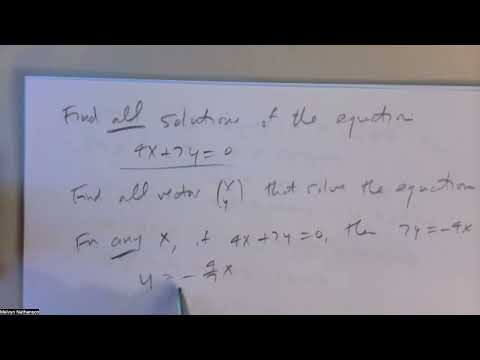
The Equation 4x + 7y = 0 Has Many Solutions
- For 4x + 7y = 0, Nathanson math lectures verifies that (7, −4) and (0, 0) are solutions.
- Choosing x = 3 forces y = −12/7, illustrating how one chosen coordinate determines another.
- Checking a proposed pair by substitution—here, 4(3) + 7(−12/7) = 0—is emphasized as a basic mathematical habit.
8:30
All Solutions of 4x + 7y = 0 as Vectors
- Instead of finding one answer, the goal is to describe every solution as a two-coordinate vector (x, y).
- Solving for y gives y = −(4/7)x, so the complete solution set is {(x, −(4/7)x) : x ∈ R}.
- The notation introduces R as the real numbers and uses curly braces to denote a set.
13:02
Coordinates, Vectors, and the Spaces R², R³, and Rⁿ
- A vector in R² has two real coordinates, while a vector in R³ has three.
- For any positive integer n, Rⁿ denotes the set of column vectors with n real coordinates.
- Linear algebra treats these collections of vectors as central objects, even when starting from a simple equation.
16:13
Homogeneous and Inhomogeneous Linear Equations
- The equation 4x + 7y = 0 is homogeneous because its right-hand-side scalar is zero.
- The equation 4x + 7y = 5 is inhomogeneous because its right-hand side is nonzero.
- For 4x + 7y = 5, both (0, 5/7) and (3, −1) are example solutions.
20:07
The Solution Space of 4x + 7y = 5
- A solution space is the set of all vectors that solve a linear equation or system.
- Choosing any real x and solving for y gives y = −(4/7)x + 5/7.
- The full solution space is {(x, −(4/7)x + 5/7) : x ∈ R}, a subset of R².
23:51
General Form of a Linear Equation in n Variables
- A linear equation in n variables has the form a₁x₁ + a₂x₂ + ⋯ + aₙxₙ = b.
- It is called nonzero when at least one coefficient aᵢ is nonzero; otherwise its variable terms all vanish.
- A solution is a vector in Rⁿ whose coordinates satisfy the equation, and the solution space collects all such vectors.
27:45
Solving 3x − 2y − 5z = 0 in R³
- The vector (1, −1, 1) solves 3x − 2y − 5z = 0 because 3 + 2 − 5 = 0.
- Choosing any x and y determines z = (3/5)x − (2/5)y.
- For example, x = −8 and y = 5 give z = −34/5; substitution confirms the equation equals zero.
33:03
A Particular Solution to 3x − 2y − 5z = 17
- The right-hand side 17 makes 3x − 2y − 5z = 17 inhomogeneous.
- Setting x = −1 and y = 5/2 gives z = −5, and substitution verifies 17.
- For arbitrary x and y, solving for z yields z = −17/5 + (3/5)x − (2/5)y.
38:36
Free Choices and Equivalent Descriptions of One Solution Set
- Any two coordinates can be chosen freely in 3x − 2y − 5z = 17, with the remaining coordinate determined by the equation.
- Solving for y instead gives y = −17/2 + (3/2)x − (5/2)z for arbitrary x and z.
- These parameterizations look different but describe exactly the same set of vectors in R³.
43:36
Why Mathematical Claims Require Proof
- Nathanson math lectures introduces proof as the basis for establishing mathematical claims, rather than relying only on examples.
- ChatGPT can generate proposed proofs, but its output can contain mistakes and needs checking.
- Lean is described as software that checks proof steps, while emphasizing that human understanding remains important.
46:14
Every Nonzero Linear Equation Has a Real Solution
- Unlike an equation such as x² = −1 over the real numbers, every nonzero linear equation in real variables has a solution.
- With one variable, a₁x₁ = b and a₁ ≠ 0 has the unique solution x₁ = b/a₁.
- With at least two variables, a nonzero linear equation has infinitely many solutions.
49:33
Solving for a Nonzero-Coefficient Variable
- Choose an index j with aⱼ ≠ 0 in a₁x₁ + ⋯ + aₙxₙ = b.
- Assign arbitrary real values to the other n − 1 variables, then solve for xⱼ by dividing by aⱼ.
- The resulting formula is xⱼ = (b − Σⱼ≠ᵢ aᵢxᵢ)/aⱼ, which constructs solutions and explains why there are infinitely many when n ≥ 2.
56:30
From Linear Equations to Vector Algebra
- The lecture moves from equation solution sets to vector spaces, vector subspaces, and affine subspaces in Rⁿ.
- Vector addition, subtraction, and scalar multiplication are introduced as the basic operations on n-dimensional vectors.
- These operations will help express solution spaces in more structured forms.
58:01
Coordinate-Wise Addition in R², R⁴, and Rⁿ
- To add vectors, add corresponding coordinates: (3, −5) + (2, 11) = (5, 6).
- In R⁴, (1, 2, 3, 4) + (5, 6, 7, 8) = (6, 8, 10, 12).
- The same coordinate-wise rule applies to any pair of vectors in Rⁿ.
1:01:32
Coordinate-Wise Subtraction and the Column-Vector Rule
- Subtract corresponding coordinates: (3, −5) − (2, 11) = (1, −16), and (1, 2, 3, 4) − (5, 6, 7, 8) = (−4, −4, −4, −4).
- For the exercise (3, −2, 4) and (0, 5, 7), the sum is (3, 3, 11) and the difference is (3, −7, −3).
- Vectors must be written as columns in this course because later matrix multiplication depends on that convention.
1:06:20
Vector Products Are Undefined; Scalar Multiplication Is Defined
- The course does not define multiplication of one vector by another; multiplying matching coordinates is not the intended operation.
- Scalar multiplication multiplies every coordinate by the same number: 7(3, −5) = (21, −35).
- For example, (1, 2, 3, 4) scaled by 7 is (7, 14, 21, 28), while one-half of (3, −2, 4) is (3/2, −1, 2).
1:14:02
Writing Solution Spaces with Direction Vectors
- The solutions of 4x + 7y = 0 can be written as all scalar multiples of (1, −4/7), or equivalently of (7, −4).
- For 3x − 2y − 5z = 17, the solution space is (0, 0, −7/5) + x(1, 0, 3/5) + y(0, 1, −2/5), for real x and y.
- This form separates one particular solution from all linear combinations of two direction vectors.
1:24:25
Next Class, Office Hours, Homework Submission, and Attendance
- The next class will continue vector algebra and begin systems of linear equations; the example 3x + 2y = 18 and 4x + 3y = −5 previews the topic.
- Office hours are Mondays and Wednesdays from 10:00 to 11:00, with additional one-on-one meetings available by email appointment.
- Homework is submitted as one PDF through Brightpace; attendance is not graded, and missed lectures are available on YouTube.
- Class is scheduled for 11:00–12:40 and will not run past 12:40.
Summary, takeaways, and chapters were generated by AI from the video's transcript and may contain errors. The video belongs to its creator, Nathanson math lectures.