Linear Algebra - Lecture 2 - Fall 2026
 Watch on YouTube →
Overview
Nathanson math lectures develops vector addition, scalar multiplication, and linear combinations as tools for describing subspaces and solving linear equations. Examples in R² and R³ establish that homogeneous equation solution sets are subspaces, while nonempty solution sets of nonzero inhomogeneous equations are translated subspaces; the lecture concludes by expressing every vector in R³ as a combination of three specific vectors.
Key takeaways
- A subset of Rⁿ is a subspace precisely when it contains the zero vector and remains closed under vector addition and scalar multiplication; these conditions also guarantee closure under subtraction.
- Every linear combination of vectors in a subspace stays in that subspace, and the set of all finite linear combinations of any nonempty vector set S forms the generated subspace ⟨S⟩.
- The solution set of a homogeneous equation such as 3x₁−2x₂+x₃=0 is a subspace; solving for free variables exposes generators (1,0,−3) and (0,1,2).
- A nonempty solution set of a nonzero inhomogeneous equation is a translate of the corresponding homogeneous solution subspace, so it is affine rather than necessarily a vector subspace.
- The vectors (0,1,1), (1,0,1), and (1,1,0) span R³ because every (x₁,x₂,x₃) has explicit combination coefficients a=(−x₁+x₂+x₃)/2, b=(x₁−x₂+x₃)/2, and c=(x₁+x₂−x₃)/2.
Chapters
0:00
Real and Complex Coordinate Vectors; Addition and Scalar Multiplication
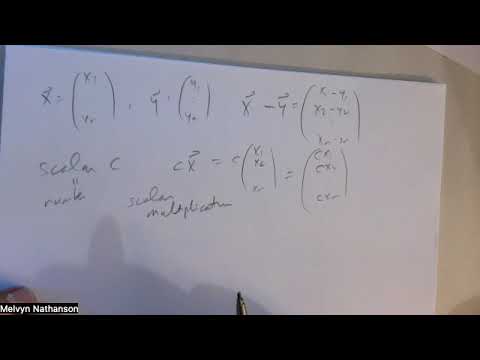
- Rⁿ consists of n-dimensional column vectors with real coordinates; the corresponding complex-coordinate space is introduced for later study.
- Vector addition and subtraction operate coordinate by coordinate and are defined only for vectors of the same dimension.
- Scalar multiplication multiplies every coordinate by the same number, such as multiplying (2, −9, 5) by 3.
8:00
Linear Combinations and Coordinatewise Computation
- A linear combination multiplies each vector by a scalar and adds the resulting vectors.
- For x₁=(1,2,3), x₂=(4,5,6), and x₃=(7,8,9), the combination 5x₁−3x₂+2x₃ equals (7,11,15).
- The example 3(−2,9)+7(1,4) evaluates to (1,55), illustrating that each coordinate is computed independently.
14:00
Writing an Inhomogeneous Equation’s Solutions as a Vector Combination
- Solving 4x+7y=5 for y gives y=5/7−(4/7)x.
- The solution vector can be written as (x,y)=(0,5/7)+x(1,−4/7).
- (0,5/7) is a particular solution of the equation, while (1,−4/7) solves the associated homogeneous equation 4x+7y=0.
20:00
Closure Under Addition and Scalar Multiplication
- A subset W is closed under addition when adding any two vectors in W produces another vector in W.
- W is closed under scalar multiplication when c·x remains in W for every x in W and every scalar c.
- Closure under both operations implies closure under subtraction, since x−y=x+(−1)y.
24:00
Subspace Definition and the x-Axis in R²
- A subspace of Rⁿ must contain the zero vector and be closed under vector addition and scalar multiplication.
- The x-axis in R² is the set of vectors (x,0), so adding two such vectors or scaling one keeps its second coordinate zero.
- The x-axis therefore satisfies all three subspace requirements.
27:00
The Diagonal Line y=x as a Subspace
- The line y=x consists of vectors (x,x), including the zero vector (0,0).
- Adding (x,x) and (x′,x′) gives (x+x′,x+x′), which remains on the line.
- Scaling (x,x) by c gives (cx,cx), so the diagonal line is closed under scalar multiplication.
30:00
Understanding Subsets Through the xy-Plane in R³
- A subset is a collection whose elements all belong to a larger set; for example, {1,2} is a subset of {1,2,3}.
- The xy-plane in R³ consists of vectors (x,y,0), so its z-coordinate is always zero.
- Adding two vectors (x,y,0) and (x′,y′,0), or scaling one by c, preserves the zero z-coordinate; the plane is a subspace.
34:00
The Coordinate-Sum-Zero Plane in R³
- Define W={ (x,y,z)∈R³ : x+y+z=0 }; examples include (1,−1,0) and (0,−2,2).
- For two vectors in W, the coordinate sum of their sum is (x+y+z)+(x′+y′+z′)=0.
- Scaling (x,y,z) by c gives coordinate sum c(x+y+z)=0, and the zero vector is also in W.
40:00
Every Subspace Is Closed Under Linear Combinations
- If x₁,…,xₖ belong to a subspace W, scalar closure keeps each cᵢxᵢ in W.
- Repeated application of addition closure shows c₁x₁+⋯+cₖxₖ also belongs to W.
- Thus any finite linear combination of vectors in a subspace remains inside that subspace.
43:00
Generating a Subspace from a Nonempty Set of Vectors
- For a nonempty set S⊆Rⁿ, the set of all finite linear combinations of vectors in S is a subspace, denoted by ⟨S⟩.
- Adding two such combinations produces a larger finite linear combination of vectors from S; scaling one simply changes its coefficients.
- Because S contains some vector s, the combination 0·s supplies the zero vector required for a subspace.
48:00
A Single Vector Generates the x-Axis
- In R², take S={e₁} with e₁=(1,0).
- All linear combinations of e₁ are scalar multiples x(1,0)=(x,0) for real x.
- Therefore ⟨{e₁}⟩ is exactly the x-axis, extending in both positive and negative directions.
50:00
Homogeneous Equation Solutions Form a Subspace
- A homogeneous linear equation has zero on its right-hand side; the solution set of any such equation in n variables is a subspace of Rⁿ.
- For 3x₁−2x₂+x₃=0, solving for x₃ gives x₃=−3x₁+2x₂.
- Every solution is x₁(1,0,−3)+x₂(0,1,2), so the solution set is generated by (1,0,−3) and (0,1,2).
56:00
Parameterizing x+y+z=0 with Two Generators
- Solving x+y+z=0 for z gives z=−x−y, with x and y free to take any real values.
- Every solution vector (x,y,−x−y) equals x(1,0,−1)+y(0,1,−1).
- The solution space is the subspace generated by (1,0,−1) and (0,1,−1).
1:03:00
Proof of the Homogeneous Solution-Subspace Theorem
- For a₁x₁+⋯+aₙxₙ=0, the zero vector is a solution because every term evaluates to zero.
- If x and y are solutions, substituting x+y into the equation separates the result into the equation’s value at x plus its value at y, giving 0+0.
- For any scalar c, substituting cx yields c(a₁x₁+⋯+aₙxₙ)=c·0=0; the solution set is therefore closed under addition and scalar multiplication.
1:08:00
Inhomogeneous Solutions as a Translated Homogeneous Subspace
- For 3x₁−2x₂+x₃=6, solving for x₃ gives x₃=6−3x₁+2x₂.
- The solutions have the form (0,0,6)+x₁(1,0,−3)+x₂(0,1,2).
- The solution set is (0,0,6)+W, where W is the homogeneous solution subspace generated by (1,0,−3) and (0,1,2).
- An affine subspace V+W is a vector subspace W translated by a fixed vector V; in R², (0,2) plus the x-axis gives the line y=2.
1:18:00
Nonzero Inhomogeneous Equations and the R³ Spanning Exercise
- The stated theorem says the solution set of a nonzero inhomogeneous linear equation is an affine subspace; nonzero means at least one variable coefficient is nonzero.
- The equation 0x₁+0x₂+0x₃=1 is excluded because it has no solutions.
- A homework exercise asks whether f₁=(0,1,1), f₂=(1,0,1), and f₃=(1,1,0) can express every vector in R³ as a linear combination.
1:25:00
Solving for Coefficients and Reviewing the Spanning Proof
- Equating coordinates in a(0,1,1)+b(1,0,1)+c(1,1,0)=(x₁,x₂,x₃) gives b+c=x₁, a+c=x₂, and a+b=x₃.
- Solving yields a=(−x₁+x₂+x₃)/2, b=(x₁−x₂+x₃)/2, and c=(x₁+x₂−x₃)/2, proving the three vectors span R³.
- The closing review re-derives the coefficient equations and explains fraction arithmetic; homework tools such as Maple are allowed, but exams require hand calculations and proofs.
Summary, takeaways, and chapters were generated by AI from the video's transcript and may contain errors. The video belongs to its creator, Nathanson math lectures.